Select the Wastewater Route for the Residential Project
Select a packaged sewage treatment plant for residential projects in Chad by matching the treatment route to confirmed flow, effluent destination, site conditions and local requirements. A sewer connection may be preferable where an authorised network exists. Otherwise, compare a buried A/O package, an MBR system and anaerobic treatment before requesting quotations.
A package plant is a decentralised, off-the-shelf treatment system that can avoid extensive new piping, pumping, reservoir and instrumentation infrastructure. African package-plant evidence also describes modular systems that can be transported to site and assembled, usually in a standard shipping container. That logistics advantage does not remove the need for site preparation, power, commissioning or local approval.
Use this sequence:
- Establish whether sewage can lawfully discharge to a sewer or whether treatment must occur within the development.
- Define average and peak flow from occupancy and connected sources.
- Identify the receiving environment or reuse destination and obtain the applicable Chad requirements from the responsible authority.
- Screen A/O, MBR and anaerobic routes against power, land, excavation, groundwater and operator constraints.
- Request quotations with process calculations and acceptance tests attached.
Aerobic, anaerobic and multistage configurations can serve small communities and larger applications, but no route can be fixed from the generic capacity range shown by a supplier. That range, 30 m³ to 550 m³/h, concerns WEC Projects package water treatment solutions and is not a sewage-plant sizing rule for a Chad residential development. Use it only as a supplier-reported commercial range, not as a design basis.
The residential packaged sewage treatment plant comparison provides a route-selection framework, while the sewer, A/O and MBR comparison highlights why discharge and reuse conditions must be settled before comparing equipment.
Compare A/O, MBR and Sewer Options Against Project Conditions
Choose a sewer where an authorised connection is technically available and cheaper than treating on site; choose A/O or MBR only after comparing the effluent destination, hydraulic load, footprint, power demand and maintenance regime.
HydropureWater’s underground A/O package sewage treatment plant combines anoxic and aerobic biological contact oxidation, sedimentation and disinfection in a buried package. Its installation below surface areas may suit sites where space is constrained, subject to excavation and groundwater findings.
The integrated MBR wastewater treatment system should be evaluated where the required treatment performance and site constraints justify membrane-related procurement and operating requirements. Comparing it with A/O requires process calculations, membrane replacement information, power demand and a defined operator maintenance plan.
The supplied package-plant evidence cites minimum reactor retention of 18–24 hours. Treat this as a design reference to challenge, not a universal sizing value: the selected supplier must show how its process calculation relates to the development’s average and peak residential flows.
| Discharge route or influent problem | Governing rule or process option | What data settles it |
|---|---|---|
| Authorised sewer connection is available | Compare the sewer connection with on-site treatment | Connection location, required pumping, authority approval, availability conditions and whole-life cost scope |
| Low-strength domestic residential sewage | Evaluate an anaerobic route where its process basis and effluent destination are acceptable | Average and peak flow, wastewater characteristics, treatment objectives, required polishing and reuse intent |
| Footprint or landscape constraints | Evaluate a buried A/O package | Available footprint, excavation access, soil, groundwater, flood level, burial depth and maintenance access |
| Tight effluent or reuse requirements | Evaluate MBR or another process with documented treatment performance | Receiving conditions, reuse application, test parameters, membrane maintenance and power availability |
| Wide hydraulic variation | Do not select from average flow alone | Occupancy assumptions, peak factor, peak-flow treatment method and equalisation requirements |
Resolve the Chad Site and Effluent Constraints
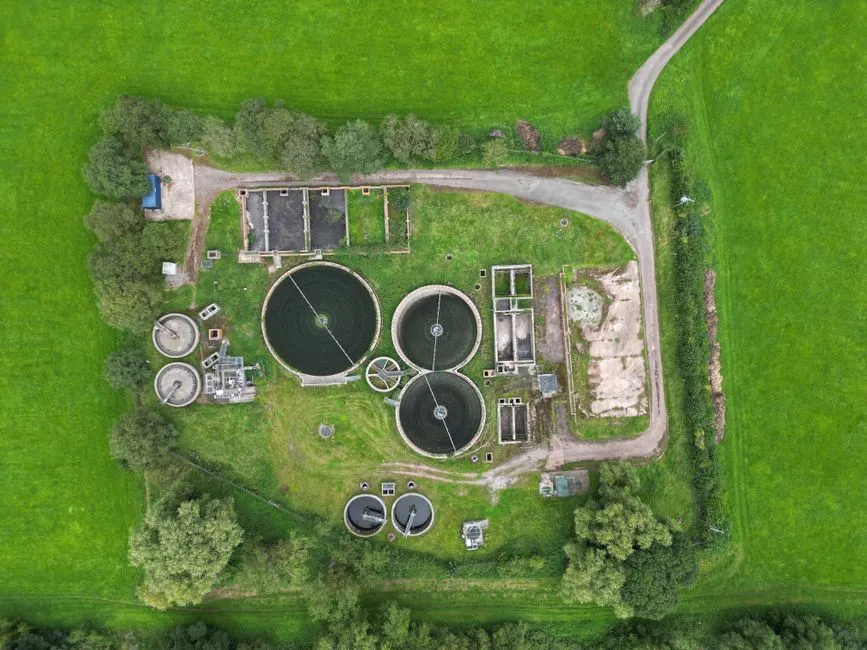
A defensible specification requires six input groups: flow, influent, discharge route, site, utilities and sludge. Identify the responsible authority and obtain written project requirements before fixing acceptance criteria.
Flow and occupancy: request average and peak residential sewage flow rates, occupancy assumptions and the contribution from homes, common areas and any commercial amenities. Require the supplier to distinguish treatment capacity, equalisation and peak-flow handling.
Influent and effluent: obtain wastewater characteristics appropriate to the connected development and confirm the final destination. State whether treated water will be discharged, reused for irrigation or another purpose, and identify the receiving conditions that control the required treatment. Do not infer reuse suitability merely because a package can produce treated effluent.
Site: provide soil and groundwater reports, flood levels, available access, excavation constraints, burial conditions and utility routes. These inputs determine whether a buried unit can be installed safely and serviced.
Power and people: confirm available power, backup arrangements, automatic controls, local operator capability and remote-support arrangements against the selected plant’s automation and maintenance requirements.
Residuals: define sludge generation, withdrawal, storage, disposal, odour control and access. Package-plant supplier literature describes aerobic, anaerobic and multistage options, but it does not establish a disposal route or permission for this Chad site.
Use the containerized sewage plant sizing worksheet only as a collection aid. For the process comparison, the A/O and MBR project comparison can help frame technical questions; its location and project conditions must not be transferred to Chad.
Prepare a Package-Plant RFQ and Acceptance Scope
Make the RFQ complete enough that suppliers quote the same physical, operational and commercial scope. Require each bidder to identify exclusions and assumptions in writing.
Ask each supplier to state design flow, peak-flow treatment, process-unit dimensions, retention basis and the expected duty of every mechanical and electrical component. Attach the project flow basis, site data and confirmed discharge requirements. Require supporting process calculations rather than a model name alone.
Define acceptance by named sample point, parameter, test method, operating period and threshold. Request the applicable approval conditions and have the procurement document reviewed against them before issue.
Separate equipment from site and lifecycle obligations. Freight, customs, foundations, installation, power connections, commissioning, training, consumables, warranty and after-sales support must appear as distinct quotation lines.
| Quote line item | Technical scope to specify | Red flags to check before signing |
|---|---|---|
| Equipment and process design | Design and peak flow, process calculation, dimensions, retention basis, equipment duty, drawings and controls | Capacity based on peak flow only; no process calculation; undefined treatment stages or component duties |
| Delivery to Chad | Shipment destination, packaging dimensions and weight, lifting points, unloading method, customs responsibility and delivery route | “Delivered” does not identify the destination or exclude customs, port charges, lifting or difficult access |
| Civil works and installation | Excavation, foundations, backfill, bunding, connections, lifting, commissioning access and restoration | Site works assumed to be free or excluded without a stated allowance and boundary |
| Power and controls | Electrical supply, control panel, protection, backup arrangement, remote communications and power consumption assumptions | Generator, power cable, switches or voltage conversion omitted from price and schedule |
| Commissioning and training | Testing, wet commissioning, stabilisation, operator training, documentation, performance test and acceptance procedure | Commissioning limited to delivery; no training materials or defined performance test |
| Sludge and odour management | Withdrawal method, storage duration, disposal route, odour control, spillage response and maintenance access | Sludge disposal excluded without a cost allocation or temporary storage allowance |
| Acceptance and warranty | Sample points, parameters, test methods, operating period, thresholds, defect correction, warranty period and spare parts | No sample points, undefined test method or subjective “satisfactory operation” acceptance |
Use the prefabricated wastewater plant specification and RFQ guide to expand document requests. The Daf, MBR, UF and RO comparison may inform process questions, but residential project acceptance must remain tied to the confirmed Chad receiving and reuse conditions.
Further Reading
Frequently Asked Questions
What flow should be used to size a packaged sewage treatment plant for a Chad residential project?
Size from both average and peak residential demand, not from the number of homes alone. Give suppliers the occupancy assumptions, connected amenities, average flow, peak factor and peak-flow treatment method, then require a process calculation that demonstrates how the selected configuration handles both conditions. The 18–24-hour retention reference must be checked against the supplier’s hydraulic and biological basis rather than applied automatically.
Should the project use a sewer connection, A/O package, MBR or anaerobic treatment?
Use a sewer where an authorised connection is available and technically suitable. Otherwise, compare A/O, MBR and anaerobic treatment against the confirmed discharge or reuse destination, site constraints, power, operator capability and residual-handling route. The disposal destination and applicable Chad requirements should be settled before ordering equipment.
What should a buyer request when comparing package-plant prices?
Request separate priced lines for equipment, freight, customs, foundations, civil works, installation, power connections, commissioning, training, start-up consumables, warranty, spare parts, sludge disposal and after-sales support. Also request a supplier list of exclusions. A comparable total cost cannot be stated without these inputs and the selected supplier’s offer.
How should Chad-specific compliance and package-plant acceptance be managed?
Obtain the applicable project requirements from the responsible Chad authority and put them into the purchase document. The RFQ should define sample points, parameters, test methods, operating period and acceptance thresholds; where an authority has not issued a project-specific limit, obtain written clarification before signature.