The Unique Challenges of Slaughterhouse Wastewater
Slaughterhouse and meat processing facilities generate some of the most challenging industrial wastewater in the food sector. The combination of blood, fat, oil, and grease (FOG), gut contents, bone fragments, and cleaning chemicals creates an effluent that is simultaneously high in organic strength, nutrient-rich, and highly variable in composition throughout the production day.
Typical raw wastewater characteristics from a medium-scale slaughterhouse (processing 500–2,000 head of cattle or 5,000–20,000 poultry per day) include:
| Parameter | Typical Range | Peak Values |
|---|---|---|
| COD | 3,000–8,000 mg/L | Up to 15,000 mg/L |
| BOD₅ | 1,500–4,000 mg/L | Up to 8,000 mg/L |
| TSS | 1,000–3,000 mg/L | Up to 6,000 mg/L |
| FOG (Oil & Grease) | 200–1,500 mg/L | Up to 3,000 mg/L |
| TKN | 150–500 mg/L | Up to 800 mg/L |
| Total Phosphorus | 25–100 mg/L | Up to 200 mg/L |
| pH | 6.0–8.5 | 4.5–9.5 (CIP cycles) |
| Temperature | 25–40°C | Up to 50°C (scalding water) |
These concentrations are 10–50 times higher than typical municipal sewage. Without proper treatment, slaughterhouse effluent can devastate receiving water bodies, deplete dissolved oxygen, cause algal blooms, and create serious odor nuisances.
Regulatory Framework
Slaughterhouse wastewater discharge is tightly regulated worldwide:
- US EPA 40 CFR Part 432: Establishes effluent limitation guidelines specifically for meat and poultry processing, including daily maximum and monthly average limits for BOD₅, TSS, FOG, fecal coliform, pH, and ammonia.
- EU BAT Reference Document (BREF) for Food, Drink, and Milk Industries: Defines Best Available Techniques (BAT) for the sector, including BAT-associated emission levels (BAT-AELs).
- WHO Guidelines: Relevant for facilities in developing countries where local regulations may be less detailed.
Facilities discharging to municipal sewers must also meet local pre-treatment standards, which typically limit FOG to 100–150 mg/L and BOD₅ to 300–600 mg/L.
Step 1: Source Control and In-Plant Best Practices
The most cost-effective wastewater treatment is prevention. Before investing in end-of-pipe treatment, every slaughterhouse should implement:
- Dry pre-cleaning: Scrape and sweep floors before washdown. This simple practice can reduce organic load to the drain by 25–40%.
- Blood collection: Blood has a COD of approximately 375,000 mg/L—one liter of spilled blood adds as much organic load as 100 liters of typical slaughterhouse wastewater. Dedicated blood collection troughs and pumps prevent blood from entering the wastewater stream entirely.
- Paunch/gut content separation: Dry-dump paunch contents to a rendering or composting operation rather than washing them into the sewer.
- FOG recovery: Grease traps and grease interceptors at each discharge point recover fat that has commercial value as rendered tallow or biodiesel feedstock.
- Water reuse: Final carcass rinse water can be reused for initial washdown; cooling water can be recirculated.
Implementing these practices before designing the treatment plant can reduce the required treatment capacity by 30–50%, delivering significant capital and operating cost savings.
Step 2: Screening and Pre-Treatment
Coarse and Fine Screening
Slaughterhouse wastewater contains large solids—bone chips, cartilage, fat globules, feathers (in poultry operations), and packaging fragments—that must be removed before any downstream equipment. A rotary mechanical bar screen with 1–3 mm spacing is the standard first unit operation. Unlike static screens that blind rapidly with fat, rotary bar screens continuously self-clean, maintaining hydraulic capacity even during peak production periods.
For poultry operations, a secondary rotary drum screen with 0.5–1.0 mm perforations captures feather fragments and fine solids that pass through the bar screen. Screenings are typically collected in dumpsters and sent to rendering.
Equalization
Slaughterhouse flows are highly intermittent. Production typically runs 8–12 hours per day, with peak flows during washdown periods that can be 3–5 times the average flow. A covered equalization tank sized for 8–12 hours of average daily flow smooths hydraulic and pollutant peaks, protecting downstream biological treatment from shock loads. Aeration or mechanical mixing in the EQ tank prevents settling and septic conditions.
Step 3: Physical-Chemical Treatment — FOG and Solids Removal
Dissolved Air Flotation (DAF)
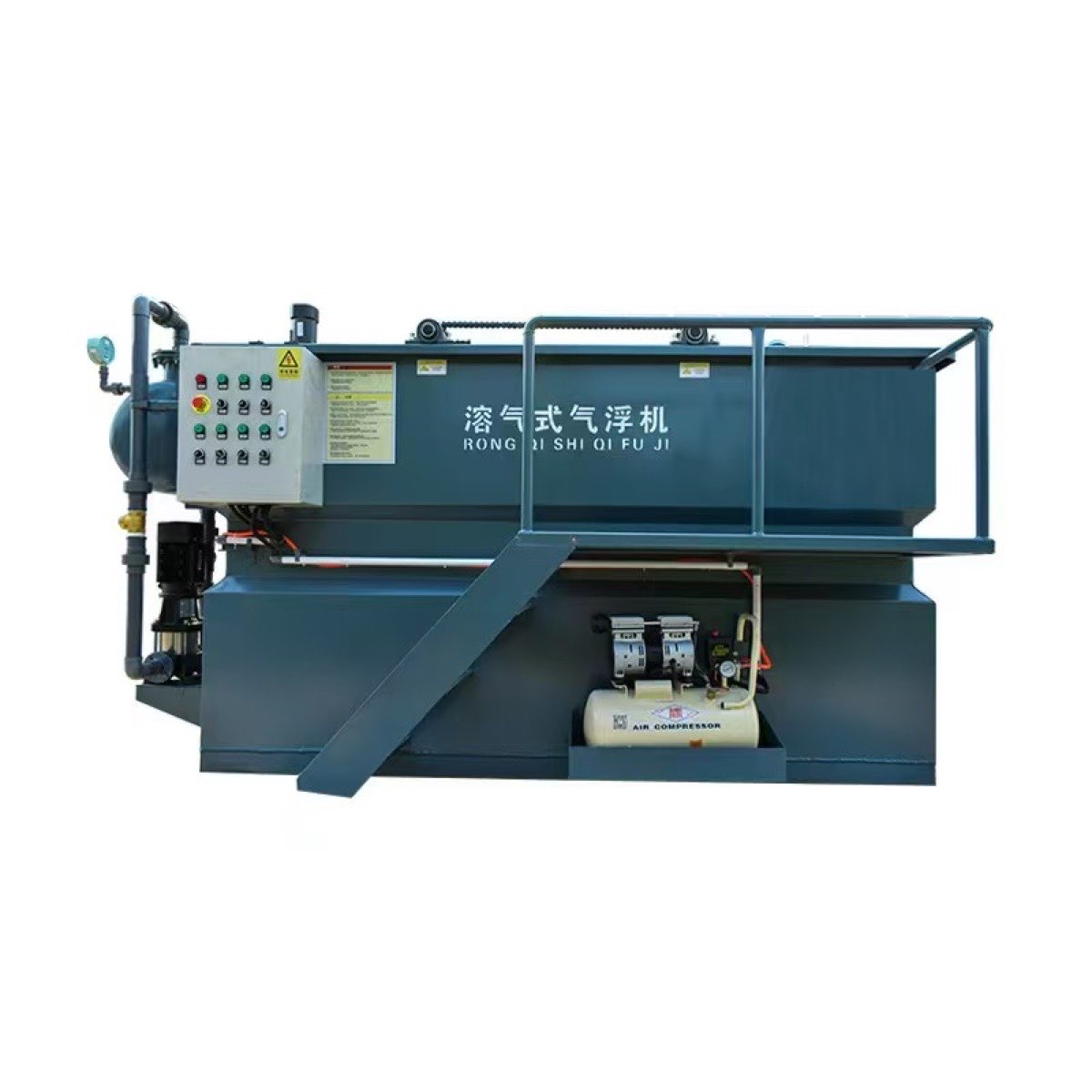
Dissolved Air Flotation (DAF) is the single most important unit operation in slaughterhouse wastewater treatment. It is the only technology that can reliably remove emulsified fats and fine suspended solids that are too light to settle and too small to screen.
In a slaughterhouse DAF application:
- Chemical pre-conditioning: Coagulants (ferric chloride or polyaluminum chloride at 100–300 mg/L) destabilize emulsified FOG. Cationic polymer (1–3 mg/L) bridges flocs for rapid flotation.
- Performance targets: 90–95% FOG removal, 85–95% TSS removal, 50–65% COD removal, 30–40% TKN removal (via particulate nitrogen removal).
- Surface loading rate: 4–8 m³/m²/hr for slaughterhouse applications (lower than municipal DAF due to higher solids loading).
- Float (sludge) characteristics: DAF float from slaughterhouses is high in fat and can be processed through rendering if recovered cleanly. Typical float solids concentration is 3–6%.
A well-designed DAF unit reduces BOD from 4,000 mg/L to 1,200–1,800 mg/L—bringing the effluent into a range that conventional aerobic biological treatment can handle efficiently.
Step 4: Biological Treatment
Anaerobic Pre-Treatment (For High-Strength Effluent)
For slaughterhouses with COD consistently above 4,000 mg/L after DAF, anaerobic pre-treatment is economically attractive. UASB (Upflow Anaerobic Sludge Blanket) or EGSB (Expanded Granular Sludge Bed) reactors can remove 70–85% of remaining COD while generating biogas (0.35 m³ CH₄ per kg COD removed at STP). For a 500 m³/day plant with 3,000 mg/L COD after DAF, this translates to approximately 525 m³/day of methane—enough to heat the process water or generate 50–80 kW of electricity via CHP.
Aerobic Polishing
After DAF (and optional anaerobic pre-treatment), aerobic biological treatment reduces residual BOD to discharge limits. Common configurations include:
- Activated sludge (extended aeration): HRT 18–24 hours, SRT 15–25 days. Achieves BOD₅ < 20 mg/L, NH₃-N < 2 mg/L.
- SBR: Well-suited for batch operations that match the slaughterhouse's daily production cycle.
- MBBR (Moving Bed Biofilm Reactor): Compact alternative that handles load variations well due to the biofilm's buffering capacity.
Nutrient Removal
Slaughterhouse wastewater is inherently nutrient-rich (high N and P from blood and gut contents). If nutrient removal is required, an A²/O or Modified Ludzack-Ettinger (MLE) configuration is appropriate. The high BOD/TN ratio (typically 5:1–8:1) in slaughterhouse wastewater is actually favorable for denitrification, as ample carbon is available as an electron donor.
Step 5: Sludge Dewatering and Disposal
Slaughterhouse treatment plants generate significant quantities of sludge from multiple sources: screenings, DAF float, waste activated sludge, and (if present) anaerobic digestate. A plate-and-frame filter press is the preferred dewatering technology for slaughterhouse sludge because:
- It achieves the highest cake dryness (30–40% solids) of any mechanical dewatering technology, minimizing disposal volume and transport costs.
- The resulting cake is firm and stackable, simplifying handling and storage.
- It handles the high grease content of DAF float sludge better than belt presses or centrifuges, which can experience slippage and fouling with greasy sludges.
Polymer conditioning (cationic polyacrylamide at 3–8 kg/tonne dry solids) is required before dewatering. The dewatered cake is typically disposed of via composting (blended with a carbon source such as wood chips), anaerobic digestion, land application (if permitted), or landfill as a last resort.
Odor Control: A Non-Negotiable Requirement
Slaughterhouse wastewater is intensely malodorous due to the decomposition of blood, protein, and fat—generating hydrogen sulfide (H₂S), ammonia, volatile organic acids, and mercaptans. Odor complaints are the most common reason for regulatory enforcement action against slaughterhouse WWTPs, even when effluent quality meets permit limits. A comprehensive odor control strategy must include:
- Covering all pre-treatment units: The screening area, equalization tank, and DAF unit should be enclosed with extracted ventilation at 6–10 air changes per hour.
- Biofilter or chemical scrubber: Extracted air is treated through a biofilter (organic media such as wood chips/compost inoculated with sulfur-oxidizing bacteria) for H₂S removal, or a two-stage chemical scrubber (first stage: H₂SO₄ for ammonia, second stage: NaOH + NaOCl for H₂S and organics). Biofilters are lower cost for moderate odor loads; chemical scrubbers are preferred when space is limited or when mercaptan concentrations are high.
- Buffer zones: Maintain a minimum 100–200 m buffer between the WWTP and any residential or commercial properties. Where this is not possible, enhanced odor control with redundant treatment capacity is essential.
- Monitoring: Install H₂S monitors at the plant boundary and at sensitive receptor locations. Real-time monitoring allows early detection of odor events before complaints arise.
Design Example: 800 m³/day Cattle Slaughterhouse WWTP
Consider a cattle slaughterhouse processing 800 head/day with total wastewater generation of 800 m³/day. The treatment train would consist of:
- Rotary bar screen (2 mm) → screenings bin
- Equalization tank (400 m³, aerated, 12-hour HRT)
- Chemical dosing + DAF (surface area 30 m², loading rate 5.3 m/hr)
- Anaerobic reactor (UASB, 200 m³, HRT 6 hours)
- Activated sludge (extended aeration, 600 m³, HRT 18 hours)
- Secondary clarifier (diameter 8 m)
- Sludge thickener + filter press (1.2 m × 1.2 m, 80 plates)
Expected effluent quality: BOD₅ < 25 mg/L, TSS < 30 mg/L, FOG < 10 mg/L, NH₃-N < 5 mg/L. Total installed cost: approximately USD 1.2–1.8 million. Operating cost: USD 0.60–0.90 per m³.
Frequently Asked Questions
Why is FOG removal so critical in slaughterhouse wastewater treatment?
Fat, oil, and grease cause multiple problems if not removed early in the treatment process. FOG coats biological flocs, reducing oxygen transfer efficiency and causing filamentous bulking in activated sludge systems. It accumulates on diffuser membranes, pipework, and sensors, increasing maintenance costs. In anaerobic systems, FOG can form floating scum layers that short-circuit flow. DAF typically removes 90–95% of FOG, protecting downstream biological treatment and reducing long-term O&M costs significantly.
Can slaughterhouse wastewater be treated to reuse quality?
Yes, with appropriate treatment, slaughterhouse effluent can be treated to a quality suitable for non-potable reuse (truck washing, yard washdown, cooling, and landscape irrigation). After biological treatment, the addition of tertiary filtration, UV disinfection, and (optionally) reverse osmosis can produce water meeting WHO and local reuse standards. Reuse can reduce a slaughterhouse's freshwater consumption by 30–50%, which is particularly valuable in water-scarce regions. However, treated wastewater should never be reused for carcass washing or any direct food-contact application due to food safety regulations.
How much biogas can a slaughterhouse wastewater treatment plant produce?
Biogas production depends on the organic load and treatment efficiency. As a rule of thumb, anaerobic treatment of slaughterhouse wastewater produces 0.5–0.7 m³ of biogas (60–70% methane) per kg of COD removed. For a 1,000 m³/day plant with influent COD of 5,000 mg/L and 80% anaerobic COD removal, this translates to approximately 2,000–2,800 m³/day of biogas, with an energy content equivalent to 4,200–5,900 kWh/day. This can offset 40–70% of the plant's total energy demand via combined heat and power (CHP) generation.
What are the biggest operational challenges in slaughterhouse WWTPs?
The three most common operational challenges are: (1) FOG accumulation in biological reactors and on instrumentation, requiring more frequent cleaning than typical industrial WWTPs; (2) extreme flow and load variation between production days, weekends, and seasonal peaks (e.g., holiday periods), which demands robust equalization and flexible process control; and (3) odor management—raw slaughterhouse wastewater is highly odorous, and all pre-treatment units (screening, equalization, DAF) should be covered with extracted air treated through a biofilter or chemical scrubber.