
Why a Perth Factory Needs a Staged ETP with a DAF Unit
A Perth factory needs a staged effluent treatment plant (ETP) because the local industrial mix — mining and mineral processing, food and beverage, metal finishing, and light petrochemical — generates emulsified oil, fine suspended solids, and colloidal metals that no single unit operation can remove in isolation. The ETP is built as three levels, as described by Quora contributor Ishanee Sharma: primary treatment uses physical and chemical methods (settling, pH control, flocculation), secondary treatment is biological (aerobic or anaerobic), and tertiary treatment uses chlorine, alum, and polishing steps before water is released or reused.
Dissolved air flotation (DAF) is the physico-chemical step that protects everything downstream. According to Quora contributor OpenBlueprint, DAF works by taking a portion of clarified effluent, pressurising it, and saturating it with air; the pressurised stream is then returned to the flotation tank, where the sudden pressure drop releases micro-bubbles that attach to suspended solids and oil droplets, lifting them to the surface for skimming. Quora contributor Roughman explains the effect: the bubbles "stick on solid particles and give them a high rate of ascent." On a Perth site, that protective barrier sits between raw screening and the biological reactor, stopping emulsified oil from coating the biomass — the same logic OpenBlueprint describes for refinery ETPs, applied to food washwater, mining camp greywater, and metal-finishing rinse water. Perth's water scarcity on the Swan Coastal Plain makes reuse or zero-liquid discharge economically attractive, which raises the bar on what the front-end DAF must remove before the downstream train. For a deeper look at the engineering mechanism, the DAF machine engineering and selection guide walks through the bubble physics in detail.
Perth Industrial Effluent Profiles That Drive Equipment Selection
Perth factories fall into four dominant effluent profiles, and each one points to a different DAF duty inside the ETP train. The first is mining and mineral processing: high suspended solids, process reagents, and tailings wash water that carry colloidal clays and residual flotation chemicals. The second is food and beverage: abattoirs, dairy, seafood processing, and beverage bottling produce high BOD streams loaded with fats, oils, and grease (FOG) and protein-rich suspended solids. The third is metal finishing and electroplating: rinse waters carry dissolved heavy metals, cyanides, and oil from cutting and stamping. The fourth is light petrochemical and transport: fuel terminals, vehicle wash, and small refineries generate emulsified oily water that behaves like a refinery ETP influent at smaller scale.
Across all four profiles, the shared requirement is removal of suspended solids, oil and grease, or colloidal metals upstream of any biological step, making DAF a near-universal first major unit operation in Perth ETPs. The most common reason an ETP underperforms in Western Australia is that the front-end sizing was done without a site-specific influent characterisation; the buyer should commission a 24-hour composite sampling campaign and a jar test before any equipment is selected. The HydropureWater DAF product range — 4–300 m³/h across 13 standard models — is applied across food processing, pulp and paper, textile, metalworking, petrochemical, and municipal pre-treatment, so it covers all four Perth profiles from a single supplier shortlist.
How DAF Works Inside a Perth ETP Train
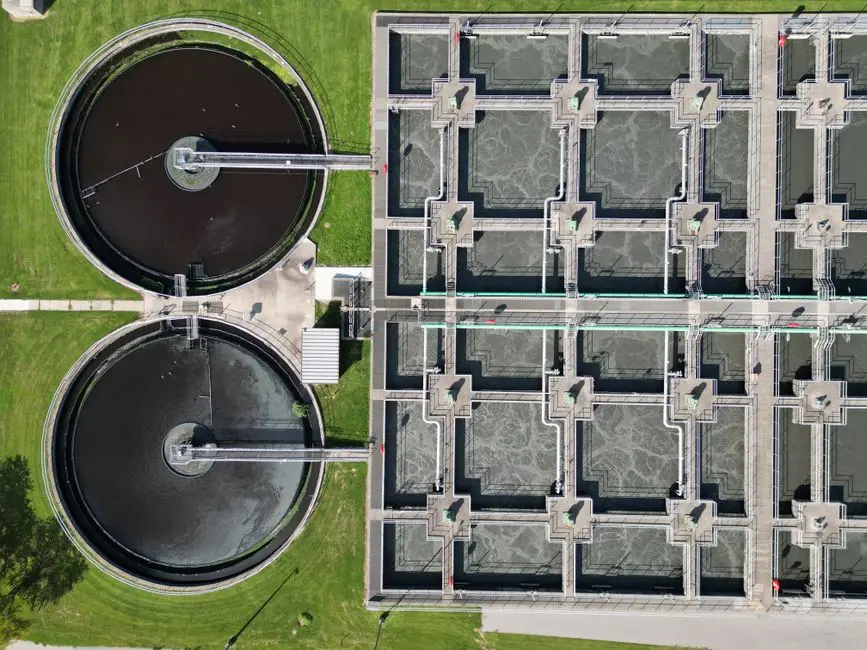
The DAF mechanism consists of four specific stages. First, a portion of clarified effluent is pressurised and saturated with air in a dedicated drum. Second, the supersaturated recycle stream is returned to the main flotation tank where the untreated wastewater enters at atmospheric pressure; the pressure drop releases millions of micro-bubbles, generally 10 to 100 microns in diameter per the OpenBlueprint description. Third, those micro-bubbles attach to suspended solids and oil droplets, reducing their effective specific gravity and lifting them to the surface as a thick froth layer. Fourth, a mechanical skimmer scrapes the floated sludge into a sludge holding tank while clarified water flows out under an overflow weir.
In a Perth ETP train, the DAF unit is positioned after coarse screening and any API-style oil-water separator, and before the biological reactor. OpenBlueprint's refinery logic applies directly: if emulsified oil reaches the biological stage it coats the bacteria in a suffocating film, prevents oxygen transfer, and collapses the microbial colony. The DAF unit is the protective barrier that keeps the biology alive. The typical downstream pairing in Perth is DAF effluent to a biological reactor (activated sludge, MBBR, or anaerobic digester depending on BOD strength), then to tertiary polishing — which in Perth commonly means media filtration or membrane polishing for reuse, often delivered as a packaged HydropureWater MBR system when the goal is reuse water quality. A standalone HydropureWater DAF system is the front-end workhorse for that train.
DAF Sizing Parameters a Perth Buyer Should Specify
Procurement for these systems requires specifying parameters that a supplier must quote line by line. The non-negotiables are hydraulic loading (m³/h per m² of flotation surface), recycle ratio, micro-bubble size band (10–100 microns per the OpenBlueprint description), skimmer drive type, materials of construction, and the chemical dosing train (coagulant, flocculant, pH correction). Sizing inputs the buyer must collect on-site are peak instantaneous flow, average daily flow, pH range, temperature, total suspended solids, oil and grease, and any metals or surfactants that affect coagulant choice.
The supplier's capacity envelope must also be confirmed in writing. The HydropureWater DAF range of 4–300 m³/h across 13 standard models covers small food lines at the low end and large mining camp or food-processing plants at the high end. The only reliable way to lock in hydraulic loading for a given influent is a jar test followed by a pilot trial; generic rules-of-thumb will not survive a DWER audit. A practical decision framework is given in the Best DAF unit for industrial wastewater 2026 spec guide, which converts the data sheet into a comparison table.
| Parameter | What the supplier must quote | What the buyer must provide |
|---|---|---|
| Hydraulic loading | m³/h per m² of flotation surface | Peak instantaneous and average flow (m³/h) |
| Recycle ratio | % of forward flow pressurised and recycled | Flow profile and TSS variability |
| Micro-bubble band | Target 10–100 micron diameter (per Quora/OpenBlueprint) | Validate with on-site pilot |
| Skimmer drive | Type, power, materials | Sludge solids expected |
| Coagulant/flocculant train | Dosing pumps, mixers, control range | Jar-test results, pH range, target metals |
| Capacity envelope | Confirm model sits inside 4–300 m³/h range | Site 24-h composite sampling data |
Perth Compliance and Reuse Considerations
Perth compliance is anchored in a Department of Water and Environmental Regulation (DWER) Works Approval and Licence, with discharge limits set under the Environmental Protection Act and the relevant Water Quality Protection Note. The buyer must confirm the current DWER publication and the Water Corporation trade-waste rules before sizing. Reuse decisions are driven by the water-scarcity economics flagged in the 2030 Water Resources Group catalogue: high evaporation and aquifer stress push most Perth factories toward irrigation reuse or zero-liquid discharge, which means the DAF stage must be sized to feed a downstream membrane or RO polishing train, not just a sewer tie-in.
The typical downstream polishing step when reuse is the target outcome is media filtration followed by UF or RO, often delivered as an HydropureWater MBR system for higher-quality reuse, or an RO skid for closed-loop recycle. Local Water Corporation trade-waste rules remain the binding day-to-day compliance numbers when discharging to sewer; these must be confirmed with Water Corp before equipment is locked in. The 2030 WRG catalogue (2013) makes the point that water-scarcity interventions must be judged at basin scale, not unit scale — a relevant framing when justifying reuse economics to a Perth board.
ETP and DAF Selection Decision Table for Perth Factories
This table maps each industry profile to its recommended DAF duty, downstream train, and reuse routing for procurement planning.
| Perth industry profile | Primary DAF duty | Downstream train | Discharge / reuse routing | DAF capacity band |
|---|---|---|---|---|
| Mining and mineral processing | Colloidal clay and reagent removal; primary clarification | Lime dosing, lamella, biological if BOD present | Typically irrigation reuse or ZLD; sewer only if Water Corp permits | Mid-to-high end of 4–300 m³/h range |
| Food and beverage | FOG and protein-rich suspended solids removal | Biological (aerobic/anaerobic), tertiary polishing | Sewer with trade-waste approval, or irrigation reuse after disinfection | Low-to-mid for small lines; high for large plants |
| Metal finishing and electroplating | Metal hydroxide precipitation and oil removal | pH correction, ion exchange or precipitation, polishing | Mostly sewer under trade-waste rules; reuse for rinse water common | Low-to-mid range |
| Light petrochemical and transport | Emulsified oil removal (refinery-style) | Biological, media filtration, possibly MBR | Sewer under trade-waste; reuse for wash water | Mid-range |
| Next step for all profiles | Jar test and pilot trial | — | — | — |
For an ROI and cost-difference view against conventional sedimentation, the DAF vs sedimentation cost and ROI breakdown gives the head-to-head numbers that a Perth CAPEX committee will ask for.
Frequently Asked Questions
How much does an industrial ETP with a DAF cost for a Perth factory?
Sized quotations based on a 24-hour composite sample, a jar test, and a confirmed discharge or reuse outcome are required to determine costs. Cost drivers a buyer should pin down with the supplier are peak flow (m³/h), influent TSS and FOG, the chosen polishing step (sewer, irrigation reuse, or zero-liquid discharge), and the DWER licence limits — the Best DAF unit for industrial wastewater 2026 spec guide maps these drivers to a data sheet.
How do I shortlist a DAF or ETP supplier in Western Australia?
Shortlist based on four criteria: a confirmed DAF capacity envelope that covers your peak flow (the HydropureWater range is 4–300 m³/h across 13 models), proven application across your industry profile, willingness to run a jar test and pilot trial on your actual influent, and the ability to supply the downstream polishing train (MBR, RO, or media filtration) as a single procurement package. Ask for Perth or Western Australian site references and a written statement of compliance with DWER Works Approval and Water Corporation trade-waste requirements before signing.
Where should a DAF unit sit in a Perth ETP train?
The unit sits after coarse screening and any API-style oil-water separator, and before the biological reactor. The Quora/OpenBlueprint description is explicit: emulsified oil that reaches biology coats the bacteria and stops oxygen transfer, so DAF is the protective barrier between raw physical separation and biological polishing. In a Perth reuse train, the DAF effluent then feeds an MBR or RO polishing step rather than a sewer tie-in.
Can a Perth factory reuse its treated effluent for irrigation or zero-liquid discharge?
Reuse is possible and often the preferred outcome due to local water-scarcity economics. The DAF stage must be sized to feed a downstream polishing train — typically media filtration plus UF or RO, or a packaged MBR — and the end-use (irrigation, cooling tower make-up, wash water) sets the final water-quality target. The buyer must confirm the reuse approval pathway with DWER and the Department of Health before sizing.