Why a housing development in Brisbane may need a packaged STP
A housing development in Brisbane that cannot connect to a reticulated sewer needs at least one on-site sewage facility per lot, or a single shared plant serving grouped lots. Business Queensland states that on-site sewage facilities are used to manage domestic sewage in areas without access to a sewer system and are designed to treat, store and dispose of sewage generated on the premises (S1). Brisbane City Council's fact sheet on onsite sewerage facilities states that, where a home cannot connect to the sewer network, an on-site sewage facility is required, comprising at least one in-ground tank and a disposal area in the yard (S5). The performance criteria any packaged STP must satisfy to be installed are set by AS 1546.3:2017 and the Queensland Plumbing and Wastewater Code (S1).
For greenfield and infill estates, this logic scales from one dwelling to many. Each lot that cannot be sewered needs its own on-site facility, or a cluster of lots must be served by a single commercial-scale package plant. The same regulatory and performance framework applies: AS 1546.3:2017, the Queensland Plumbing and Wastewater Code, and a current chief executive approval from the Department of Housing and Public Works (DHPW) or the Department of the Environment, Tourism, Science and Innovation (DETSI) (S1). A development's body corporate or contracted operator must also plan for the maintenance baseline: a septic tank for an average home needs a pump-out every 3–5 years and a visual inspection every 12 months, with a licensed service agent reporting to both owner and Council on a sewage treatment plant (S5).
How Queensland decides which authority approves your plant
The 4.2 kL/day line is the single most important threshold for a Brisbane housing development. Business Queensland states that the Department of Housing and Public Works issues chief executive approvals for on-site sewage treatment plants capable of treating no greater than 4.2 kL of sewage in a day, and the Department of the Environment, Tourism, Science and Innovation issues approval for systems treating sewage from 4.2 kL or more (S1). A small cluster of houses may fall under the 4.2 kL/day ceiling; a multi-lot housing development almost always exceeds it, pushing the application route to DETSI.
The current approvals register on Business Queensland groups plants by effluent class — advanced secondary with nutrient reduction, advanced secondary, and secondary — and by approval number; only plants with a current, non-superseded approval may be installed, and the register explicitly lists superseded, lapsed, expired and withdrawn entries that are no longer valid (S1). Recent DHPW approvals illustrate the small end of the range: Concrete Aqua Advanced and Poly Aqua Advanced, both 8 EP / 1,200 L, under approvals 01/2026 and 02/2026 (S1). For commercial-scale plants above 4.2 kL/day, approval documents referenced on the same register (for example 21/2023, 19/2023 and 16/2025) define the hydraulic capacity and effluent quality the designer must match to the development's load (S1).
The non-compliance consequence is concrete. Brisbane City Council's fact sheet states that local governments have the ability under the Plumbing and Drainage Act 2018 (section 70) to issue a penalty infringement notice of 20 penalty units to a person who operates a non-compliant on-site sewage facility (S5). Selecting a plant that is not on the current register, or installing an approval that has been superseded, creates immediate legal risk for the developer, the owner and the operating body.
| Design flow | Approving authority | Legislation | Typical project scale |
|---|---|---|---|
| ≤ 4.2 kL/day | Department of Housing and Public Works (DHPW) | Plumbing and Drainage Act 2018; QPW Code; AS 1546.3:2017 | Single dwellings, small clusters (e.g. 8 EP / 1,200 L reference units) |
| ≥ 4.2 kL/day | Department of the Environment, Tourism, Science and Innovation (DETSI) | Environmental Protection Act; QPW Code; AS 1546.3:2017 | Multi-lot housing developments, commercial-scale package plants |
More detail on the regulator's role in similar packaged plant projects is set out in this effluent treatment plant selection guide for utility-scale projects.
Sizing a packaged STP for a Brisbane housing development
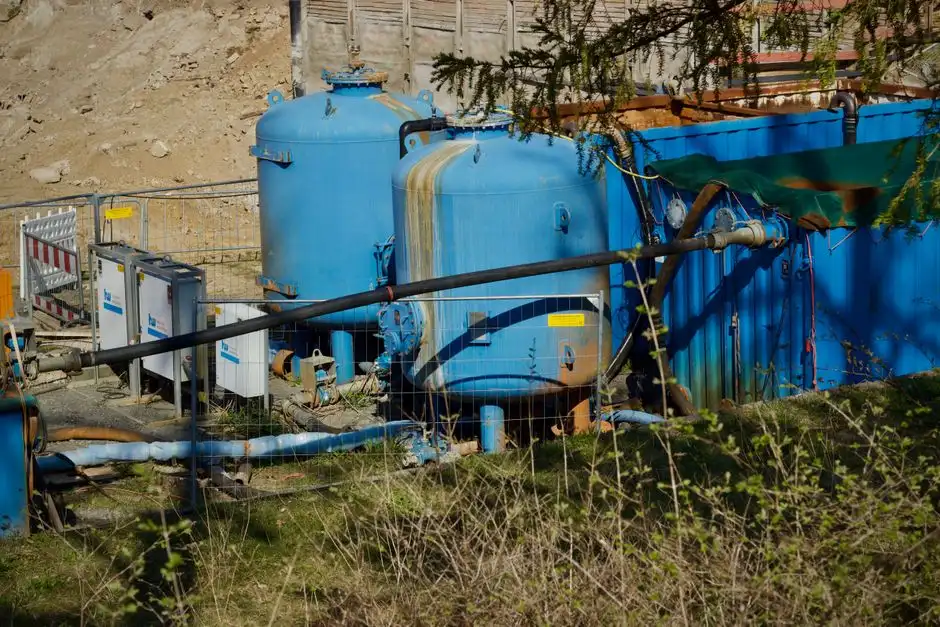
Design flow drives plant class. Business Queensland sets the rule that performance criteria for on-site sewage treatment plants and greywater treatment facilities are defined in AS 1546.3:2017 and the Queensland Plumbing and Wastewater Code (S1). For a housing development, design flow is calculated as: number of dwellings × EP per lot × peak/loading factor, with EP loadings and peak factors as defined in the QPW Code and AS 1546.3:2017. The DHPW-approved 8 EP / 1,200 L reference unit (Concrete Aqua Advanced and Poly Aqua Advanced) is a worked example of how the register documents hydraulic capacity per approval number (S1).
For community-scale systems above 4.2 kL/day, the order of magnitude is defined by the supplier's own scoping range. True Water Australia states it delivers services to small-to-medium size communities of 50–5,000 EP with daily treatment capacities of 5 kL to 500 kL, and that its technology has secured more than 2,500 government approvals with a combined treatment capacity of five million litres per day (S4). A Brisbane housing development typically sits inside this band, and the supplier's reference benchmark is a useful comparison point for what a single community-scale package plant can deliver (S4).
For commercial-scale plants above 4.2 kL/day, the approval documents referenced on the Business Queensland register (for example 21/2023, 19/2023, 16/2025, 03/2026) define the hydraulic capacity and effluent class that the designer must match to the development's load (S1). The supplier's manufacturer compliance statement is the document submitted with the local government application to demonstrate that the chosen model is approved for that flow and effluent class (S1).
Before sizing, the engineer must collect: number of dwellings, expected occupancy, peak factor, any trade-waste load (for example from a clubhouse or commercial tenancy), the target effluent class set by Council, and the site constraints — setback distances, soil class, slope, and the disposal area available in the yard. Brisbane City Council specifies that the disposal area must be clearly identified, must not be shaded, must not receive roof or surface water, and must not be used for vehicles or storage (S5). The supplier should be asked to confirm that the proposed model can achieve the target effluent class at the calculated peak flow, not just the average daily flow.
Three packaged STP classes used in Queensland housing
Three plant classes dominate the residential and small-community segment in Queensland: buried anoxic/aerobic (A/O) package plants, MBR membrane bioreactor package plants, and aerobic sand filter systems. All three are represented in the current DHPW/DETSI approvals register (S1). The developer's choice is driven by design flow, target effluent class, site constraints and lifecycle cost, not by brand.
| Class | Treatment process | Typical effluent class | Footprint / site fit | Register example |
|---|---|---|---|---|
| Buried A/O package plant (WSZ class) | Anoxic/aerobic biological contact oxidation, sedimentation, disinfection in a single buried unit | Advanced secondary; advanced secondary with nutrient reduction | Buried, low visual impact; suits residential lots, hotels, small estates | Various DHPW approvals on the Business Queensland register (S1) |
| MBR package plant | Activated sludge with submerged membrane filtration at sub-micron pore size | Advanced secondary with nutrient reduction; near-reuse quality | Compact footprint suited to tight urban infill; packaged skid/container options | EnviroTAS-AS with nutrient reduction, approval 15/2023 (S1) |
| Aerobic sand filter | Aerobic biological treatment followed by sand filtration media | Advanced secondary; advanced secondary with nutrient reduction | Requires disposal area and filter media; established in Queensland register | Envirotech Aerobic Sand Filter — CP Signature Series, approval 01/2023 (S1) |
For an underground A/O package in a single buried unit, the buried A/O package sewage treatment plant format is the most common reference on housing projects. For tighter sites that demand near-reuse effluent, an MBR package STP for residential estates delivers advanced secondary with nutrient reduction at a smaller footprint. The DHPW register also lists aerobic sand filters as an established class, with the Envirotech Aerobic Sand Filter — CP Signature Series, approval 01/2023, being one current example (S1).
Brisbane City Council distinguishes septic tanks (primary or basic treatment) from sewage treatment plants (secondary or higher treatment), and notes that the facility best suited to a property will depend on the environment where it is installed (S5). Recent small-cluster DHPW approvals — Concrete Aqua Advanced and Poly Aqua Advanced, 8 EP / 1,200 L, approvals 01/2026 and 02/2026 — sit at the lower end of the housing range (S1). For larger packaged MBR systems, the building block is typically a flat-sheet MBR module; the PVDF flat sheet MBR module is the format used in containerised and skid-mounted plants. The effluent class — secondary, advanced secondary, or advanced secondary with nutrient reduction — is set by the approval document and constrains the disposal design downstream (S1).
Approval pathway from spec to commissioning in Brisbane
The sequence below reflects the actual submission route a developer follows, based on the regulatory framework documented by Business Queensland and Brisbane City Council (S1, S5).
- Confirm the threshold. If design flow is ≤ 4.2 kL/day, the application is handled by DHPW; if it is > 4.2 kL/day, the application is handled by DETSI (S1).
- Match the plant to the approval. Select a packaged STP whose current treatment plant approval number, model and effluent class on the Business Queensland register match the project's design flow and target effluent quality (S1). Reject any plant that is superseded, lapsed, expired or withdrawn.
- Submit to local government. Lodge the approval application with Brisbane City Council together with the manufacturer's compliance statement and a site-specific design, per the framework on Business Queensland (S1).
- Install, commission and register a service agent. Installation is carried out by a licensed plumber/drainer. On commissioning, a licensed service agent is engaged to monitor the plant and report to both the owner and Council on each service (S5).
- Operate and maintain. Service the plant to the manufacturer's guidelines. Brisbane City Council may follow up if a service report is not received within the normal service interval (S5).
For projects where the packaged MBR is delivered as a containerised or skid-mounted unit, the sizing logic is laid out in a related guide on sizing a containerized MBR STP and in the broader skid-mounted package plant specifications reference.
Choosing a supplier without inheriting compliance risk
A defensible shortlist for a Brisbane housing development starts with the approvals register, not the brochure. The first filter is that the supplier's quoted model must appear on the Business Queensland register with a current, non-superseded approval number and the right effluent class for the project (S1). The second filter is evidence: the supplier must produce AS 1546.3:2017 and Queensland Plumbing and Wastewater Code compliance evidence, the effluent class certificate, and the manufacturer compliance statement that the local government requires with the application (S1).
Third, confirm the service-agent network. Under Queensland Government legislation, the service agent is required to provide the results of every service to both the property owner and the Council, and Council may follow up if a service report is not received within the normal service interval (S5). A supplier that cannot name a licensed service agent covering the development's location will leave the developer holding the compliance risk. Fourth, ask for a supplier track record on community-scale projects. True Water Australia states it has secured more than 2,500 government approvals for its technology, with a combined treatment capacity of five million litres per day, and that it delivers services to small-to-medium size communities of 50–5,000 EP (S4). That scale of reference is one useful benchmark for what a community-scale supplier should be able to demonstrate.
| Check | What to ask the supplier | Why it matters |
|---|---|---|
| Current DHPW/DETSI approval | Approval number, model, effluent class, expiry status | Plant must not be superseded, lapsed, expired or withdrawn (S1) |
| Standards compliance | AS 1546.3:2017 and QPW Code compliance evidence | Set as performance criteria by Business Queensland (S1) |
| Manufacturer compliance statement | Document to lodge with the local government application | Required submission per Business Queensland (S1) |
| Service-agent network | Named licensed service agent covering the site; service interval | Service agent must report to owner and Council (S5) |
| Community-scale track record | Number of government approvals and combined capacity | Reference benchmark for community-scale delivery (S4) |
Additional engineering detail on data standards for package plants is documented in the skid-mounted package plant specifications reference, and parallels for domestic-scale selection are covered in this domestic sewage treatment plant selection guide.
Frequently Asked Questions
Which Queensland authority approves a packaged STP for a housing development?
The Department of Housing and Public Works issues chief executive approvals for plants treating no greater than 4.2 kL of sewage per day, and the Department of the Environment, Tourism, Science and Innovation issues approval for systems treating 4.2 kL or more per day (S1). Most multi-lot housing developments exceed 4.2 kL/day, so the application route is to DETSI. The plant must also be on the current Business Queensland approvals register, and any plant listed as superseded, lapsed, expired or withdrawn cannot be installed (S1).
What is the order-of-magnitude cost for a packaged STP on a housing development?
The research does not provide a Queensland-specific price for a packaged STP. Cost depends on the design flow (kL/day), the effluent class required, the site constraints, and the supply, install and operate model chosen. A useful sizing anchor is that one Australian utility provider, True Water Australia, states it delivers 5 kL to 500 kL treatment systems for 50–5,000 EP communities (S4). The buyer should request a written quote tied to the calculated design flow, the target effluent class, and a separate line for the ongoing service-agent contract, because the service contract is what the local government will monitor under the Plumbing and Drainage Act 2018 (S5).
How do I size a packaged STP for a Brisbane housing estate?
Design flow is calculated as: number of dwellings × EP per lot × peak/loading factor, with EP loadings and peak factors as defined in the Queensland Plumbing and Wastewater Code and AS 1546.3:2017 (S1). The DHPW-approved 8 EP / 1,200 L reference units (Concrete Aqua Advanced and Poly Aqua Advanced, approvals 01/2026 and 02/2026) are a worked example of how small-cluster plants are documented on the register (S1). Inputs to collect before sizing: number of dwellings, expected occupancy, peak factor, any trade-waste load, target effluent class, and site constraints such as setback, soil class and the disposal area (S1, S5).
What supplier evidence should I require to avoid compliance risk?
Require the current DHPW or DETSI approval number, the AS 1546.3:2017 and Queensland Plumbing and Wastewater Code compliance evidence, the effluent class certificate, and the manufacturer compliance statement needed for the local government application (S1). Also require the name of the licensed service agent who will service the plant and report to both the owner and Brisbane City Council on each service, because Council may follow up if a service report is not received within the normal service interval (S5). A reference benchmark for community-scale delivery is 2,500+ government approvals and a combined treatment capacity around five million litres per day, as cited by one Australian utility provider (S4) — useful as a comparison point, not as a guarantee.