Why a Housing Development in Luanda Needs a Packaged Sewage Plant
The headline sanitation projects in Luanda are designed at city scale and do not address the sewage needs of a single housing estate. The IDOM-led sanitation plan constructs two interceptors that channel wastewater from Luanda's city centre to a new wastewater treatment plant (WWTP) sized for up to 1,790,000 residents (IDOM, project page, undated). The World Bank's Angola–Luanda Bita Water Supply Guarantee Project is a US$1,090 million potable-water scheme executed by EPAL, with an IBRD guarantee of US$500 million, intended to mobilise commercial financing for the Government of Angola rather than to deliver estate-level sewage infrastructure (World Bank Project Appraisal Document, June 2019).
The African Development Bank's US$124.4 million Coastal Towns Inclusive Sanitation Project targets Benguela, Baía Farta, Catumbela and Lobito for a combined 1.4 million people, financing centralised reticulation and treatment (AfDB press release, undated). The engineering-relevant question for a Luanda developer is which factory-built unit best fits the estate — typically a buried anoxic/aerobic (A/O) integrated plant or a containerised membrane bioreactor (MBR). The presence of DouroECI on EPAL pre-feasibility work and IDOM on interceptor design confirms active local engineering capacity to support both public–private partnership (PPP) delivery and packaged-plant selection (DouroECI project list, undated). For a deeper Angolan context, see the Angola residential wastewater engineering guide.
What Counts as a 'Packaged' Sewage Treatment Plant in Angola
A packaged sewage treatment plant is a factory-built biological treatment unit — skid- or container-integrated — delivered to site with minimal on-site civil works. Two dominant classes are deployed across tropical Africa. The first is the buried integrated A/O plant, which combines anoxic and aerobic zones, sedimentation and disinfection inside a single shell that can be installed below grade with landscaping above. The second is the skid- or containerised MBR, which adds submerged ultrafiltration membranes to a biological reactor to produce near-reuse-quality effluent in a compact above-grade footprint. Buried A/O plants can be set below grade to free surface area for amenity use; MBR plants are typically mounted in ISO containers or FRP tanks and require crane access for installation. The World Bank SORT rating for the Bita programme records Angola's institutional capacity for implementation and sustainability as High risk, and overall project risk as High (World Bank Project Appraisal Document, June 2019). This risk profile favours packaged plants that can run with minimal operator intervention and include remote monitoring, because site-based specialist staffing in Luanda is harder to sustain than at a municipal utility. Buyers should treat the High institutional-capacity rating as a sizing factor, as it pushes the specification toward factory acceptance testing, pre-commissioning and a documented operator-training plan before handover.
Sizing a Packaged Plant for a Luanda Housing Estate
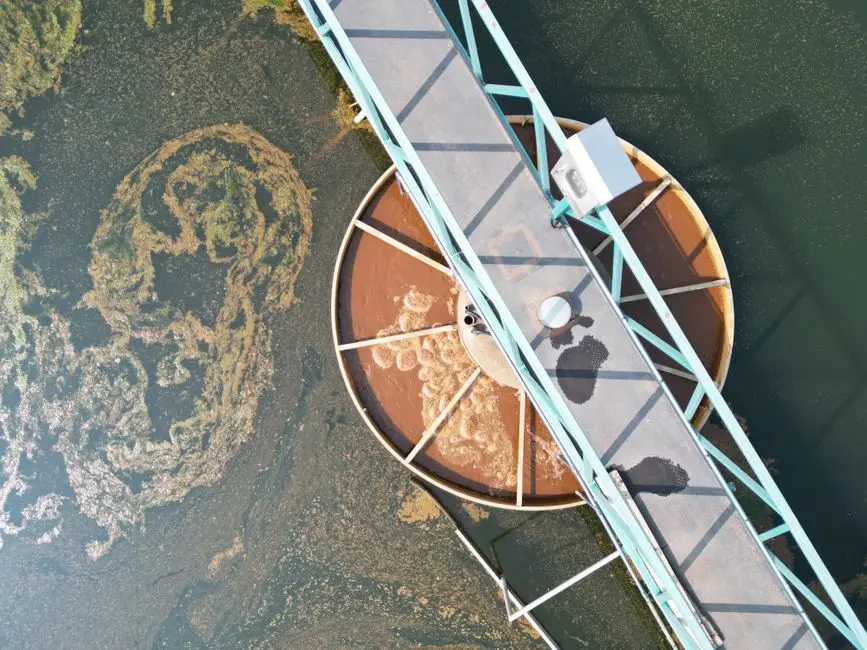
Sizing a packaged plant for a Luanda estate starts with four inputs that the project engineer must obtain locally: design population (units × occupancy), peak factor, average per-capita wastewater flow, and influent BOD/COD. With those inputs, design flow is calculated as average daily flow multiplied by a peaking factor — qualitatively in the 2.0–2.5 range used for residential developments, though the Luanda-specific value must be confirmed from measured data. BOD loading per capita in domestic sewage is the standard input used to size biological stages; the engineer should request a measured BOD value rather than adopting a generic one. Match plant capacity to peak flow rather than average flow, because Luanda's hot climate and intermittent water supply can produce pronounced diurnal peaks. For housing estates delivered in phases, the packaged plant should be sized for the full built-out phase but capable of running efficiently at low load during the initial occupation phase to prevent over-aeration of biological stages and poor sludge yield. The parameter table below summarises the inputs a Luanda project engineer must collect before issuing a sizing enquiry.
| Sizing input | What to request or measure | Source of evidence |
|---|---|---|
| Design population | Units × occupancy at full build-out, plus phased plan | Project brief (not in research) |
| Average per-capita flow | Measured Luanda domestic flow, not generic | Not supplied in research; request locally |
| Peaking factor | Residential value, typically 2.0–2.5 (qualitative) | Not supplied in research; request locally |
| Influent BOD / COD | Measured Luanda domestic sewage, not generic | Not supplied in research; request locally |
| Effluent target | Discharge to soakaway/marine, or reuse for irrigation | Project brief (not in research) |
| Power reliability | Grid outage frequency, on-site generation | Not supplied in research; request from EPAL/utility |
Buried A/O vs Containerised MBR: Which Fits Luanda Housing
The two packaged classes answer different estate briefs. Buried A/O is suited to small-to-medium estates where land is available for subsurface installation, where landscaping above the tank is desired, and where the grid is reasonably stable — typical of a suburban Luanda condominium of a few hundred dwellings. A buried A/O package plant for residential estates runs without a dedicated operator and is tolerant of the simple on-site checks an estates team can carry out. Containerised MBR is suited to medium-to-large estates, to dense inner-Luanda sites with limited footprint, and to projects that need reuse-quality effluent for landscape or golf-course irrigation; a containerised MBR system for housing developments requires membrane integrity monitoring but produces effluent close to reuse standard. Power reliability is the deciding factor under Angola's High overall risk rating: an MBR plant must be specified with adequate buffer tank volume, low-energy aeration and a generator or UPS sized to ride out grid interruptions, otherwise membrane fouling accelerates during outages (World Bank Project Appraisal Document, June 2019, overall risk High). If the estate plans to discharge to a soakaway or marine outfall, buried A/O is sufficient; if irrigation reuse is the design driver, MBR is the safer baseline. For sizing methodology on containerised MBR, the containerised MBR sizing methodology walkthrough and the containerised MBR sizing for residential use guide give a step-by-step process that translates directly to tropical Luanda once local flow and load data are substituted.
| Decision criterion | Buried A/O (WSZ-type) | Containerised MBR |
|---|---|---|
| Estate size | Small to medium (roughly up to ~1,000 dwellings) | Medium to large (above ~1,000 dwellings) |
| Footprint | Below grade, landscaping possible above | Above grade, ISO container or FRP tank |
| Operator input | Minimal, periodic checks | Membrane integrity monitoring required |
| Power sensitivity | Tolerant of short outages | Needs buffer tank, low-energy aeration, UPS/genset |
| Effluent quality | Discharge standard | Reuse-quality for irrigation |
| Best fit on Angola risk profile | Suburban sites with stable grid | Reuse-driven or footprint-constrained sites |
Pre-Purchase Checklist for a Luanda Packaged Sewage Plant
A short list of questions separates a workable purchase from a costly one. First, request the population and flow basis used in sizing, plus the peaking factor assumed, and check it against your measured inputs. Second, confirm factory test scope, container or skid certification, and the boundary between supplier and civil contractor for site works (excavation, backfill, electrical, lifting). Third, if MBR is selected, ask for membrane warranty terms and the documented replacement cycle, as these drive lifecycle cost. Fourth, request the PLC/automation scope, the remote-monitoring option and the operator training plan, all of which matter under Angola's High institutional-capacity risk rating (World Bank Project Appraisal Document, June 2019, institutional capacity High). Fifth, ask whether the supplier can structure a Performance Improvement Plan (PIP)-style handover, similar to the PIP required of EPAL on the Bita project, with measurable indicators reviewed over the first 12 months of operation (World Bank Project Appraisal Document, June 2019). Sixth, verify the spare-parts supply chain into Luanda before contract award — confirm stocking of spare parts and consumables for packaged sewage plants through a Luanda-based agent, given the High overall risk rating recorded for the Bita programme.
Frequently Asked Questions
How do I choose between buried A/O and containerised MBR for a 1,000-dwelling Luanda estate?
Match the technology to the discharge or reuse target and to power reliability. A 1,000-dwelling estate is at the boundary between the two classes: buried A/O is appropriate if the estate will discharge to a soakaway or marine outfall and the grid is reasonably stable, while containerised MBR is the better choice if the treated effluent will be reused for landscape irrigation, or if the site footprint is constrained. Obtain measured Luanda flow and BOD data, then apply the peaking factor used in the supplier's sizing calculation before committing to either class.
What drives the 2026 capital and operating cost of a packaged sewage plant in Angola?
Request a quotation tied to your sizing inputs rather than to a generic catalogue figure. The cost drivers that consistently appear across packaged-plant procurement are container or skid material grade, membrane type and aeration system for capex, and membrane replacement interval, energy use and sludge handling for opex. Angola's High overall project risk rating (World Bank, June 2019) means a generator or UPS sized for grid outages and a documented spare-parts path into Luanda should be priced in from the start, not added later as a variation.
What is the typical lead time for a packaged STP into Luanda, and what shortens it?
Lead time depends on whether the plant is a standard catalogue series or a custom-engineered skid. Standard catalogue units typically have shorter manufacturing windows, while custom-engineered skids require additional drawing approval and factory acceptance test (FAT) scheduling. Confirm the FAT date, the shipping route into Luanda port, and the on-site commissioning window before signing the purchase order; the High overall risk rating on the Bita project is a useful internal benchmark for the level of schedule detail a Luanda buyer should demand (World Bank, June 2019).
Which Angola-specific compliance and supplier-selection risks should I manage before signing?
Engineers should reference international standards for biological domestic sewage treatment and confirm with the Ministry of Energy and Water whether a project-specific discharge consent is required. On the supplier side, the institutional-capacity risk that the World Bank recorded as High for the Bita programme (World Bank Project Appraisal Document, June 2019) argues for selecting a supplier with prior Angolan project experience, a documented PIP-style handover, and a Luanda-based spare-parts channel rather than a lowest-bidder unfamiliar with local logistics.