Choosing between aerobic vs anaerobic wastewater treatment depends on influent COD, energy price, sludge disposal cost, and the BOD or COD permit limit. A Wisconsin dairy plant treating 300 m³/day at about 5,000 mg/L COD faces the same trade-off many food, pharmaceutical, and chemical sites face. An aerobic activated sludge train can deliver single-stage COD removal above 95%, while an anaerobic UASB can recover about 0.35 m³ methane per kg COD removed but often needs polishing.
Aerobic vs Anaerobic Wastewater Treatment: Core Process Differences
Aerobic systems use dissolved oxygen to oxidize organics and typically suit COD below 1,000 mg/L, with COD removal of 75–98% at HRT 4–12 hours. Anaerobic systems treat high-strength wastewater above 2,000 mg/L COD without oxygen, yield about 0.35 m³ methane per kg COD removed, and often need aerobic polishing to meet BOD limits under 50 mg/L.
Aerobic wastewater treatment converts BOD or COD into carbon dioxide, water, and biomass when dissolved oxygen is available. Anaerobic treatment breaks organics down without oxygen and yields biogas that is typically 60–70% methane and 30–40% CO₂. Those process differences set the operating windows for industrial plants.
Aerobic treatment parameters commonly used in design include:
- Dissolved oxygen: earlier guidance often cited 0.5–2.0 mg/L; EPA training materials (2021) set reactor average DO at 1.0–2.0 mg/L and note that DO above 2.0 mg/L typically wastes aeration energy
- Hydraulic retention time (HRT): 4–12 hours
- Solids retention time (SRT): 5–20 days
- Mixed liquor suspended solids (MLSS): 2,000–5,000 mg/L (EPA training materials list 1,500–3,500 mg/L for many activated-sludge plants)
- Optimal temperature: 15–30°C
- Optimal pH: 6.5–8.5
Anaerobic treatment parameters differ because methanogens grow slowly and need stable conditions:
- HRT: 12–48 hours
- SRT: 20–50 days
- MLSS: 10,000–30,000 mg/L
- Optimal temperature: 30–38°C (mesophilic) or 50–57°C (thermophilic)
- Optimal pH: 6.8–7.4
| Parameter | Aerobic Treatment | Anaerobic Treatment |
|---|---|---|
| Oxygen Requirement | Requires dissolved oxygen (0.5–2.0 mg/L) | Oxygen-free environment |
| Hydraulic Retention Time (HRT) | 4–12 hours | 12–48 hours |
| Solids Retention Time (SRT) | 5–20 days | 20–50 days |
| MLSS Concentration | 2,000–5,000 mg/L | 10,000–30,000 mg/L |
| Temperature Range | 15–30°C | 30–38°C (mesophilic) or 50–57°C (thermophilic) |
| pH Range | 6.5–8.5 | 6.8–7.4 |
| Byproducts | CO₂, biomass, water | Methane (60–70%), CO₂, biomass |
Performance Comparison: COD/BOD Removal, Energy Use, and Sludge Yield
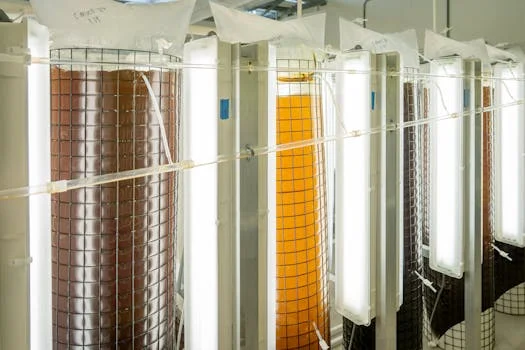
Aerobic and anaerobic trains diverge on organic removal, power use, and solids yield. Those gaps drive OPEX, footprint, and whether a plant can meet its permit without a second stage.
COD/BOD removal efficiency. Aerobic systems typically achieve 75–98% COD removal and suit low-strength wastewater with COD below 1,000 mg/L, often delivering BOD removal above 90% in industrial service. Anaerobic systems typically achieve 51–96% COD removal and fit high-strength wastewater with COD above 2,000 mg/L. Many anaerobic effluents still need aerobic polishing to reach BOD below 50 mg/L.
Energy consumption. Earlier industry ranges for aerobic aeration often used 0.5–1.5 kWh/kg COD removed. According to US EPA training materials (2021), conventional activated sludge typically uses about 1.0 kWh per lb BOD₅ removed (~2.2 kWh/kg BOD₅). Oxidation ditches typically use about 1.6 kWh per lb BOD₅ (~3.5 kWh/kg BOD₅). Anaerobic reactors can be net energy producers at about 0.35 m³ methane per kg COD removed, often cited as roughly 3.5 kWh/kg COD equivalent when methane is used on site.
Sludge yield. Aerobic systems produce about 0.4–0.6 kg TSS/kg COD removed, so dewatering and haulage dominate residual cost. Anaerobic systems produce about 0.05–0.1 kg TSS/kg COD removed, which cuts disposal volume and simplifies solids handling.
Footprint and odor. Aerobic plants need larger tanks and clarifiers but rarely generate H₂S under normal DO control. Anaerobic plants occupy less reactor volume yet need gas holders, flares, or utilization skids. They can release H₂S odor if pH falls below 6.5 or sulfate is high.
| Metric | Aerobic Treatment | Anaerobic Treatment |
|---|---|---|
| COD Removal Efficiency | 75–98% | 51–96% |
| BOD Removal Efficiency | 90–99% | 60–95% (may require post-treatment) |
| Energy Consumption | 0.5–1.5 kWh/kg COD removed | Net energy producer: 0.35 m³ methane/kg COD removed (3.5 kWh/kg COD equivalent) |
| Sludge Yield | 0.4–0.6 kg TSS/kg COD removed | 0.05–0.1 kg TSS/kg COD removed |
| Footprint | Larger (aeration tanks, clarifiers) | Smaller (but requires gas handling) |
| Odor Potential | Minimal (no H₂S production) | Potential for H₂S odor (if pH <6.5 or high sulfate) |
When to Use Anaerobic or Aerobic Treatment
Influent COD concentration is the first screen for choosing anaerobic or aerobic treatment on industrial wastewater. Aerobic systems fit COD below 1,000 mg/L because oxygen transfer keeps pace with load. Anaerobic systems fit COD above 2,000 mg/L and can handle loads up to about 20,000 mg/L in UASB or EGSB configurations. Medium-strength streams at 1,000–2,000 mg/L COD often justify a hybrid train with anaerobic pretreatment and aerobic polishing.
BOD/COD ratio. Aerobic biology works well when BOD/COD exceeds about 0.5, as in many dairy, food, and municipal streams. Anaerobic biology is often preferred when BOD/COD falls below about 0.3, as in pulp/paper, chemical, and pharmaceutical wastewater with more recalcitrant organics.
Temperature and toxicity. Aerobic systems tolerate roughly 10–35°C and recover more readily after toxic shocks from metals or chlorinated compounds. Anaerobic systems need 30–38°C mesophilic or 50–57°C thermophilic control. Sulfides, free ammonia, or chlorinated compounds can stop methanogenesis.
| Industry | Typical Wastewater Characteristics | Recommended System |
|---|---|---|
| Dairy Processing | COD: 2,000–5,000 mg/L, BOD/COD: 0.6–0.8, High fats/oils | Aerobic or hybrid (anaerobic + aerobic) |
| Brewery | COD: 3,000–6,000 mg/L, BOD/COD: 0.5–0.7, High solids | Anaerobic + aerobic polishing |
| Textile | COD: 1,000–3,000 mg/L, BOD/COD: 0.2–0.4, High color, dyes | Aerobic (with chemical pre-treatment) |
| Pharmaceutical | COD: 5,000–15,000 mg/L, BOD/COD: 0.1–0.3, Toxic compounds | Anaerobic (with toxicity mitigation) |
| Pulp/Paper | COD: 2,000–10,000 mg/L, BOD/COD: 0.3–0.5, High lignin | Anaerobic or hybrid |
For equipment shortlists after the process choice is clear, use our guide to selecting wastewater treatment equipment.
Cost Comparison: CAPEX, OPEX, and ROI for Industrial Applications
Capital cost, power, sludge disposal, and methane revenue set the true cost of ownership for aerobic vs anaerobic wastewater treatment plants. Aerobic plants usually spend less up front and more on aeration and solids. Anaerobic plants spend more on gas handling and earn back through lower sludge mass and fuel displacement.
CAPEX. Aerobic systems commonly fall in the $1,500–$3,000 per m³/day capacity band because tanks, clarifiers, and blowers are simpler. Anaerobic systems commonly fall in the $2,000–$4,000 per m³/day band once gas holders, flares, and utilization equipment are included.
OPEX and sludge. Aerobic OPEX often lands at $0.20–$0.50 per m³ treated, driven by aeration and disposal of 0.4–0.6 kg TSS/kg COD removed at roughly $0.10–$0.30 per kg TSS. Anaerobic OPEX often lands at $0.10–$0.30 per m³ treated after methane credit of about $0.05–$0.15 per m³, with sludge disposal nearer $0.05–$0.15 per kg TSS.
Sample ROI for a 500 m³/day dairy plant at 3,000 mg/L COD. An aerobic option at about $2,400/m³/day implies roughly $1.2M CAPEX, about $73,000/year OPEX at $0.40/m³, and about $18,000/year sludge cost, or about $91,000/year total. An anaerobic option at about $3,000/m³/day implies roughly $1.5M CAPEX, about $27,400/year OPEX at $0.15/m³, about $14,600/year methane revenue at $0.08/m³, and about $2,250/year sludge cost, or about $15,050/year net. Payback in this worked example is about 4.2 years for anaerobic versus about 6.5 years for aerobic.
Maintenance. Aerobic maintenance typically runs $5,000–$15,000/year for blowers and wasting routines. Anaerobic maintenance typically runs $10,000–$30,000/year for gas systems, pH control, and toxicity monitoring.
| Cost Category | Aerobic Treatment | Anaerobic Treatment |
|---|---|---|
| CAPEX ($/m³/day) | $1,500–$3,000 | $2,000–$4,000 |
| OPEX ($/m³) | $0.20–$0.50 | $0.10–$0.30 (net after methane revenue) |
| Sludge Disposal ($/kg TSS) | $0.10–$0.30 | $0.05–$0.15 |
| Annual Maintenance ($) | $5,000–$15,000 | $10,000–$30,000 |
| Payback Period (Years) | 5–8 | 3–6 |
For line-item budgeting beyond this matrix, see our 2025 wastewater treatment cost guide.
Hybrid Systems: Combining Aerobic and Anaerobic Stages
Hybrid wastewater treatment systems place anaerobic COD destruction ahead of aerobic polishing so plants recover energy while still meeting tight BOD limits. Common pairings include anaerobic UASB plus aerobic MBBR, anaerobic EGSB plus activated sludge, and anaerobic IC plus SBR for variable flows.
In a UASB plus MBBR layout, the anaerobic stage often removes 70–80% of COD while the aerobic stage polishes to BOD below 50 mg/L, cutting energy use by about 50–70% versus aerobic-only service. EGSB plus activated sludge handles organic loads up to about 20,000 mg/L COD and supports nutrient removal in the aerobic step. Overall hybrid COD removal of 90–99% is typical when both stages are sized correctly, with sludge yield often 70–90% lower than aerobic-only trains.
A brewery example at 5,000 mg/L COD used anaerobic UASB plus aerobic MBBR. The UASB removed about 80% of COD at 0.3 m³ methane/kg COD removed. Total COD removal reached about 95% with effluent BOD below 50 mg/L, about 60% energy savings versus aerobic-only, and about 75% less sludge. Design splits often use anaerobic HRT 6–12 hours and aerobic HRT 4–8 hours, with anaerobic SRT 20–50 days and aerobic SRT 5–20 days. Keep anaerobic pH near 6.8–7.4. The aerobic stage can run 6.5–8.5 and may need nitrogen or phosphorus dosing.
Where membrane polishing is preferred after anaerobic pretreatment, review our MBR systems for aerobic polishing.
Case Study: Aerobic vs Anaerobic for a Food Processing Plant
A California food processing plant needed COD below 250 mg/L and BOD below 50 mg/L while controlling power and sludge cost. The plant compared aerobic activated sludge, anaerobic UASB alone, and a hybrid UASB plus aerobic MBBR on a 300 m³/day stream at 4,000 mg/L COD, 1,500 mg/L BOD, 300 mg/L TSS, 25–30°C, and pH 6.5–7.5.
| System | COD Removal (%) | Energy Use (kWh/m³) | Sludge Yield (kg TSS/kg COD) | CAPEX ($) | OPEX ($/m³) |
|---|---|---|---|---|---|
| Aerobic Activated Sludge | 95% | 1.2 | 0.5 | $900,000 | $0.45 |
| Anaerobic UASB | 85% | -0.5 (energy producer) | 0.08 | $1,100,000 | $0.15 (net after methane revenue) |
| Hybrid (UASB + MBBR) | 98% | 0.3 | 0.15 | $1,300,000 | $0.25 |
The aerobic option met limits but carried about $164,000/year energy cost and about $15,000/year sludge cost. The anaerobic-only option cut net energy cost to about $27,000/year and offset roughly 30% of OPEX with methane, yet still needed polishing for BOD. The hybrid train met the permit at about $27,000/year net OPEX with moderate CAPEX and about 75% energy savings versus aerobic-only. The plant selected the hybrid: the UASB removed about 80% of COD and fed boilers with methane, while the MBBR closed the BOD gap.
Which Is Better: Aerobic or Anaerobic Treatment?
Neither aerobic nor anaerobic treatment is universally better; the better choice matches COD strength, permit stringency, and energy strategy. Use the checklist below before freezing a process flow diagram.
- Characterize wastewater: COD band (<1,000, 1,000–2,000, or >2,000 mg/L), BOD/COD ratio, temperature, toxicity, and pH.
- Define effluent limits: COD, BOD, TSS, nutrients, and any reuse target such as irrigation or process water.
- Map site constraints: available footprint, power price volatility, and odor rules.
- Compare CAPEX and OPEX: budget, target payback (3–5, 5–10, or >10 years), and any biogas or carbon incentives.
- Assess operations: in-house skill for gas systems versus blower-centric aerobic plants.
- Plan scalability: expected flow or composition change and need for modular expansion.
- Confirm with pilots: bench or pilot data before full-scale design and sizing.
For capacity calculations after the process is selected, use our wastewater treatment system sizing guide.
Who this is for. Plant engineers, EPC designers, and procurement teams comparing aerobic vs anaerobic options on industrial wastewater above roughly 1,000 mg/L COD, or deciding whether a hybrid train is worth the extra CAPEX. Who should look elsewhere. Sites with only dilute sanitary flow and no industrial COD spike usually stay with conventional aerobic secondary treatment. Septic-only domestic systems need different onsite design rules than industrial UASB or activated-sludge plants. Next step. Share influent COD, flow, temperature, and permit limits so a process engineer can size aerobic, anaerobic, or hybrid options against your discharge targets.
Frequently Asked Questions
What is the main difference between aerobic and anaerobic treatment?
Aerobic systems need dissolved oxygen and fit low-strength wastewater with COD below 1,000 mg/L, typically reaching 75–98% COD removal. Anaerobic systems run without oxygen, suit COD above 2,000 mg/L, and produce about 0.35 m³ methane per kg COD removed. Anaerobic effluent often needs aerobic polishing when permits require BOD below 50 mg/L.
Which system is more energy-efficient?
Anaerobic systems are usually more energy-efficient on high-strength wastewater because methane recovery can offset plant power. Aerobic aeration still commonly falls near 0.5–1.5 kWh/kg COD removed in industry ranges, while EPA training materials (2021) report about 1.0 kWh per lb BOD₅ removed for conventional activated sludge. On dilute streams, aerobic simplicity can outweigh anaerobic gas-system cost.
Can anaerobic treatment meet discharge limits without post-treatment?
Rarely for strict industrial permits. Anaerobic COD removal of 51–96% often leaves BOD above limits such as 50 mg/L. Hybrid anaerobic plus aerobic trains are the usual compliance path when plants need both energy recovery and a low sludge yield.
What industries use anaerobic treatment?
Food and beverage plants such as dairies and breweries, pulp and paper mills, chemical plants, and pharmaceutical sites commonly use anaerobic reactors. The fit is strongest when COD is high, wastewater is warm, and BOD/COD is moderate to low or compounds are partly recalcitrant.
How much methane can an anaerobic system produce?
Designers typically use about 0.35 m³ methane per kg COD removed under favorable conditions. At 300 m³/day and 5,000 mg/L COD with strong conversion, that order of magnitude is about 525 m³/day methane, or roughly 5,250 kWh/day of primary energy if fully utilized in boilers or generators.
Related Equipment
- DAF systems for pre-treatment before aerobic or anaerobic processes — view specifications, capacity range, and technical data
- chemical dosing for pH adjustment and nutrient balancing — view specifications, capacity range, and technical data
Need a customized solution? Request a free quote with your specific flow rate and pollutant parameters.