Rural & Small Community Sewage Treatment: Which Process Fits Your Community?
More than 2.3 billion people worldwide lack access to safely managed sanitation, and the majority live in rural areas and small communities. In developed nations, rural communities often rely on aging septic systems or are connected to centralized treatment plants through prohibitively expensive collection systems. In developing nations, raw or inadequately treated sewage is frequently discharged directly to waterways.
The solution, increasingly, is decentralized wastewater treatment — right-sized systems that serve individual communities at or near the point of generation. This guide helps engineers, municipal planners, and development organizations select the most appropriate treatment process for communities ranging from 100 to 10,000 people.
Why Rural Communities Need Different Solutions
Rural and small community wastewater treatment faces a distinct set of challenges that make simply scaling down urban treatment plants impractical:
- Highly variable flows: Small populations mean diurnal flow variations of 4:1 or more, with near-zero flow at night. Peak factors of 3–5× average daily flow are common.
- Limited operator availability: Full-time certified wastewater operators are expensive and difficult to recruit for isolated communities. The system must tolerate days or weeks of minimal attention.
- Seasonal population fluctuations: Tourist communities, university towns, and agricultural areas can see population swings of 200–500% between seasons.
- Budget constraints: Per-capita infrastructure costs are inherently higher for small systems. Federal and state grant programs (such as USDA Water & Environmental Programs in the US) help but rarely cover the full cost.
- Diverse discharge environments: Effluent may be discharged to small streams with limited dilution capacity, applied to land, or recharged to groundwater — each requiring different treatment levels.
Treatment Process Options for Small Communities
Option 1: Underground Integrated Package Plants (50–500 m³/day)
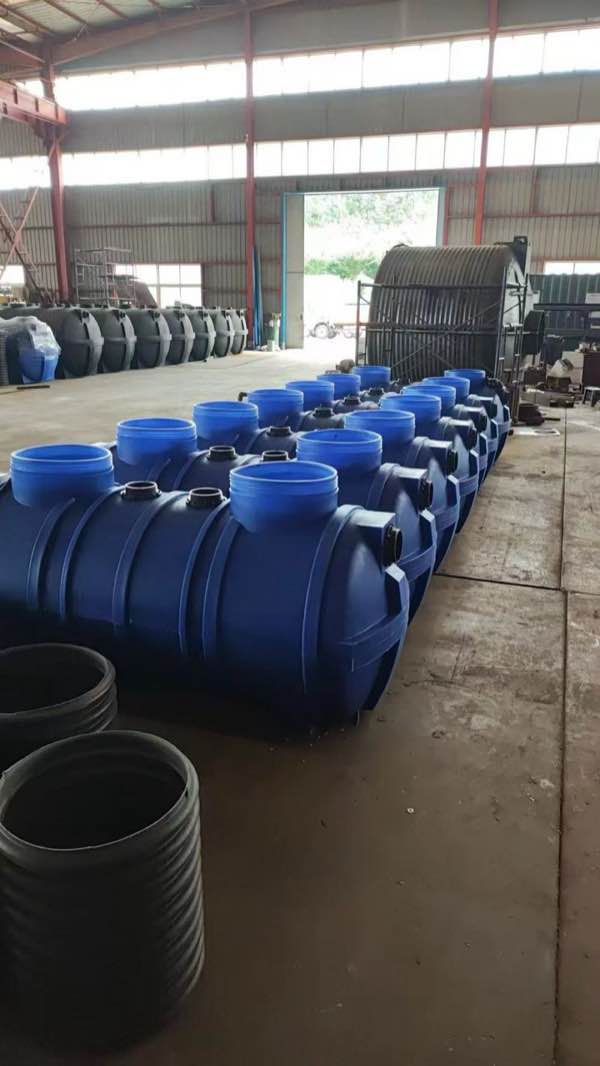
Underground package plants have become the technology of choice for small communities across Asia, the Middle East, and increasingly in Europe and the Americas. These systems integrate all treatment stages — screening, biological treatment, clarification, and disinfection — into a single buried unit.
The WSZ Underground Integrated Sewage Treatment Plant is representative of this category. Key advantages for rural communities include:
- Invisible installation: Buried systems eliminate visual impact, noise, and odor concerns. The surface can be used as a park, parking area, or garden — critical for community acceptance.
- Stable temperature: Underground installation provides thermal insulation, maintaining biological process temperatures 5–10°C above ambient in winter. This significantly improves treatment performance in cold climates.
- Low operator requirement: Modern units with automated controls, remote monitoring, and self-cleaning features can operate with as little as 2–4 hours of operator attention per week.
- Modular expansion: Multiple units can be installed in parallel as the community grows, avoiding the need to build oversized infrastructure upfront.
These systems typically use a combination of anoxic and aerobic zones with attached-growth or suspended-growth biomass. The A/O (Anoxic/Oxic) or A²/O (Anaerobic/Anoxic/Oxic) process configurations provide simultaneous removal of organics, nitrogen, and phosphorus.
Option 2: MBR Systems for Stringent Requirements (20–1,000 m³/day)
When effluent quality requirements are particularly strict — for discharge to sensitive receiving waters, for water reuse, or to comply with stringent regulatory standards — MBR integrated treatment systems offer the most reliable solution for small communities.
MBR is especially valuable for rural communities in these scenarios:
- Water reuse for irrigation: In water-scarce regions, MBR effluent quality (BOD < 5, TSS < 1, turbidity < 0.5 NTU) meets or exceeds most irrigation reuse standards without additional treatment.
- Discharge to sensitive water bodies: Communities near lakes, reservoirs, or coastal areas designated as sensitive zones under the EU Water Framework Directive or similar regulations.
- Space-limited village centers: MBR's 30–50% smaller footprint is valuable when the only available site is a small plot within the village.
Option 3: Constructed Wetlands (Natural Treatment Systems)
For communities with available land and minimal budget, constructed wetlands provide effective treatment using natural biological and physical processes. Key types include:
- Subsurface flow wetlands: Wastewater flows through a gravel bed planted with reeds or similar species. No open water surface means no mosquito breeding and no public access concerns. Typical hydraulic loading: 3–6 cm/day.
- Free water surface wetlands: Open-water systems with emergent vegetation. Higher land requirements but can provide habitat benefits. Suitable for polishing secondary effluent.
- Hybrid systems: Vertical flow followed by horizontal flow wetlands, achieving nitrification in the vertical stage and denitrification in the horizontal stage.
Land requirement is the primary constraint: 5–10 m² per person for subsurface flow systems treating raw wastewater, or 2–3 m² per person when treating primary-settled effluent. Constructed wetlands perform well in warm climates but may not meet discharge standards in cold winters without supplemental treatment.
Option 4: Stabilization Ponds (Lagoons)
Waste stabilization ponds remain one of the most cost-effective treatment options where land is abundant. A typical system consists of:
- Anaerobic pond: 2–5 days retention, removes 40–70% BOD
- Facultative pond: 5–30 days retention, further BOD removal via algal-bacterial symbiosis
- Maturation pond: 5–20 days, pathogen removal through UV exposure and pH elevation
Total land requirement: 30–50 m² per person. While excellent for warm climates, stabilization ponds struggle in cold regions and cannot meet stringent nutrient standards without supplementary treatment.
Option 5: SBR (Sequencing Batch Reactor)
SBR systems are well-suited to small communities because they handle variable flows naturally — the batch process simply adjusts cycle times based on inflow. A single SBR tank performs all treatment steps (fill, react, settle, decant) in sequence, eliminating the need for separate clarifiers and return sludge pumping.
SBR is particularly effective when nutrient removal is required, as the cycle can be programmed to include aerobic, anoxic, and anaerobic phases within each batch. However, SBR requires more sophisticated automation than continuous-flow systems.
Disinfection for Rural Systems
Disinfection is the final barrier against pathogen discharge and is required by most regulatory frameworks. Options for small community systems include:
- Chlorination: The simplest and most widely used method. Sodium hypochlorite (liquid bleach) dosing is suitable for the smallest systems. For larger flows, on-site chlorine dioxide generators provide more effective disinfection with fewer harmful disinfection byproducts than chlorine. ClO₂ is particularly effective against Cryptosporidium and Giardia — parasites that are resistant to free chlorine.
- UV disinfection: Effective and chemical-free, but requires low turbidity effluent (< 10 NTU) to work effectively. An excellent choice downstream of MBR systems.
- Ozone: Highly effective but complex and expensive for small systems. Rarely justified for rural applications.
Decision Framework: Selecting the Right Process
Use this framework to narrow down the most appropriate technology for your community:
| Decision Factor | Underground Package | MBR | Wetland | Lagoon | SBR |
|---|---|---|---|---|---|
| Available land | Low | Very low | Very high | Extremely high | Low |
| Capital cost | Medium | Medium-High | Low-Medium | Low | Medium |
| Operating cost | Medium | Medium-High | Very low | Very low | Medium |
| Effluent quality | Good | Excellent | Good | Moderate | Good-Excellent |
| Operator skill needed | Low-Medium | Medium | Very low | Very low | Medium |
| Cold climate suitability | Good | Good | Poor | Poor | Good |
| Visual/odor impact | None (buried) | Minimal | Positive | Moderate | Minimal |
| Nutrient removal | Moderate | Excellent | Moderate | Poor | Excellent |
Regulatory Considerations
US EPA Standards for Small Systems
The US EPA's secondary treatment standards (40 CFR Part 133) apply to all publicly owned treatment works (POTWs) regardless of size. Small systems may qualify for equivalent-to-secondary treatment provisions, which allow higher BOD/TSS limits (45/45 mg/L) for treatment ponds in certain conditions. Many states have specific small community programs — check your state environmental agency for applicable regulations.
EU Requirements
The EU Urban Wastewater Treatment Directive requires appropriate treatment for all agglomerations above 2,000 population equivalents (PE) discharging to freshwater, and above 10,000 PE discharging to coastal waters. Below these thresholds, member states must still ensure "appropriate treatment" — the definition varies by country.
WHO Guidelines
For developing countries, the WHO's "Guidelines for the Safe Use of Wastewater, Excreta and Greywater" provides health-based targets for treatment where effluent or biosolids will contact people or food crops. These guidelines use a quantitative microbial risk assessment (QMRA) approach rather than fixed effluent standards.
Funding and Financing
Rural wastewater projects often require creative financing. Common sources include:
- USDA Rural Development (US): Water & Environmental Programs offer loans and grants for rural communities under 10,000 population.
- State Revolving Funds (US): Clean Water State Revolving Funds provide below-market-rate loans for wastewater infrastructure.
- EU Cohesion Fund: Supports water and wastewater infrastructure in member states with GNI per capita below 90% of the EU average.
- Development banks: World Bank, Asian Development Bank, African Development Bank all have active water and sanitation lending programs.
- Carbon credits: Methane capture from anaerobic treatment processes can generate carbon credits under various offset programs.
Frequently Asked Questions
What is the minimum population that justifies a community treatment system vs. individual septic?
There is no universal threshold, but the crossover point where community systems become more cost-effective than individual septic systems is typically around 20–50 homes (50–150 people), depending on housing density and soil conditions. At densities above 4 homes per hectare, community collection and treatment is almost always more economical and environmentally sound than individual on-site systems. For new developments, cluster systems serving 10–30 homes are increasingly popular as a middle ground.
How do you handle seasonal flow variations in tourist communities?
Seasonal variation is one of the most challenging design issues for small community systems. The best approaches include: sizing the biological treatment for peak season but designing it to operate in reduced-energy mode during low season; using SBR systems that naturally adjust to flow variations; designing modular systems where one unit can be shut down during low season; and incorporating flow equalization basins to buffer daily peaks. The key is to avoid both hydraulic overload during peak season and biological starvation during low season.
Can I use treated wastewater for agricultural irrigation in my community?
Yes, with appropriate treatment and regulatory approval. Most jurisdictions allow irrigation reuse with treated wastewater meeting specific quality criteria. The US EPA Guidelines for Water Reuse (2012) and WHO Guidelines (2006) provide frameworks. Generally, unrestricted irrigation (food crops eaten raw) requires BOD < 10 mg/L, TSS < 5 mg/L, and E. coli < 100 CFU/100mL. MBR effluent meets these criteria directly. CAS effluent typically requires tertiary filtration and disinfection. Many arid-region communities find that the value of reuse water more than offsets the additional treatment cost.
What ongoing costs should a small community budget for wastewater treatment?
Annual operating costs for small community treatment systems typically range from $30–100 per person per year, depending on the technology and effluent requirements. Major cost categories include: energy (30–50% of total), labor (20–30%), sludge removal and disposal (10–20%), chemicals (5–15%), and equipment maintenance and replacement (10–15%). A well-designed system serving 1,000 people should budget approximately $50,000–80,000 per year for operations and maintenance, including a reserve fund for major equipment replacement.