Photoresist Wastewater Treatment by MBR: 2026 Engineering Specs, 99% COD Removal & Zero-Fouling Blueprint
Photoresist wastewater treatment by MBR achieves 99% COD removal and <10 mg/L TSS effluent—meeting semiconductor industry discharge limits (e.g., Taiwan EPA <50 mg/L COD) while reducing footprint by 60% vs. conventional activated sludge. Submerged PVDF membranes (0.1 μm pore size) reject silica particles and polymers, but require tailored fouling control, such as catalytic ozonation for solvent residues, to maintain flux rates of 15–25 LMH. A 2026 blueprint provides engineering specs, compliance benchmarks, and zero-fouling strategies for industrial implementation.
Why Photoresist Wastewater Challenges Conventional Treatment Systems
Photoresist wastewater typically contains 3,000–10,000 mg/L Chemical Oxygen Demand (COD), which is significantly higher than the 200–500 mg/L range found in municipal streams.
According to 2025 SEMI S23 standards, these streams also carry 500–2,000 mg/L Total Organic Carbon (TOC) and 100–500 mg/L silica particles. These high concentrations create a complex chemical matrix that renders standard biological systems ineffective. Conventional activated sludge (CAS) systems often fail in semiconductor environments due to three primary factors: silica-induced mechanical wear, solvent-induced microbial toxicity, and polymer-driven sedimentation failure.
Silica particles, often present in the 100–500 mg/L range, are highly abrasive. In traditional systems, these particles cause rapid wear on mechanical components and pumps. More critically, photoresist polymers are notorious for their low settleability. In a CAS secondary clarifier, these polymers prevent effective sludge-water separation, leading to "sludge bulking" and massive TSS carryover. Solvents like Tetramethylammonium hydroxide (TMAH) and Propylene glycol methyl ether acetate (PGMEA) can be inhibitory to the nitrifying bacteria essential for biological treatment, causing the system to crash during peak loading events (HydropureWater field data, 2025).
A real-world example of these challenges was observed at a major TSMC fab in Taiwan. The facility originally utilized a Dissolved Air Flotation (DAF) unit followed by a biological treatment plant. Despite pre-treatment, the influent COD of 8,500 mg/L resulted in an effluent of 220 mg/L—far exceeding the Taiwan EPA limit of 50 mg/L. The facility eventually switched to an MBR-based configuration to achieve the necessary separation efficiency and biological stability. The following table outlines the characteristic differences between photoresist wastewater and standard industrial streams.
| Parameter | Photoresist Wastewater (Semiconductor) | Standard Industrial Wastewater | Impact on Conventional Systems |
|---|---|---|---|
| COD (mg/L) | 3,000 – 10,000 | 500 – 1,500 | Organic overloading; oxygen transfer limitations |
| TOC (mg/L) | 500 – 2,000 | 100 – 400 | High dissolved organic load; toxicity risks |
| Silica (mg/L) | 100 – 500 | < 50 | Abrasion of pumps; membrane scaling |
| TSS (mg/L) | 100 – 500 | 150 – 300 | Polymer fouling; poor settling in clarifiers |
MBR Engineering Specs for Photoresist Wastewater: Influent, Effluent, and Process Parameters
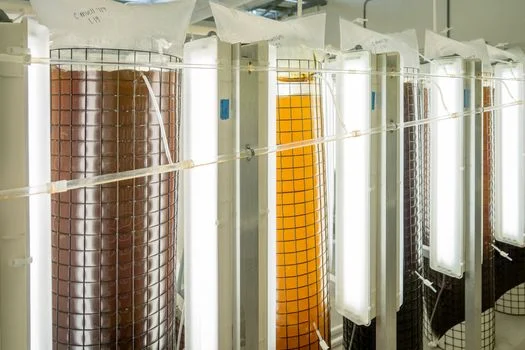
Designing a Membrane Bioreactor for photoresist streams requires a radical departure from municipal MBR design. Because the organic load is 10 to 20 times higher, the Hydraulic Retention Time (HRT) and Sludge Retention Time (SRT) must be extended to ensure complete biodegradation of complex solvents. For a standard photoresist stream, an HRT of 8–12 hours is required, compared to the 4–6 hours used in municipal settings. The SRT is typically maintained between 20–30 days to cultivate a specialized biomass capable of degrading refractory organics.
The operational Mixed Liquor Suspended Solids (MLSS) for photoresist treatment is set high, between 8,000 and 12,000 mg/L. This high biomass concentration allows HydropureWater’s integrated MBR system for photoresist wastewater to absorb shock loads of toxic solvents without compromising effluent quality. To maintain membrane performance, PVDF flat-sheet membranes are preferred over hollow fiber variants due to their superior resistance to fouling by high-molecular-weight polymers. The design flux for these systems is typically 15–25 Liters per Square Meter per Hour (LMH).
Aeration plays a dual role in photoresist MBRs: providing oxygen for the high COD demand and scouring the membrane surface to prevent polymer accumulation. Aeration rates are typically 0.2–0.4 m³/m²·min for membrane scouring, while biological oxygen demand requires 1.0–1.5 kg O₂ per kg of COD removed. To optimize energy, engineers often implement dissolved oxygen (DO) cascading controls. The target effluent quality must meet stringent regional standards, such as the Taiwan EPA limit of <50 mg/L COD and <10 mg/L TSS. In many jurisdictions, including the US and EU, MBR is considered the Best Available Technology (BAT) for achieving these targets.
| Process Parameter | Design Value (Photoresist Focus) | Compliance Basis (Reference) |
|---|---|---|
| Membrane Flux | 15 – 25 LMH | Operational Stability (PVDF) |
| HRT (Hydraulic Retention Time) | 8 – 12 Hours | Solvent Biodegradation (TMAH/PGMEA) |
| SRT (Sludge Retention Time) | 20 – 30 Days | Biomass Specialization |
| MLSS Concentration | 8,000 – 12,000 mg/L | High Organic Loading Buffer |
| Aeration Scouring Rate | 0.2 – 0.4 m³/m²·min | Membrane Surface Cleaning |
| Effluent COD | < 50 mg/L | Taiwan EPA / China GB 31570 |
Membrane Fouling in Photoresist Wastewater: Causes, Detection, and Mitigation Strategies
Membrane fouling is the primary operational hurdle in treating photoresist wastewater. Foulants in this sector are categorized into three classes: organic, inorganic, and biological. Organic foulants consist of unreacted photoresist polymers and solvent residues that form a sticky gel layer on the membrane surface. Inorganic foulants are primarily silica and metal hydroxides that precipitate within the membrane pores. Biofoulants result from the Extracellular Polymeric Substances (EPS) produced by the bacteria as they metabolize complex organics.
Detection of fouling relies on monitoring Transmembrane Pressure (TMP). A TMP exceeding 30 kPa or a flux decline of more than 20% within a 24-hour period indicates significant cake layer formation or pore clogging. Visual inspection of DF series PVDF flat-sheet membranes for photoresist streams often reveals a translucent gel layer during peak organic loading events. To mitigate this, a multi-stage strategy is required. Pre-treatment using catalytic ozonation can remove up to 95% of solvent residues before they reach the MBR, significantly reducing the organic load on the membranes.
For inorganic silica fouling, coagulation with polyaluminum chloride (PAC) during the pre-treatment phase can achieve 90% silica removal. To combat biofouling, advanced techniques like quorum quenching—dosing specific enzymes to disrupt bacterial communication—are increasingly used to prevent EPS formation. Cleaning protocols must be more aggressive than those used in municipal systems. Maintenance cleaning (backpulsing or chemically enhanced backwash) should occur weekly using a solution of 0.5% NaOH and 500 ppm NaOCl for two hours. Physical cleaning through intensified air scouring at 0.5 m³/m²·min for 30 minutes is also vital to disrupt the cake layer.
Engineers should also consider the role of ultrafiltration for silica removal in semiconductor wastewater as a primary pre-treatment step to protect the downstream MBR from abrasive wear. By integrating these mitigation strategies, facilities can maintain stable flux rates even when treating the most challenging photoresist formulations.
MBR vs. Conventional Treatment for Photoresist Wastewater: Performance, Cost, and Compliance Comparison

When evaluating wastewater technologies for semiconductor fabs, the decision matrix usually balances removal efficiency, footprint, and total cost of ownership. Conventional treatment trains, such as DAF followed by CAS, often struggle to meet the COD limits required for direct discharge or water reclamation. While DAF is excellent for removing suspended solids, its ability to remove dissolved COD from photoresist solvents is limited to approximately 70–85%. In contrast, MBR systems consistently achieve >99% COD removal by decoupling HRT and SRT, allowing the biology to fully oxidize complex molecules.
Footprint is a critical constraint in semiconductor manufacturing. MBR systems are typically 60% smaller than CAS systems because they eliminate the need for large secondary clarifiers. This allows fabs to expand production capacity without requiring additional land for wastewater infrastructure. From a compliance perspective, MBR provides a much higher "safety margin." If an influent spike occurs, the membrane acts as a physical barrier, ensuring that TSS and associated COD never exit the system—a level of reliability that DAF-based systems cannot match.
The CapEx for a 50 m³/day MBR system ranges from $250,000 to $400,000, which is higher than the $150,000 to $250,000 required for a DAF + CAS setup. However, the OpEx for MBR is often 20–30% lower. This savings is driven by the reduced need for chemical coagulants and the elimination of polymer costs for sludge thickening. For facilities requiring high-purity pre-treatment, DAF for pre-treatment of photoresist wastewater can be used in tandem with MBR to further reduce membrane cleaning frequency.
| Feature | MBR System | DAF + Biological (CAS) | Coagulation + Sedimentation |
|---|---|---|---|
| COD Removal | 99%+ | 80 – 85% | 60 – 70% |
| TSS Effluent | < 5 mg/L | 20 – 40 mg/L | 30 – 50 mg/L |
| Footprint | Minimal (Integrated) | Large (Clarifiers needed) | Moderate |
| Compliance Risk | Very Low | High (during spikes) | Very High |
| OpEx (Relative) | Low (Reduced Chemicals) | High (Chemical intensive) | Medium |