Flocculant dosing unit troubleshooting starts with diagnosing symptoms like cloudy effluent or pump underperformance. Common fixes include clearing suction line blockages (reported in 68% of TNW Co. cases), recalibrating metering pumps to maintain 0.5–5 ppm dosage accuracy, and eliminating air ingress at inlet connections—reducing downtime by up to 55% when addressed proactively. For the industrial engineer, an offline dosing system is more than a mechanical failure; it is a risk to discharge compliance and a catalyst for skyrocketing operational costs.
Why Flocculant Dosing Units Fail: Root Causes and System Impact
Mechanical failures account for 60% of dosing unit stoppages, often stemming from the abrasive or viscous nature of concentrated polymer solutions (HydropureWater field data, 2025). When a dosing unit fails to deliver the precise chemical volume required, the impact ripples through the entire wastewater treatment plant. Chemical over-dosing is a frequent consequence of poor calibration, which can increase sludge volume by 30–50%. This unnecessary solids load significantly raises disposal costs and can blind filter press cloths, leading to further mechanical strain.
Air entrainment is another primary driver of system inefficiency, capable of reducing pump efficiency by up to 40% due to cavitation and inconsistent flow. Because polymer is highly viscous, air bubbles trapped in the suction line or pump head prevent the diaphragm or piston from displacing the correct volume of liquid. This results in "ghost dosing," where the pump appears to be running, but no active chemical is reaching the process stream.
The chemistry of the flocculant itself often contributes to operational faults. Proper polymer hydration requires a maturation time of 30–60 minutes. If the dosing unit’s preparation tank is undersized or the mixer fails, "fish eyes" (undissolved polymer globules) form. These globules are the leading cause of internal pump blockages and fouled injection nozzles. Temperature fluctuations in the storage area can alter the viscosity of the flocculant, meaning a pump setting that worked at 25°C may result in a 15% dosage drop if the temperature falls to 10°C without recalibration.
Symptom-Based Troubleshooting Guide for Field Technicians
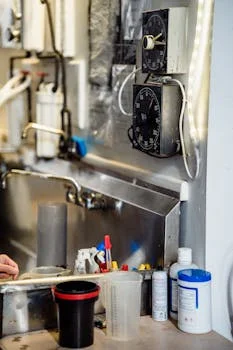
Rapid diagnosis in the field requires matching visual or sensory symptoms to mechanical realities. When an engineer observes cloudy water or poor floc formation in the clarifier, the first step is to verify the dosage rate against influent turbidity. For water with a turbidity of less than 100 NTU, the target dosage should typically remain between 0.5–3 ppm. If the pump is stroke-calibrated but the water remains untreated, the issue likely lies in the chemical concentration or the age of the prepared batch.
If the dosing pump is running but not dispensing, technicians must verify suction line integrity. Even a microscopic air leak at a threaded connection can break the vacuum required for the pump to prime. This is especially common in systems utilizing a data-driven chemical dosing system troubleshooting guide to identify recurring air-lock issues. When chemical consumption becomes excessive, engineers should inspect the metering pump stroke length; while standard operational ranges are 20–100%, running a pump at less than 20% stroke often leads to poor repeatability and over-dosing.
Pulsating discharge or "hammering" in the lines usually indicates a failure in the one-way valve seat. In hard water areas, calcium carbonate buildup on the valve ball prevents a clean seal, allowing backflow. The following diagnostic matrix provides a systematic framework for these common field observations:
| Observed Symptom | Probable Root Cause | Diagnostic Threshold / Action |
|---|---|---|
| Cloudy effluent / Small flocs | Under-dosing or poor hydration | Check dosage (target 0.5–5 ppm); verify 30-60 min mix time. |
| Pump running, zero flow | Air lock or suction blockage | Check for bubbles in suction line; inspect 100-micron strainer. |
| Rapid chemical depletion | Over-calibration / Stroke error | Verify stroke length is within 20–100% range; recalibrate. |
| Erratic discharge pressure | One-way valve fouling | Clean valve ball and seat; check for mineral scaling. |
| Excessive pump vibration | Cavitation / High viscosity | Increase suction pipe diameter or reduce stroke speed. |
For more complex issues involving multi-stage systems, refer to our data-driven chemical dosing system troubleshooting guide to isolate electrical faults from hydraulic failures.
Mechanical Faults and How to Fix Them
Suction line blockages are the single most common mechanical fault in flocculant preparation. To resolve a blockage, the line should be flushed with warm water (approximately 40°C), which helps dissolve concentrated polymer buildup more effectively than cold water. To prevent recurrence, technicians should install a 100-micron pre-filter on the suction side, ensuring it is positioned for easy weekly cleaning. If the blockage persists, check the foot valve at the bottom of the tank, as sediment often accumulates at the lowest point of the suction assembly.
Air in the pump head, often called an air lock, is the primary reason for a loss of prime. The standard procedure for diaphragm pumps involves loosening the vent screw on the pump head while the unit is running. Allow the pump to cycle until a steady stream of liquid—free of bubbles—is discharged from the vent, then reseal the screw. If the system is a PLC-controlled automatic chemical dosing system, ensure the low-level alarm is functioning, as allowing the tank to run dry is the leading cause of air ingress.
Leaking packing or seals can lead to chemical waste and environmental hazards. In many industrial dosing pumps, a slight weepage is necessary for lubrication, but if the leakage exceeds 10 drops per minute, the gland nut must be tightened incrementally. If tightening does not stop the leak, the seal is likely scored by undissolved polymer particles and must be replaced. Similarly, one-way valve failure requires the disassembly of the valve housing. If the ball or seat shows signs of pitting or "wire-drawing" (small grooves cut by high-velocity liquid), cleaning will not suffice; the components must be replaced to restore a 100% seal.
When performing these repairs on a PLC-controlled automatic chemical dosing system, always isolate the power and relieve system pressure before opening any pressurized lines or valve housings.
Optimizing Dosage: Calibration, Control, and Feedback Loops
Calibrating a dosing pump monthly using the gravimetric method is the only way to ensure the system maintains ±5% accuracy of the setpoint. To perform this, collect the pump's output in a graduated cylinder or on a scale for exactly one minute, then calculate the flow rate based on the specific gravity of the flocculant. This manual verification accounts for pump wear and changes in liquid viscosity that digital displays may overlook.
To move from reactive troubleshooting to proactive optimization, engineers should integrate online turbidity sensors with a 0–1000 NTU range. By establishing a feedback loop—where the sensor sends data to the PLC, which then adjusts the variable frequency drive (VFD) on the pump—the system can automatically react to influent spikes. This reduces the reliance on manual intervention and ensures that proven fixes for inaccurate coagulant dosing are applied in real-time. For example, if influent turbidity increases by 20%, the VFD can instantly increase the pump stroke speed to maintain the required ppm ratio.
Targeting dosage accuracy within ±5% of the setpoint under normal load fluctuations is the industry benchmark for high-performance systems. Implementing these proven fixes for inaccurate coagulant dosing can be found in our detailed guide on proven fixes for inaccurate coagulant dosing, which covers the nuances of sensor calibration and PID loop tuning.
Preventive Maintenance Schedule and Performance Benchmarks
A rigorous preventive maintenance (PM) schedule is the most effective way to prevent unplanned downtime in wastewater treatment. Inspecting filters and strainers weekly is recommended per HydropureWater system guidelines to ensure that no debris reaches the high-precision pump internals. On a monthly basis, engineers must verify the solution concentration; the standard for most industrial polymers is 0.1–0.5% polymer weight/volume. If the concentration deviates by more than 10%, it indicates a failure in the dry feeder or the water inlet solenoid.
Mechanical wear parts, specifically seals and valves, should be replaced every 6 months or after 2,000 operating hours, whichever comes first. This proactive replacement prevents the catastrophic loss of prime that occurs when a diaphragm finally ruptures or a valve seat fails. Recording all dosing logs is essential; if a system requires a 15% increase in pump speed to achieve the same water quality over a three-month period, it is a clear indicator of pump wear or a change in raw chemical quality.
| Frequency | Task Description | Performance Benchmark |
|---|---|---|
| Weekly | Clean suction strainers and injection nozzles | Zero visible debris; no pressure drop |
| Monthly | Gravimetric pump calibration | ±5% accuracy of PLC setpoint |
| Monthly | Verify solution concentration (wt/vol) | 0.1% to 0.5% range |
| 6 Months | Replace diaphragm, O-rings, and check valves | Preventive (before failure) |
| Annually | Full system pressure test and PLC logic check | Hold 5 bar for 10 mins; no alarms |
Frequently Asked Questions
What causes a flocculant dosing pump to lose prime?
The most common causes are air leaks in the suction line connections or the solution level in the tank falling below the foot valve. Viscous polymer can also cause the check valves to stick in the open position.How often should I calibrate my chemical dosing pump?
For critical industrial applications where discharge compliance is at risk, monthly calibration is required. For standard, stable processes, quarterly calibration is usually sufficient.Can the wrong flocculant type cause dosing unit failure?
Yes. Using a polymer with a higher molecular weight than the system was designed for can lead to undissolved "fish eyes," which clog the 100-micron strainers and damage pump diaphragms.What is the ideal flocculant dosage for industrial wastewater?
While it varies by application, the typical range is 0.5–5 ppm. The exact dosage must be determined via a jar test and verified by real-time turbidity monitoring.How do I know if my dosing system is under-dosing?
The primary signs are poor settling in the clarifier, a "pin-floc" appearance, and high Total Suspended Solids (TSS) in the effluent, typically exceeding 30 mg/L.