Silicon Carbide Wastewater: The Compliance Challenge in Semiconductor Manufacturing
A semiconductor manufacturing facility in Jiangsu, China, incurred over $1.2 million in annual environmental fines before upgrading to a silicon carbide wastewater treatment system to meet GB8978-2025 discharge limits. The facility struggled with suspended solids (TSS) concentrations that consistently exceeded the 50 mg/L target, often spiking to 150 mg/L during peak production cycles. Conventional sedimentation tanks and polymer-based dosing systems failed to capture submicron silicon carbide particles, which typically range from 0.1 to 10 µm in size. These abrasive particles not only bypassed primary treatment but also caused catastrophic mechanical wear and fouling in downstream reverse osmosis (RO) systems, increasing maintenance costs by 200%.
Silicon carbide wastewater is uniquely difficult to treat because it contains high concentrations of abrasive SiC particles, organic binders, and heavy metals such as Copper (Cu), Nickel (Ni), and Chromium (Cr). The particles exhibit high hardness (9.5 on the Mohs scale) and are often chemically stable, resisting standard oxidation processes. China's GB8978-2025 sets strict TSS and COD limits, while the EU Industrial Emissions Directive 2010/75/EU and the US EPA Effluent Guidelines (40 CFR Part 469) require similar stringent controls for semiconductor and electronic component manufacturing effluent. Failure to manage these contaminants leads to rapid equipment degradation and legal non-compliance.
The core issue with traditional treatment is the Brownian motion of submicron SiC particles. In standard clarifiers, these particles remain suspended indefinitely or settle too slowly for industrial flow rates. Organic binders used in the wafer-cutting process contribute to high Chemical Oxygen Demand (COD) levels that interfere with traditional flocculation. To address these challenges, engineers are shifting toward a hybrid approach that integrates advanced semiconductor wastewater treatment solutions with robust ceramic filtration technologies.
How Silicon Carbide Ceramic Membranes Work: Engineering Specs & Separation Mechanisms
Silicon carbide ceramic membranes operate at flux rates of 120–180 LMH, approximately 2 to 3 times higher than conventional PVDF polymeric membranes in high-solids industrial applications. This high flux results from the material's inherent hydrophilicity and high porosity. Unlike polymeric membranes that suffer from pore narrowing and surface fouling in the presence of abrasive solids, SiC membranes maintain a stable permeate flow due to their extreme mechanical hardness and chemical resistance. The pore size of SiC membranes, typically ranging from 0.04 to 0.1 µm, ensures that 99% of TSS is removed through size exclusion.
The separation mechanism utilizes cross-flow filtration combined with intensive air scouring. In this configuration, the wastewater flows parallel to the membrane surface at high velocities, creating shear forces that prevent the accumulation of a filter cake. An integrated aeration rate of 0.5–1.0 Nm³/m²/h provides continuous scouring, keeping the membrane surface clean and extending the interval between chemical clean-in-place (CIP) cycles. SiC membranes are compatible with a pH range of 0–14 and can withstand temperatures up to 800°C.
| Parameter | SiC Ceramic Membrane | Polymeric (PVDF) Membrane | Alumina (Al₂O₃) Membrane |
|---|---|---|---|
| Pore Size (µm) | 0.04 – 0.1 | 0.1 – 0.4 | 0.1 – 0.2 |
| Design Flux (LMH) | 120 – 180 | 40 – 80 | 80 – 120 |
| pH Resistance | 0 – 14 | 2 – 11 | 2 – 12 |
| Max Temperature (°C) | 800 | 45 | 500 |
| Service Life (Years) | 8 – 10 | 3 – 5 | 6 – 8 |
When compared to other ceramic materials like Alumina (Al₂O₃) or Zirconia (ZrO₂), SiC offers superior thermal conductivity and lower transmembrane pressure (TMP). This efficiency allows for a smaller equipment footprint—often 50% less than polymeric systems—making a SiC-compatible MBR system for semiconductor wastewater ideal for retrofitting existing facilities with space constraints.
Hybrid System Design: Combining SiC Membranes with DAF and Chemical Dosing for ZLD
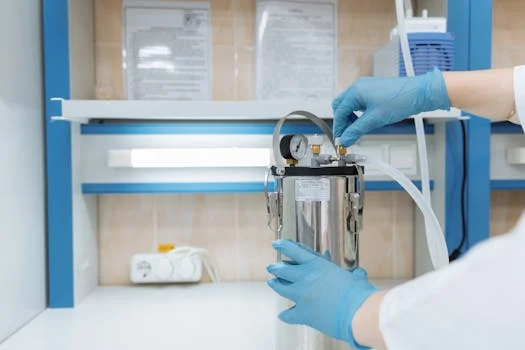
A hybrid wastewater treatment architecture combining dissolved air flotation (DAF) with SiC membrane bioreactors (MBR) achieves a 70% reduction in downstream reverse osmosis (RO) membrane fouling rates. This multi-stage process is essential for achieving Zero Liquid Discharge (ZLD) compliance in silicon carbide manufacturing. The process begins with a high-efficiency DAF system for SiC particle removal, which targets the bulk of the free-floating solids and emulsified oils. By introducing micro-bubbles, the DAF unit lifts 85–90% of the suspended SiC particles to the surface for mechanical skimming.
The second stage involves a PLC-controlled chemical dosing for SiC membrane pretreatment. Automatic sensors monitor influent turbidity and pH, adjusting the delivery of coagulants (Polyaluminum Chloride, PAC) at 50–100 mg/L and flocculants (Polyacrylamide, PAM) at 1–3 mg/L. This step aggregates submicron particles into larger flocs that are more easily managed by the SiC MBR. The SiC membrane then acts as a final polishing barrier, ensuring the permeate has a Silt Density Index (SDI) of less than 3, which is the requirement for stable RO operation.
| Treatment Stage | Equipment Type | Key Function | Efficiency Metric |
|---|---|---|---|
| Primary Removal | DAF | Removal of 0.5-10µm particles | 85% TSS Reduction |
| Pretreatment | Auto Dosing Unit | Flocculation of submicron solids | Aggregated Floc Size >20µm |
| Secondary Filtration | SiC MBR System | Submicron barrier & COD reduction | 99.9% TSS Removal |
| ZLD Polishing | Reverse Osmosis (RO) | Desalination for water reuse | 95% Water Recovery |
The role of the PLC in this hybrid design cannot be overstated. By automating the aeration rates and backwash frequencies based on real-time TMP data, the system reduces energy consumption by 30% compared to manually operated external cross-flow systems.
Case Study Results: 99% TSS Removal and 40% Sludge Reduction
Silicon carbide membrane systems demonstrate significant improvements in wastewater treatment performance.Field data from 2025 implementations shows that SiC membrane systems achieve 99.9% removal of suspended silicon carbide particles, reducing effluent TSS from 1,500 mg/L to less than 1 mg/L. In the Jiangsu semiconductor case study, the influent COD of 800 mg/L was reduced to less than 40 mg/L, representing a 95% reduction. This level of performance is critical for facilities that must discharge into sensitive municipal sewers or seek to reuse water within their cooling towers and process lines.
One of the most significant economic benefits observed was a 40% reduction in sludge volume compared to conventional activated sludge processes. Because the SiC MBR operates at a higher Mixed Liquor Suspended Solids (MLSS) concentration (up to 15,000 mg/L), the sludge is more concentrated and requires less frequent dewatering. This translated to a direct saving of $45,000 per year in sludge disposal and transport costs for the facility.
Energy consumption for the integrated system was recorded at 0.6 kWh/m³, which is significantly lower than the 1.2 kWh/m³ typically required by external cross-flow polymeric systems.
Cost Breakdown: CAPEX, OPEX, and ROI for SiC Membrane Systems
The total cost of ownership for a 200 m³/day silicon carbide wastewater treatment system averages $0.22/m³ in operational expenses, providing a 3.2-year return on investment (ROI). While the initial capital expenditure (CAPEX) for a SiC-based system is approximately 20% higher than a polymeric MBR system, the long-term savings in maintenance and membrane replacement create a much more favorable financial profile.
| Cost Category | SiC Hybrid System (per m³) | Polymeric MBR (per m³) | Conventional AS (per m³) |
|---|---|---|---|
| Energy Consumption | $0.10 | $0.14 | $0.08 |
| Chemical Dosing | $0.05 | $0.07 | $0.12 |
| Maintenance/Replacement | $0.07 | $0.18 | $0.15 |
| Total OPEX | $0.22 | $0.39 | $0.35 |
| ROI Period | 3.2 Years | 4.8 Years | 5.5 Years |
The financial justification for SiC membranes is reinforced when considering the avoidance of environmental fines and the value of recovered water.
Decision Framework: When to Choose SiC Membranes Over Polymeric or Conventional Systems
Choosing the right technology depends on wastewater characteristics, regulatory requirements, and long-term budget cycles.Industrial facilities processing abrasive solids or operating at pH levels outside the 4–9 range require SiC ceramic membranes to avoid rapid mechanical degradation typical of polymeric fibers. A MBR vs. conventional activated sludge comparison reveals that while conventional systems are cheaper upfront, they cannot consistently meet the sub-1 mg/L TSS limits required for ZLD or high-tech manufacturing.
Engineers should use the following decision framework to evaluate SiC feasibility:
- Choose SiC Membranes if: TSS exceeds 500 mg/L, the wastewater contains abrasive particles (SiC, Al₂O₃, sand), or the process involves extreme pH (pH <3 or >11).
- Choose Polymeric MBR if: The wastewater is primarily organic with low TSS (<100 mg/L), the budget for CAPEX is strictly limited to under $1M, and the water is non-abrasive.
- Choose Conventional Systems if: Discharge limits are lenient (TSS >100 mg/L), space is not a constraint, and the facility lacks technical staff to manage advanced filtration systems.