Vietnam industrial effluent limits: what changed on 1 Sept 2025?
Vietnam industrial effluent limits under QCVN 40:2025/BTNMT took effect on 1 September 2025 via Circular 06/2025/TT-BTNMT. Table 1 sets zone A/B/C caps by flow F. For F > 2,000 m³/day, Column A allows COD ≤60 mg/L, BOD₅ ≤30 mg/L and TSS ≤30 mg/L. Existing plants may keep prior rules until 31 December 2031; new projects use the 2025 tables now.
Earlier plant memos often cited a single COD target of 80 mg/L, BOD of 30 mg/L and color of 50 Pt-Co. Those figures remain useful planning shorthand, but they are not the full legal matrix. A 100 m³/h textile plant can still hit Column A bands with MBR plus activated carbon at about 0.34 USD/m³ OPEX and 1.1 M USD CAPEX in typical Bac Ninh designs. Where the receiving-water zone is not yet classified, Column B applies by default under Circular 06/2025/TT-BTNMT.
According to VnEconomy (2025), facilities already operating—or projects with EIA approval, environmental permit or registration before 1 September 2025—may keep applying their prior national wastewater regulations until 31 December 2031. The Law on Environmental Protection (LEP) 2020 still frames commercial risk: earlier compliance notes used a 2× environmental-fee multiplier for persistent exceedances. For a medium plant discharging 2,400 m³/day, a persistent 10% COD exceedance was estimated to push monthly fees above 15,000 USD, with a possible 3-month remediation shutdown. The table below keeps those earlier single-number planning values beside the older Class A reference set.
| Parameter | TCVN 5945:2010 (Class A) | QCVN 40:2025 (New Limit) | % Reduction |
|---|---|---|---|
| Chemical Oxygen Demand (COD) | 100 mg/L | 80 mg/L | 20% |
| Biochemical Oxygen Demand (BOD₅) | 50 mg/L | 30 mg/L | 40% |
| Total Suspended Solids (TSS) | 100 mg/L | 50 mg/L | 50% |
| Ammonium (NH₄⁺ as N) | 5 mg/L (variable) | 10 mg/L (fixed) | Tighter controls |
| Color (Pt-Co) | 100 | 50 | 50% |
Treat the 80 / 30 / 50 mg/L row above as earlier design shorthand. For F > 2,000 m³/day, Column A sets COD ≤60 mg/L, BOD₅ ≤30 mg/L and TSS ≤30 mg/L. For F ≤ 2,000 m³/day, Column A sets COD ≤65 mg/L, BOD₅ ≤40 mg/L and TSS ≤40 mg/L (QCVN 40:2025/BTNMT).
Parameter table: 2025 vs 2010 side-by-side
Parameter comparison tables must state both the numeric cap and the TCVN test method used on the permit. Non-standard methods still cause DONRE rejections on renewals we support. Earlier guidance compared a single “new limit” column with TCVN 5945:2010 Class A. Keep those planning numbers below for continuity, then size the plant to the official A/B/C and flow bands.
| Parameter | Unit | TCVN 5945:2010 | QCVN 40:2025 | Test Method (TCVN) |
|---|---|---|---|---|
| Temperature | °C | 40 | 40 | TCVN 4557:1988 |
| pH Value | - | 6 to 9 | 6 to 9 | TCVN 6492:2011 |
| BOD₅ (20°C) | mg/L | 50 | 30 | TCVN 6001-1:2008 |
| COD | mg/L | 100 | 80 | TCVN 6491:1999 |
| TSS | mg/L | 100 | 50 | TCVN 6625:2000 |
| Arsenic | mg/L | 0.1 | 0.05 | TCVN 6626:2000 |
| Mercury | mg/L | 0.01 | 0.005 | TCVN 7877:2008 |
| Color | Pt-Co | 100 | 50 | TCVN 6185:2015 |
Note: Sampling frequency requires a daily flow-proportional composite for COD/BOD and weekly grab samples for heavy metals (per Circular 10/2021/TT-BTNMT).
| Parameter | Unit | Column A (QCVN 40:2025) | Column B | Column C | Condition |
|---|---|---|---|---|---|
| BOD₅ (20°C) | mg/L | ≤30 | ≤50 | ≤60 | F > 2,000 m³/day |
| COD | mg/L | ≤60 | ≤70 | ≤90 | F > 2,000 m³/day |
| TSS | mg/L | ≤30 | ≤60 | ≤80 | F > 2,000 m³/day |
| Color | Pt/Co | ≤50 | ≤100 | ≤150 | All flows (Table 2) |
| Ammonium (as N) | mg/L | ≤5.0 | ≤10 | ≤12 | All flows (Table 2) |
| Arsenic | mg/L | ≤0.05 | ≤0.25 | ≤0.25 | All flows (Table 2) |
| Mercury | mg/L | ≤0.001 | ≤0.005 | ≤0.005 | All flows (Table 2) |
Earlier guidance used COD 80 mg/L and mercury 0.005 mg/L as single “new” targets. The 2025 regulation sets COD ≤60 mg/L for F > 2,000 m³/day Column A, and mercury ≤0.001 mg/L in Column A (QCVN 40:2025/BTNMT, Tables 1–2).
What does QCVN 40:2025/BTNMT require?
QCVN 40:2025/BTNMT requires industrial dischargers to keep every controlled parameter at or below the maximum values in Tables 1 and 2 for the assigned receiving-water column and flow band. The regulation covers industrial effluent discharged to receiving waters. It does not cover offshore oil and gas produced water, livestock effluent, or domestic/municipal wastewater (Circular 06/2025/TT-BTNMT; VnEconomy, 2025). TOC may replace COD where the permit allows that choice.
Most plants we size for Bac Ninh industrial parks run at the lower end of the F > 2,000 m³/day band once dyeing or food lines expand. Permit files must list pH, total coliform, Table 1 organics/solids, and the characteristic Table 2 parameters for the sector. Cooling water is limited mainly on temperature plus residual chlorine and chloroform when chlorine disinfection is used.
Which industries are classified high-risk?
Decree 08/2022/ND-CP identifies 16 industrial sectors as high risk for environmental pollution, with stricter oversight and mandatory automated monitoring. If your site is on that list, discharge-permit renewal still hinges on proving the WWTP can hold organics inside the applicable QCVN 40:2025 column. Factories inside a Bac Ninh industrial zone that send water to a CETP remain responsible for pre-treatment so the CETP can meet its final outfall duty.
The high-risk list includes:
- Textile Dyeing: Specifically fabric and yarn dyeing, washing, and grinding operations.
- Food & Beverage: Seafood processing, tapioca starch production, sugar cane processing, and rubber latex.
- Chemicals: Production of chemical fertilizers, plant protection drugs, and basic chemicals.
- Heavy Industry: Metallurgical processing, mining, tanning, and oil refining.
- Pulp and Paper: Production of paper, pulp, and fiberboard (MDF/HDF).
For these sectors, online monitoring stations are usually a permit condition, not an optional upgrade. Failure to follow the full step-by-step compliance checklist before enforcement checkpoints can put the environmental license at risk of revocation.
Proven treatment trains to hit the new limits
COD below 60–80 mg/L on high-strength textile or food wastewater needs tertiary polishing or membrane biology. Conventional activated sludge often drifts above 100 mg/L COD on peak shifts. Engineers therefore add intensified biology or a polishing stage. Textile lines should put a DAF unit for pre-treatment of fibers and oils ahead of membranes to cut fouling.
| Treatment Train | Best For | Expected COD | Expected Color | Power Demand |
|---|---|---|---|---|
| Option A: DAF + MBR + UV | Textile, Food, Pharma | < 75 mg/L | < 40 Pt-Co | 0.9 kWh/m³ |
| Option B: CAS + Cloth Filter + PAC | General Manufacturing | < 65 mg/L | < 35 Pt-Co | 0.6 kWh/m³ |
| Option C: EGSB + MBBR + AC | Starch, Seafood, Beer | < 55 mg/L | < 30 Pt-Co | 1.2 kWh/m³ (net) |
Option A uses a package MBR that holds <80 mg/L COD by replacing secondary clarifiers with ultrafiltration membranes. That removes TSS-linked COD carryover and supports higher MLSS for harder organics. Option B is the usual retrofit path: powdered activated carbon plus cloth-media filtration on an existing CAS train. Option C suits high-load organics, with an EGSB recovering biogas that offsets aeration power. For process selection detail, see the head-to-head comparison of MBR and SBR for the same limits.
Selection checklist before you freeze the P&ID
- Confirm receiving-water column (A/B/C) and whether F is above or below 2,000 m³/day.
- List sector-specific Table 2 parameters that will appear on the permit.
- Decide COD versus TOC for continuous monitoring hardware.
- Size color removal for ≤50 Pt/Co if Column A applies.
- Budget membrane CIP and a 5-year replacement fund if MBR is selected.
- Verify CETP inlet specs if you discharge to an industrial-zone sewer.
- Map the 2031 transition date against your next permit renewal.
CAPEX and OPEX for a 100 m³/h plant
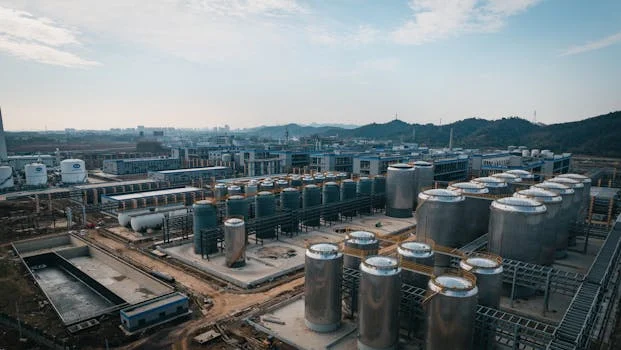
CAPEX for a 100 m³/h industrial WWTP built to the tighter 2025 bands typically falls between 0.9 million and 1.3 million USD. Material choice drives most of that spread—304 stainless steel versus epoxy-coated carbon steel for MBR tankage. Foreign-invested Bac Ninh plants often accept the roughly 15% stainless premium for a 20-year wet-side life.
OPEX is what boards challenge first. Based on HydropureWater field data (2025), a compliant train averages 0.28–0.34 USD per cubic meter treated:
- Power: 0.08 - 0.12 USD/m³ (Aeration and membrane scouring).
- Chemicals: 0.06 - 0.09 USD/m³ (Coagulants, pH adjustment, and membrane CIP).
- Maintenance: 0.05 - 0.07 USD/m³ (Including a 5-year membrane replacement fund).
- Sludge Disposal: 0.09 - 0.11 USD/m³ (Assuming dewatering to 20% dry solids).
Payback on a high-efficiency rebuild is typically 1.8–2.5 years when the 2× penalty tariff and mass-based environmental protection fee (EPF) are included. Cutting COD from 100 mg/L to 60 mg/L at 100 m³/h still reduces annual EPF liability by about 22,000 USD in the earlier fee model used for board memos.
How should treatment, monitoring and compliance limits align?
Treatment, monitoring and compliance limits must share one design basis: the column, flow band and parameter list written into the environmental permit. Under LEP 2020, facilities with discharge capacity above 200 m³/day must install automated continuous monitoring linked to the provincial DONRE. The station typically reports flow, temperature, pH, TSS, COD (or TOC) and other permit-listed parameters at the intervals set in the permit and related circulars.
Lab methods should follow Appendix 1 of QCVN 40:2025/BTNMT—for example TCVN 6001-1:2008 for BOD₅ and TCVN 6491:1999 for COD—or an accepted SMEWW/ISO alternative listed there. Automatic continuous results may be used where law allows. If domestic or livestock streams mix with industrial effluent, the combined stream is managed as industrial effluent under this regulation.
Who this is for / Next step
This page is for EHS managers, plant engineers and EPC teams sizing or retrofitting industrial WWTPs in Vietnam, especially textile, food, chemical and pulp sites facing QCVN 40:2025 columns A or B. Teams discharging only domestic sewage to a municipal works, or livestock farms under separate rules, should look elsewhere. If you need a train sized to your column, flow and sector parameter list, send the permit limits through our request-quote form for article 271 and we will return a CAPEX/OPEX sketch.
Frequently Asked Questions
When did QCVN 40:2025/BTNMT take effect?
QCVN 40:2025/BTNMT took effect on 1 September 2025 under Circular 06/2025/TT-BTNMT dated 28 February 2025. New projects filed after that date must apply the new tables immediately. Existing facilities with prior EIA approval, permit or registration may continue under their previous wastewater regulations until 31 December 2031, according to VnEconomy reporting on the circular’s transition rules.
What COD limit applies under QCVN 40:2025 Column A?
Column A COD is ≤60 mg/L when discharge flow F exceeds 2,000 m³/day, and ≤65 mg/L when F is at or below 2,000 m³/day. Earlier planning sheets often used a single 80 mg/L COD target. Design to the official Table 1 band for your flow, and confirm whether TOC is accepted instead of COD on the permit.
Do existing factories need to upgrade by September 2025?
Not necessarily on day one. Plants already operating, or projects approved before 1 September 2025, may keep prior national wastewater regulations until 31 December 2031. New capacity and post-effective-date filings must meet QCVN 40:2025/BTNMT now. Most operators still start upgrade engineering early because permit renewals and CETP contracts can pull the new limits forward.
What color and ammonium limits should textile plants target?
Table 2 sets color at ≤50 Pt/Co in Column A, ≤100 in Column B and ≤150 in Column C. Ammonium as N is ≤5.0 mg/L in Column A, ≤10 mg/L in Column B and ≤12 mg/L in Column C. Dye houses on Column A receiving waters therefore need reliable decolorization plus nitrification control, not only BOD/COD removal.
Which treatment train is most common for 100 m³/h textile effluent?
DAF + MBR + UV is the train most plants we size at 100 m³/h select when Column A organics and color both apply. Expected performance is under 75 mg/L COD and under 40 Pt-Co at about 0.9 kWh/m³. CAS with cloth filtration and PAC remains the lower-power retrofit when tankage already exists and peak loads are mild.