The step screen wastewater manufacturer cost for a stainless escalator fine screen is usually quoted as $15,000–$120,000 CAPEX by channel width and alloy. Units in this guide are rated for about 50–12 000 m³/h at 1–6 mm aperture and capture about 95% of 3 mm solids under clean-channel test conditions. OPEX for a ~1 kW drive is often about $1,200/yr including power and brush sets. Buyers lock those bands before the RFQ, because later alloy and washer changes move the bid.
How step screen wastewater manufacturer cost is quoted
A step screen is usually priced from about $15,000 to $120,000 by channel width and 304 or 316 stainless steel. A 1 m 304 SS unit often starts near $15,000. Tender notes from 2024 put a 2 m 316 SS unit near $35,000 and a 3 m sealed-gearbox 316 SS unit near $65,000.
Typical step screen price in 2025–2026 vendor quotes still clusters at $15,000–$120,000 once washers, sealed gearboxes, and PLC packages are counted. A 1 m 304 SS unit often starts near $15,000. The 2024 Glanua and Huber tender data used here put 2 m 316 SS near $35,000 and 3 m sealed-gearbox 316 SS near $65,000.
What is the step screen capex and opex breakdown?
Step screen CAPEX covers the screen, alloy, washers, sealed gearbox, and PLC, and step screen OPEX is mostly 0.55–1.5 kW of power, brushes, and oil. Motor power is typically 0.55–1.5 kW. At $0.12/kWh, annual power cost is about $300–$600 (HydropureWater field data, 2025). Nylon brush sets cost about $180 and last 18–24 months, and gearbox oil use is about 2 L/yr (~$40), plus occasional sensors.
| Parameter | Specification | 2025 Price Band (CAPEX) | Annual OPEX (Estimate) |
|---|---|---|---|
| Channel Width (1 m), Material (304 SS) | Standard duty, basic controls | ~$15,000 | $400 - $700 |
| Channel Width (2 m), Material (316 SS) | Medium duty, enhanced corrosion resistance | ~$35,000 | $500 - $850 |
| Channel Width (3 m), Material (316 SS) | Heavy duty, sealed gearbox, advanced controls | ~$65,000 | $600 - $1,000 |
| Motor Power (0.55-1.5 kW) | Electricity cost at $0.12/kWh | N/A | $300 - $600 |
| Nylon Brushes | Replacement every 18-24 months | N/A | $90 - $120 (annualized) |
| Gearbox Oil | 2 L/yr replacement | N/A | $40 |
Read the table as installed hardware plus a separate power line. The $400 - $700 band on a 1 m 304 SS unit already sits above power alone because brushes and oil are inside it. Most plants we audit reach the $1,200/yr all-in figure only when the drive runs near 1 kW for most of the year.
What Is a Step Screen in Wastewater Treatment?
A step screen is a fine mechanical screen made of alternating fixed and moving lamella plates that lift screenings up a stepped face and discharge them at the top. Typical openings are 1–6 mm, and many municipal plants specify 3–6 mm for rag and fiber control ahead of pumps, grit systems, or MBR trains. The moving lamellas create a self-cleaning mat of screenings that raises capture of fibrous debris without a separate rake chain.
Treatment Plant Operator (2026) classifies coarse screens as openings greater than 6 mm and fine screens as 2–6 mm. The same authors call 1/2 to 3/4 inch spacing adequate for conventional secondary treatment, and they move membrane plants to a finer second screen. This guide still specs step units at 1–6 mm, including the 1 mm end of the band. Most plants we size for MBR protection sit at 3–6 mm, not at 1 mm, unless hair and fiber are already in the complaint log.
Most plants we size for municipal headworks keep approach velocity near 0.6–1.0 m/s at average flow so grit does not settle upstream and debris is not driven through the slots. Channel width for step units is usually kept at or below about 3 m. Wider channels often shift to multi-rake or rotary bar designs.
According to Lohse and Maguire in Treatment Plant Operator (2026), approach velocity is often held near 1.0–1.5 ft/s to limit grit deposition, while velocity through the screen is targeted near 3 ft/s. The same article says fine-screen headloss should be checked with partial blinding, often up to 50%. TM 5-814-3 caps mechanically cleaned screen approach velocity at 3.0 ft/s at maximum flow, and it caps velocity through the bars at 2.0 ft/s on a clean screen at maximum normal daily flow. TM 5-814-3 also requires the channel ahead of the screen to be straight for 25 feet.
Step Screen vs Rotary Bar Screen: Decision Matrix
Mechanical fine-screen selection turns on aperture, channel width, and debris size. Step screens fit best when aperture is ≤6 mm and the plant needs >95% rag removal at 3 mm to protect downstream pumps and processes (HydropureWater field data, 2025). The stepping action lifts and dewaters fibrous mats and limits blinding on fine slots. A rotary bar screen is usually the better fit when channel width exceeds 3 m and coarse debris >25 mm dominates the load.
Head-loss must be checked against the hydraulic profile. At 1 m/s approach velocity, earlier plant data in this guide used 80–120 mm for step screens and 150–250 mm for rotary bar screens. Industry summaries more often quote 100–200 mm headloss at peak flow for step screens (Water & Wastewater, 2024). Most plants we hydraulically check use the higher of the clean-screen number and a blinded case.
Retrofit notes show some step-screen designs can move from a 6 mm (1/4 in) slot to a 3 mm (1/8 in) slot. Headloss changes only a little when open area stays high (Treatment Plant Operator, 2024). For coarse-to-medium bar screening specs, compare the Rotary Mechanical Bar Screen (GX Series).
Matt Bodwell's Ohio WEA presentation lists step-screen screenings capture ratio near 35% at 6 mm and near 53% at 3 mm, with a 3 mm band of 50–56%. The same deck describes UKWIR National Screen Evaluation Facility runs of two weeks under differential control. That mass ratio is not the 95% of 3 mm solids cited from clean-channel field checks (HydropureWater field data, 2025). Most plants we accept treat the 95% figure as a target and ask which test produced it.
| Feature/Application | Step Screen | Rotary Bar Screen |
|---|---|---|
| Optimal Aperture Range | 1–6 mm (fine screening) | 6–25 mm (coarse to medium screening) |
| Primary Application | High efficiency rag/fiber removal, protecting downstream pumps & processes | High volume coarse debris removal, primary protection for influent pumps |
| Channel Width Suitability | Up to 3 m | Typically >3 m |
| Head-Loss (at 1 m/s approach velocity) | 80–120 mm | 150–250 mm |
| Solids Capture Efficiency (3 mm) | >95% | <90% (for fine solids) |
| Ragging/Blinding Tendency | Low (self-cleaning action) | Moderate (dependent on bar spacing and cleaning mechanism) |
What is the 316 stainless steel step screen price?
A 316 stainless steel step screen price in the tender set used here is about $35,000 at 2 m channel width and about $65,000 at 3 m with a sealed gearbox. The NPV worksheet later adds about $6,000 when a $35,000 304 SS base moves to 316 SS, for a $41,000 CAPEX. 304 SS still suits most municipal channels. 316 SS is the corrosion choice where chlorides attack welds and submerged fasteners, not a default upgrade.
Most plants we spec in coastal or industrial sewers price 316 before they price a thicker 304 frame. A minimum 4 mm frame plate on a 3 m-wide unit still applies to both alloys, because deflection is a stiffness problem, not a corrosion problem. Ask for chloride data and a FAT slot sample in the same RFQ line as the alloy choice.
Key Specs That Matter to Procurement
Aperture tolerance on 1–3 mm slots should be held tight, often near ±0.1 mm in vendor QC, so fine solids do not bypass the face. Ask for measured slot samples on the FAT, not only a drawing note. For a 3 m-wide unit, a minimum 4 mm frame plate helps limit resonance and deflection under continuous hydraulic load. Thin frames fatigue and throw the lamellas out of alignment.
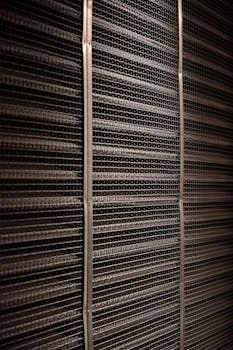
Material choice is a corrosion decision, not a brochure upgrade. Most municipal channels we spec still run on 304 SS. 316 SS is the safer pick where chlorides or industrial discharges attack welds and submerged fasteners. For 24/7 duty, specify a gearbox service factor ≥1.5 and prefer oil-bath lubrication over grease packing for heat rejection and continuous film coverage.
What is the step screen maintenance cost annual?
Annual step screen maintenance cost is usually the sum of power at $300–$600, brushes annualized at $90 - $120, and about $40 of gearbox oil, before labor. Daily visual checks catch jammed objects and uneven mat discharge. Monthly brush inspections catch edge wear before capture falls. Annual gearbox oil changes and biennial bearing lubrication keep a gearbox service factor ≥1.5 honest, and brush sets typically swap every 18–24 months.
Rising headloss at steady flow is a separate job from the annual cost rollup. Check partial blinding, FOG coating, bypass seals, and motor current before you blame aperture size. Rising current with low screenings production often means a damaged lamella or mechanical binding. For the fault tree itself, use the step screen troubleshooting note, and keep a manual bypass screen ready for the first heavy rag event.
How does the step screen roi 10 year npv calculation work?
A step screen 10-year NPV at 6% discounts CAPEX plus yearly OPEX, then credits repairs you avoid. Upgrading from 304 to 316 stainless steel can cut a step screen's 10-year NPV by about 3% through lower corrosion repairs and longer brush life. A base 304 SS unit at $35,000 CAPEX with about $28,000 of 10-year OPEX discounts to roughly $63,000 NPV at 6%. Adding about $6,000 for 316 SS raises CAPEX to $41,000, but cutting corrosion repairs by about $1,000/yr and extending brush life ~30% (18 to 24 months) brings 10-year NPV to about $61,000.
Use that delta only after you confirm chloride risk and spare-parts lead times. According to Lohse and Maguire (Treatment Plant Operator, 2026), the wider life-cycle stack also includes labor, spares, wear parts, and downtime. They note many bar screens can be rehabilitated inside a typical 30-year service life when the frame and bars are still sound. Most plants we cost keep this 10-year screen NPV and park structural rehab on a separate line.
For parallel fine-screen CAPEX bands, see the Fine Screen Wastewater Cost Price: 2025 Industrial Equipment Guide. Channel-level ROI worksheets that sit next to this article are in the Step Screen Wastewater Cost Price: 2026 B2B Pricing & ROI Guide.
Who This Is For / Next Step
Plant engineers, EPC designers, and procurement managers use this cost guide when they size 1–6 mm fine screens in channels up to about 3 m. Look elsewhere if the channel is wider than 3 m and debris >25 mm dominates—start with a rotary or multi-rake bar screen instead. Selection checks are design and peak flow, aperture versus the downstream protection target, 304 versus 316, gearbox service factor ≥1.5, and measured headloss at peak with ~50% blinding. Brush, washer-compactor spares, and a bypass channel belong on the same list.
Share channel drawings and peak flow when you request a step screen quote so the CAPEX band can narrow before the full RFQ. Most plants we quote close the gap fastest when chloride data and the blinding allowance arrive with the drawing.
Frequently Asked Questions
Five buyer questions below cover maintenance cadence, aperture, 3 mm capture, alloy choice, and flow from about 50 m³/h to 12,000 m³/h.
What is the typical maintenance schedule for a step screen?
Routine step screen maintenance uses daily visual checks, monthly brush inspections, annual gearbox oil changes, and biennial bearing lubrication, with brush replacement every 18–24 months on continuous duty. Nylon brush sets cost about $180, which annualizes near $90 - $120, and gearbox oil is about 2 L/yr (~$40). Most plants we commission add a motor-current glance on the daily walk so binding shows before a lamella bends.
How does screen aperture affect capture efficiency?
Smaller apertures (1–3 mm) raise capture of fine solids and rags compared with 6 mm slots, but they also raise headloss and cleaning frequency at the same approach velocity. Pumps often tolerate a coarser opening, while MBR protection usually needs 3 mm or finer. Most plants we size for MBR feed specify 3–6 mm and confirm peak headloss before they lock the slot.
What is the typical design screenings capture ratio for a 3 mm step screen?
Vendor and field figures for 3 mm step screens often cite about 95% capture of 3 mm solids under clean-channel test conditions (HydropureWater field data, 2025). Matt Bodwell's Ohio WEA presentation lists a step-screen screenings capture ratio near 53% at 3 mm and near 35% at 6 mm. Those mass-capture figures are not the same test as a 3 mm particle count. Most plants we start up weigh screenings in the first wet week before they accept guarantee language.
When should I choose 304 vs 316 stainless steel?
304 stainless steel fits most municipal channels with modest chloride and typical domestic sewage. 316 stainless steel is preferred where salinity or industrial discharge attacks submerged metal, because molybdenum slows pitting on frames and lamellas. The 10-year example adds about $6,000 to a $35,000 304 SS unit and moves NPV from about $63,000 to about $61,000 at 6% when repairs drop. Most coastal plants we review buy 316 only after a chloride sample.
Can a step screen handle widely fluctuating flow rates?
Yes, step screens are commonly applied from about 50 m³/h to 12,000 m³/h by changing step frequency with differential level or timer control. Confirm peak-flow headloss and a blinding allowance so the channel does not overtop into the bypass during storms. Treatment Plant Operator (2026) treats differential level control as standard because the drive starts when headloss rises. Most plants we size for storm peaks check clean-screen velocity before they trust a timer alone.