Introduction: The Multi-Site Management Challenge
Organizations that operate wastewater treatment systems across multiple locations face a fundamentally different set of challenges than single-site operators. Whether you are a utility managing 15 pump stations and 3 treatment plants, a food and beverage company with treatment systems at 8 production facilities, or an industrial group with decentralized wastewater treatment across a dozen manufacturing sites, the complexity of multi-site operations grows non-linearly with each additional location.
Common pain points include:
- Inconsistent operations: Different sites develop different procedures, leading to variable treatment quality and compliance risk
- Information silos: Operational data is trapped in site-level SCADA systems, making enterprise-wide visibility impossible
- Inefficient staffing: Each site maintains its own operations team, even when workload doesn't justify full-time coverage
- Fragmented maintenance: Work orders are tracked on paper or spreadsheets, parts inventories are duplicated, and institutional knowledge walks out the door with departing employees
- Reporting burden: Each site prepares its own compliance reports, often in different formats, with no centralized quality assurance
Software-as-a-Service (SaaS) platforms designed specifically for wastewater management are solving these challenges by providing a unified digital layer that connects all sites, standardizes operations, and delivers enterprise-wide visibility from a single dashboard.
What Makes a Wastewater SaaS Platform Different
Beyond Generic IoT and CMMS
While generic IoT platforms (AWS IoT, Azure IoT Hub, ThingsBoard) and general-purpose computerized maintenance management systems (CMMS) like Fiix or UpKeep can be adapted for wastewater use, purpose-built wastewater SaaS platforms offer critical advantages:
- Wastewater-specific data models: Built-in understanding of treatment processes, water quality parameters, and their interrelationships. The platform knows that rising effluent ammonia might indicate inadequate aeration or MLSS washout — a generic IoT platform treats it as just another number.
- Regulatory compliance engines: Pre-built templates for NPDES DMR (Discharge Monitoring Report) preparation, EU UWWTD reporting, and other jurisdiction-specific requirements. Automatic flagging of values that exceed permit limits.
- Process benchmarking: Ability to compare performance across sites — energy per cubic meter treated, chemical consumption per kg pollutant removed, specific sludge production — enabling identification of best practices and underperforming sites.
- Treatment process visualization: Schematic-based dashboards that represent actual treatment process flow diagrams, not just generic charts and gauges.
Core Module: Centralized Alarm Management
The Problem with Site-Level Alarms
In a traditional multi-site setup, each site's SCADA or PLC system generates its own alarms. These alarms are displayed on local operator stations and, at best, forwarded via auto-dialer or SMS to on-call personnel. The problems are well-documented:
- Alarm flooding: A single process upset can trigger dozens of related alarms, overwhelming operators
- No prioritization: A minor instrument drift alarm looks the same as a critical permit exceedance
- No cross-site correlation: A regional weather event affecting multiple sites generates independent alarm storms at each location
- No historical analysis: Alarm data is not stored or analyzed, so recurring issues are never systematically addressed
Cloud-Based Alarm Intelligence
A SaaS platform aggregates alarms from all sites into a single managed alarm system with the following capabilities:
Alarm Rationalization: During platform setup, every alarm is reviewed and classified according to ISA-18.2 / IEC 62682 alarm management standards. Nuisance alarms are suppressed. Related alarms are grouped so that a single root cause generates one actionable notification, not twenty.
Priority-Based Routing: Critical alarms (permit exceedances, equipment failures affecting treatment) go immediately to the on-call operator via push notification and phone call. High-priority alarms go via push notification. Medium-priority alarms appear on the dashboard for next-business-day action. Low-priority alarms are logged for trend analysis only.
Contextual Notifications: When an operator receives an alarm, the notification includes the current reading, the alarm threshold, a 24-hour trend chart, the relevant SOP (standard operating procedure) link, and suggested corrective actions. This enables faster, more informed response — especially valuable when the responding operator is not physically at the site.
Alarm Analytics: The platform tracks alarm frequency, duration, and response times across all sites, generating monthly alarm management reports. Chronic "bad actors" — alarms that fire repeatedly without being resolved — are identified for engineering review.
Core Module: Work Order Management
From Reactive to Proactive Maintenance
Maintenance is the second-largest operating cost in wastewater treatment (after energy), and the quality of maintenance directly impacts treatment performance, equipment lifespan, and regulatory compliance. A SaaS-based work order system transforms maintenance from a fragmented, reactive activity into a standardized, data-driven process.
Automatic Work Order Generation: When the platform detects an alarm condition, abnormal equipment behavior, or a scheduled maintenance due date, it automatically generates a work order with:
- Equipment identification (asset tag, location, specifications)
- Problem description (auto-populated from alarm data or maintenance schedule)
- Maintenance history for the asset (last 10 work orders)
- Required parts (linked to inventory management)
- Standard procedure document (SOP)
- Priority level and target completion date
Cross-Site Resource Sharing: When a specialist skill is needed (e.g., membrane module replacement on an underground integrated sewage treatment system or calibration of a complex analyzer), the platform can identify available qualified technicians across all sites and dispatch the nearest one, rather than each site maintaining its own specialist or contracting externally.
Parts Inventory Optimization: By tracking parts consumption across all sites, the platform identifies opportunities to consolidate purchasing, standardize equipment specifications, and optimize spare parts inventory. Instead of each site maintaining its own stock of pump seals, impellers, and dosing pump diaphragms, critical spares can be held at strategic locations with guaranteed delivery times.
Integration with Chemical Dosing Systems
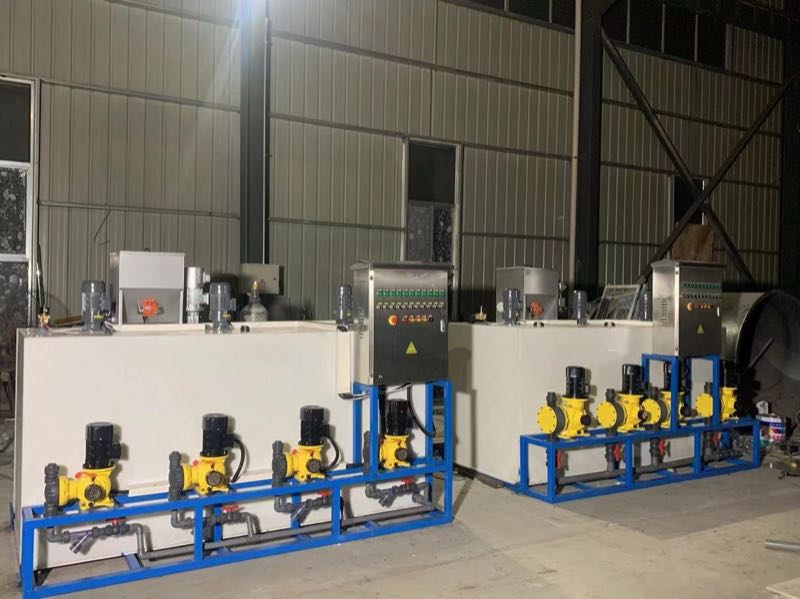
Work order management is particularly valuable for maintaining automatic chemical dosing systems. These systems require regular maintenance — diaphragm replacement, check valve inspection, calibration tube cleaning, and chemical replenishment. The SaaS platform tracks actual chemical consumption against theoretical requirements, automatically generating replenishment orders when tank levels drop below thresholds and scheduling preventive maintenance based on actual pump stroke counts rather than arbitrary calendar intervals.
Core Module: Regulatory Reporting
Automated Compliance Documentation
For multi-site operators, regulatory reporting can consume hundreds of staff-hours per month. Each site may report to different regulatory authorities, under different permits, with different parameters, limits, and reporting frequencies. A SaaS platform streamlines this by:
Centralized Data Validation: Before any data is used in a compliance report, the platform applies validation rules: range checks, rate-of-change checks, comparison with redundant instruments, and flagging of missing data periods. Data quality issues are identified early and can be investigated while records are still fresh.
Automated Report Generation: Reports are assembled automatically from validated monitoring data, formatted to meet the specific requirements of each regulatory jurisdiction. For US facilities, this means NPDES DMR forms with correct parameter codes, sample types, and statistical bases. For EU facilities, this means UWWTD annual reports with 24-hour composite averages and load calculations.
Limit Exceedance Management: When monitoring data approaches or exceeds permit limits, the platform immediately alerts operations staff and compliance managers, initiates root cause investigation workflows, and prepares the required exceedance notification for the regulatory authority. Early detection and rapid response can often prevent a minor exceedance from becoming a major violation.
Audit Trail: Every data point, from raw sensor reading to final reported value, is fully traceable through the platform's audit trail. Any data modifications (corrections, exclusions) require documented justification and supervisor approval. This level of data integrity meets the requirements of EPA's Cross-Media Electronic Reporting Rule (CROMERR) and equivalent regulations.
Implementation Strategy for Multi-Site Deployments
Phase 1: Pilot Site (Months 1-3)
Select one representative site for initial deployment. This site should have reliable internet connectivity, cooperative operations staff, and represent the "middle of the road" in terms of treatment complexity — not the simplest site (which wouldn't test the platform thoroughly) and not the most complex (which would slow the pilot with edge cases).
During the pilot:
- Install or verify online instruments for key parameters
- Deploy the edge gateway and establish cloud connectivity
- Configure process dashboards, alarm rules, and reporting templates
- Train operations staff on the platform
- Run in parallel with existing systems for 30 days to validate data accuracy
Phase 2: Rollout to Remaining Sites (Months 3-9)
Using lessons learned from the pilot, deploy to remaining sites in batches of 2-4. Standardize configurations where possible (common alarm thresholds, common KPIs, common report templates) while accommodating site-specific requirements (different permit limits, different treatment technologies, different instrument types).
Phase 3: Enterprise Optimization (Months 9-12)
With all sites connected, enable enterprise-level features:
- Cross-site performance benchmarking dashboards
- Centralized alarm management with regional on-call rotation
- Consolidated spare parts inventory management
- Enterprise-level regulatory compliance calendar
- Energy benchmarking and optimization campaigns
Evaluating SaaS Platforms: Key Questions
When evaluating wastewater management SaaS platforms, ask these critical questions:
- Data ownership: Who owns the data if you terminate the subscription? Can you export all historical data in standard formats (CSV, API)?
- Uptime guarantee: What is the SLA? Is there a local failover mechanism if the cloud service is unavailable?
- Integration: Does the platform support your existing PLC/SCADA brands (Allen-Bradley, Siemens, Schneider)? What protocols are supported?
- Scalability pricing: Is pricing per site, per data point, or per user? How does cost scale as you add sites?
- Cybersecurity: Is the platform SOC 2 Type II certified? What about network segmentation between OT and IT systems?
- Regulatory templates: Does the platform include templates for your specific regulatory jurisdiction, or will you need to build them from scratch?
- Mobile capability: Can operators perform all critical functions (alarm response, work order management, data entry) from a mobile device?
The Business Case for SaaS
For a multi-site operator managing 5-10 wastewater treatment facilities, the typical business case for a SaaS platform includes:
| Benefit Category | Annual Value (5-10 sites) |
|---|---|
| Staffing optimization (centralized operations) | $150,000 - $400,000 |
| Maintenance cost reduction (predictive vs. reactive) | $50,000 - $150,000 |
| Chemical optimization | $30,000 - $100,000 |
| Regulatory reporting labor savings | $40,000 - $80,000 |
| Avoided compliance penalties | $20,000 - $200,000 |
| Total Annual Benefits | $290,000 - $930,000 |
| Annual SaaS subscription (5-10 sites) | $30,000 - $80,000 |
| Net Annual Value | $260,000 - $850,000 |
Frequently Asked Questions
Can a SaaS platform work with our existing SCADA system, or do we need to replace it?
SaaS platforms are designed to complement, not replace, existing SCADA systems. The typical integration uses an edge gateway or OPC-UA server to bridge the SCADA system to the cloud platform. Your local SCADA continues to provide real-time control and local operator interface, while the SaaS platform adds enterprise-level visibility, analytics, and reporting. Over time, some operators choose to migrate more functions to the cloud, but this is an evolution, not a requirement.
What happens to our operations if the SaaS platform goes down?
Well-designed implementations maintain full local autonomy. Your on-site PLCs and SCADA system continue to operate independently of the cloud platform. The edge gateway buffers all data locally (typically 72 hours or more) and automatically uploads when connectivity is restored. You lose remote visibility and cloud-based analytics during the outage, but treatment operations continue uninterrupted. Critical alarms can be configured to also route through independent cellular dialers as a redundant notification path.
How does data security work when wastewater operational data is in the cloud?
Leading wastewater SaaS platforms implement multiple security layers: TLS 1.3 encryption for all data in transit, AES-256 encryption for data at rest, role-based access control with multi-factor authentication, network segmentation between OT and IT systems, regular penetration testing, and SOC 2 Type II compliance certification. Data is typically stored in geographically redundant data centers within the customer's regulatory jurisdiction. Many platforms also maintain ISO 27001 certification for information security management.
What is the minimum number of sites that justifies a SaaS platform investment?
While SaaS platforms provide value even for single-site operations (primarily through automated reporting and remote monitoring), the business case becomes compelling at 3 or more sites. At this scale, centralized alarm management, cross-site benchmarking, and shared staffing models generate sufficient savings to justify the subscription cost several times over. For organizations with 10+ sites, SaaS-based centralized operations become virtually essential for manageable, cost-effective operations.