Introduction: The Staffing Challenge in Wastewater Treatment
For small and medium-sized enterprises (SMEs) operating wastewater treatment systems, staffing represents one of the most significant operational costs. Traditionally, wastewater plants require round-the-clock human oversight — skilled operators monitoring gauges, adjusting chemical feeds, responding to alarms, and preparing compliance reports. For an SME processing 500 to 5,000 cubic meters per day, maintaining a full operations team can account for 40-60% of total operating expenses.
The convergence of affordable Industrial Internet of Things (IIoT) sensors, cloud computing platforms, and intelligent automation has fundamentally changed this equation. Today, a single trained operator — equipped with the right digital tools — can effectively manage what previously required a team of three to five people. This is not a futuristic vision; it is the operational reality for thousands of facilities worldwide that have embraced online monitoring and cloud-based management.
In this guide, we examine how SMEs can implement online monitoring and cloud platforms to achieve minimal staffing operations without sacrificing treatment quality or environmental compliance.
Understanding Online Monitoring for Wastewater Treatment
What Online Monitoring Means in Practice
Online monitoring refers to the continuous, real-time measurement of key water quality parameters and process variables using sensors installed directly in the treatment process. Unlike traditional grab sampling — where a technician collects a water sample and sends it to a laboratory — online monitors provide readings every few seconds or minutes, creating a continuous data stream.
The core parameters typically monitored online include:
- Chemical Oxygen Demand (COD) — the primary indicator of organic pollution load
- Ammonia Nitrogen (NH₃-N) — critical for biological treatment optimization
- Total Phosphorus (TP) — increasingly regulated under EPA and EU directives
- pH and ORP (Oxidation-Reduction Potential) — fundamental process control parameters
- Dissolved Oxygen (DO) — essential for aerobic biological treatment
- Turbidity and Suspended Solids (SS) — indicators of effluent quality
- Flow Rate — for mass balance calculations and billing
From Data Points to Actionable Intelligence
Raw sensor data alone does not reduce staffing needs. The value emerges when data is processed, contextualized, and presented through intelligent dashboards. Modern cloud platforms transform thousands of daily readings into trend analyses, predictive alerts, and automated control signals.
For example, rather than an operator manually checking DO levels every hour and adjusting blower speed, an online DO sensor feeds data to a PID controller that automatically modulates aeration. The operator receives a notification only when the system cannot maintain target ranges — a genuine exception that requires human judgment.
Cloud Platforms: The Brain Behind Minimal Staffing
Architecture of a Cloud-Based Wastewater Management System
A typical cloud-based system for wastewater management consists of three layers:
- Edge Layer — On-site sensors, PLCs, and an edge gateway (often a ruggedized industrial PC or IoT gateway) that collects data from all instruments and transmits it to the cloud via 4G/5G or Ethernet.
- Cloud Layer — A centralized platform (hosted on AWS, Azure, or a regional provider) that stores data, runs analytics algorithms, manages alarms, and provides the web-based dashboard interface.
- User Layer — Web browsers and mobile apps through which operators, managers, and even regulators access real-time and historical data.
Key Features That Enable Staff Reduction
The following cloud platform features directly contribute to reduced staffing requirements:
1. Remote Process Control
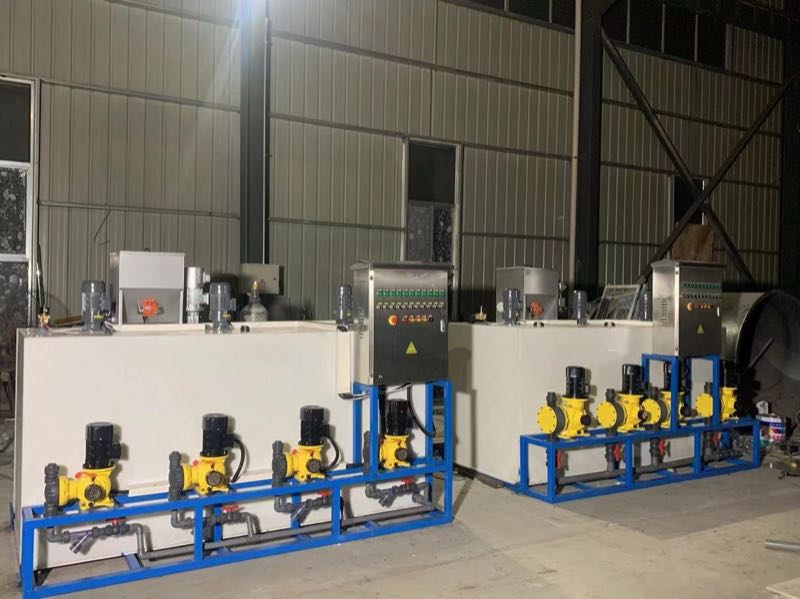
Operators can adjust setpoints, start or stop pumps, and modify chemical dosing rates from any location with internet access. This eliminates the need for physical presence during routine adjustments. An automatic chemical dosing system integrated with cloud monitoring can self-adjust reagent feed rates based on real-time influent quality, reducing the most labor-intensive aspect of chemical treatment.
2. Intelligent Alarm Management
Traditional SCADA systems generate excessive alarms — a phenomenon known as "alarm flooding" — which desensitizes operators and leads to missed critical events. Cloud platforms use machine learning to establish normal operating baselines and generate alarms only for genuine anomalies. Alarms are prioritized, routed to the right person via SMS, email, or push notification, and include contextual information for faster response.
3. Automated Reporting
Regulatory compliance reporting — daily monitoring records, monthly discharge reports, annual summaries — can consume 10-15 hours per week of operator time. Cloud platforms auto-generate these reports from stored data, formatted to meet EPA NPDES, EU Urban Waste Water Treatment Directive, or local regulatory requirements.
4. Predictive Maintenance
By analyzing equipment runtime, vibration data, power consumption, and performance trends, cloud platforms can predict when a pump, blower, or membrane module is approaching failure. This shifts maintenance from scheduled (costly) or reactive (risky) to predictive (optimal), reducing the need for dedicated maintenance staff.
Implementation Roadmap for SMEs
Phase 1: Instrument the Critical Points (Weeks 1-4)
Start with the parameters that have the highest regulatory and process impact. For most SMEs, this means:
- Influent flow meter and pH sensor
- Effluent COD, NH₃-N, and TP online analyzers
- Dissolved oxygen sensors in biological treatment tanks
- Turbidity sensor on final effluent
Total investment for a basic online monitoring suite ranges from $15,000 to $40,000 depending on analyzer specifications and the number of monitoring points.
Phase 2: Connect to Cloud (Weeks 4-6)
Install an edge gateway to aggregate sensor data and transmit to the chosen cloud platform. Many equipment vendors now offer pre-configured gateways that support standard industrial protocols (Modbus RTU/TCP, MQTT, OPC-UA). Ensure the gateway includes local data buffering to prevent data loss during internet outages.
Phase 3: Configure Dashboards and Alarms (Weeks 6-8)
Work with the platform provider to configure:
- Process overview dashboards showing real-time status of all treatment stages
- Trend charts for key parameters with regulatory limit lines
- Alarm rules with appropriate thresholds, delays, and escalation paths
- Automated daily/weekly/monthly report templates
Phase 4: Integrate Automated Control (Weeks 8-12)
This is where staffing reduction becomes tangible. Integrate cloud platform control signals with on-site automation:
- Automatic aeration control based on DO and NH₃-N feedback
- Automatic chemical dosing adjustment based on influent pH, COD, or TP — the automatic chemical dosing system plays a central role here
- Automatic sludge wasting based on MLSS concentration
- Automatic backwash scheduling for filtration or MBR membrane bioreactor systems
Phase 5: Optimize and Reduce (Months 3-6)
After 2-3 months of cloud-connected operation, analyze staffing patterns. Most SMEs find they can:
- Eliminate night shifts entirely (remote monitoring handles after-hours)
- Reduce weekend staffing to on-call only
- Have one operator manage 2-3 treatment trains simultaneously
- Reassign freed-up staff to higher-value activities like process optimization
Real-World Economics: The ROI Case
Consider a typical SME operating a 2,000 m³/day industrial wastewater treatment plant:
| Cost Category | Before Cloud | After Cloud | Annual Savings |
|---|---|---|---|
| Operators (FTE) | 5 (3 shifts + relief) | 2 (day shift + on-call) | $90,000 - $150,000 |
| Chemical consumption | Baseline | -15% to -25% (optimized dosing) | $12,000 - $30,000 |
| Energy (aeration) | Baseline | -10% to -20% (DO-based control) | $8,000 - $20,000 |
| Compliance penalties | $5,000 - $50,000/year risk | Near zero (continuous monitoring) | $5,000 - $50,000 |
| Cloud platform subscription | N/A | $3,000 - $8,000/year | ($3,000 - $8,000) |
| Net Annual Savings | $112,000 - $242,000 |
With an upfront investment of $40,000 - $80,000 for sensors, gateway, and integration, payback periods typically range from 4 to 8 months.
Security and Reliability Considerations
SMEs often express concern about entrusting critical infrastructure control to cloud platforms. These concerns are valid and should be addressed through proper architecture:
- Local fallback — The on-site PLC must maintain autonomous operation if cloud connectivity is lost. The cloud platform enhances and optimizes; it should never be a single point of failure.
- Data encryption — All data in transit (TLS 1.3) and at rest (AES-256) must be encrypted.
- Access control — Role-based access with multi-factor authentication. Operators get control access; managers get read-only dashboards; regulators get compliance reports only.
- Data sovereignty — Ensure the cloud provider stores data in jurisdictions that comply with local regulations (GDPR in Europe, etc.).
- Redundancy — The edge gateway should buffer at least 72 hours of data locally, and the cloud platform should have 99.9%+ uptime SLA.
Choosing the Right Platform for Your SME
When evaluating cloud platforms for wastewater management, SMEs should prioritize:
- Industry-specific features — Generic IoT platforms lack wastewater-specific analytics. Choose platforms built for water/wastewater with built-in parameter calculations, regulatory templates, and process models.
- Scalability — Start small but ensure the platform can grow as you add monitoring points or additional treatment facilities.
- Integration capability — The platform must communicate with your existing PLCs and instrumentation without requiring wholesale replacement of field devices.
- Mobile-first design — Your on-call operator will be responding from a smartphone at 2 AM. The mobile experience must be as capable as the desktop dashboard.
- Vendor support — Cloud platforms require ongoing support. Evaluate the vendor's track record, response times, and willingness to customize.
The MBR Advantage in Cloud-Managed Operations
Membrane bioreactor systems are particularly well-suited to cloud-based minimal staffing operations. The MBR integrated wastewater treatment system combines biological treatment and membrane filtration in a compact footprint, and its operation is highly data-driven. Trans-membrane pressure (TMP), permeate flux, and fouling rates can all be monitored online, with automated backwash and chemical cleaning cycles triggered by the cloud platform based on real-time membrane performance data.
This makes MBR systems ideal for SMEs seeking to achieve high effluent quality (suitable for reuse) while maintaining minimal on-site staffing.
Frequently Asked Questions
What internet bandwidth is needed for cloud-based wastewater monitoring?
Most wastewater monitoring data is low-bandwidth — a typical facility with 20-30 sensors transmitting every 30 seconds generates less than 50 MB per day. A standard 4G cellular connection (10+ Mbps) is more than sufficient. However, if you plan to stream video from on-site cameras, bandwidth requirements increase significantly. We recommend a dedicated industrial SIM card with at least 2 GB monthly data allowance for sensor data alone, plus additional capacity for video if needed.
Can we implement cloud monitoring without replacing our existing PLC?
Yes. Most cloud implementations use an edge gateway that communicates with your existing PLC via standard industrial protocols (Modbus, Profibus, EtherNet/IP). The gateway translates PLC data into cloud-compatible formats (MQTT, HTTP/REST). This approach preserves your existing automation investment while adding cloud capabilities. Full PLC replacement is only necessary if the existing controller lacks the I/O capacity for additional sensors.
How do regulatory agencies view cloud-stored monitoring data?
Most regulatory frameworks, including the US EPA's Electronic Reporting Rule and the EU's Best Available Techniques (BAT) reference documents, accept electronically stored monitoring data provided it meets data integrity requirements (audit trails, tamper protection, validated instruments). Many agencies are actively encouraging digital reporting. However, always verify with your local regulatory authority, as requirements vary by jurisdiction. Cloud platforms with built-in audit trails and data validation actually provide stronger evidentiary support than paper-based records.
What is the typical payback period for SMEs investing in online monitoring?
Based on industry data across hundreds of SME installations, the typical payback period for online monitoring and cloud platform investment is 4 to 12 months. The primary savings drivers are staffing reduction (40-60% of savings), chemical optimization (20-30%), energy savings (10-15%), and avoided compliance penalties (variable but potentially significant). Facilities with high chemical consumption or those facing regulatory pressure tend to see the fastest payback.