Why Philippine Food Processors Face Unique Wastewater Challenges
Food processing wastewater in the Philippines often carries BOD of 500–3,000 mg/L (meat) and 1,000–5,000 mg/L (dairy), against the DENR Class C BOD cap of 50 mg/L. A compliant 350 m³/day train typically uses screening, DAF, MBBR or SBR, and disinfection, at ₱12–25 million CAPEX (2025 data).
High-strength organics and active DENR enforcement set the operational baseline. According to the EMB National Water Quality Status Report (2023), food and beverage effluent remains a primary organic-pollution contributor in Laguna de Bay and the Marikina River. For a meat processing facility, FOG can reach 500 mg/L, or about 50 times the Class C oil-and-grease allowance. In 2023, a 350 m³/day meat plant in Laguna was fined ₱2.4 million for repeated BOD exceedances, showing the cash cost of weak pretreatment.
Geographic factors shape the design. Ambient temperatures above 30 °C accelerate anaerobic decomposition in equalization tanks and trigger odor complaints. High TSS from poultry and livestock lines can clog municipal sewers and draw LGU surcharges if not pre-treated. The table below maps typical influent values against DENR DAO 2016-08 Class C discharge limits. According to DENR DAO 2016-08 Table 9, Class C COD is 100 mg/L and Class D COD is 200 mg/L; earlier plant summaries often listed ≤200 mg/L for Class C, so size biology to the Table 9 Class C value of 100 mg/L.
| Parameter | Meat Processing (mg/L) | Dairy Processing (mg/L) | Beverage/Brewing (mg/L) | DENR Class C Limit (mg/L) |
|---|---|---|---|---|
| BOD | 500 – 3,000 | 1,000 – 5,000 | 2,000 – 6,000 | ≤ 50 |
| COD | 1,200 – 6,000 | 2,000 – 8,000 | 4,000 – 10,000 | ≤ 200 |
| TSS | 400 – 2,500 | 500 – 1,500 | 200 – 800 | ≤ 70 |
| FOG | 100 – 600 | 200 – 1,000 | < 50 | ≤ 10 |
| pH | 6.0 – 8.5 | 4.5 – 11.0 | 4.0 – 12.0 | 6.5 – 9.0 |
Step-by-Step Wastewater Treatment Process for Food Processing Plants
Pretreatment removes over 60% of TSS and 90% of FOG before biological stages, preventing system failure and trimming aeration energy. Philippine designs must also absorb monsoon hydraulic surges, so equalization tanks are sized for 8–12 h retention as a hard minimum rather than a suggestion.
The process begins with Pretreatment. Rotary mechanical bar screens (GX Series) handle feathers, bone fragments, and packaging debris, taking out 60–80% of TSS upfront. After screening, equalization at 8–12 h stabilizes pH and flow. Primary treatment typically uses DAF systems for FOG removal in food processing wastewater. Micro-bubbles lift grease and fine solids for mechanical skimming, which is critical for dairy and meat lines that run above 200 mg/L FOG. pH is adjusted to 6.5–8.5 at this stage to protect the biology downstream.
Secondary treatment removes the bulk of the organic load. MBR systems for high-efficiency BOD/COD removal and Moving Bed Biofilm Reactors (MBBR) are preferred for their biomass density and shock-load tolerance, routinely achieving 85–95% BOD removal. For beverage wastewater in the Philippines, engineers typically extend Hydraulic Retention Time to 18–24 h to fully digest complex sugars. Tertiary treatment uses chlorine dioxide disinfection for food plant effluent to deliver a 99.9% pathogen kill and meet the DENR coliform limit of <1,000 MPN/100 mL.
Finally, Sludge Handling converts separated solids into a manageable form. A plate and frame filter press (1–500 m²) is the local standard for dewatering sludge to 20–30% dry solids, cutting disposal volume and allowing the cake to go to landfill or industrial composting. Integrating these stages keeps the facility compliant while keeping chemical and electrical draw in check. For sites with constrained civil works, an Underground Package Sewage Treatment Plant (WSZ Series) can replace above-ground biological basins where footprint or permitting pushes the design underground.
Technology Comparison: DAF vs. MBBR vs. SBR for Philippine Food Processors
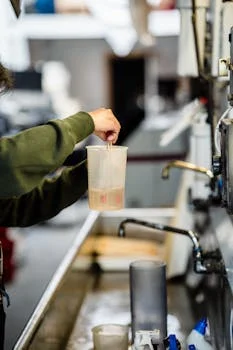
DAF is non-negotiable as the pre-treatment step for meat and dairy effluent, because biological systems such as SBR cannot efficiently digest emulsified fats above roughly 200 mg/L. The MBBR-vs-SBR decision is usually driven by land area and production variability: SBR offers batch flexibility, while MBBR wins in compact industrial estates where every square meter counts.
DAF (Dissolved Air Flotation): The workhorse for high-FOG streams in meat and dairy plants. It delivers 90–95% FOG removal and 50–70% TSS reduction, with capital costs of ₱3–₱8 million in the Philippines for 50–300 m³/h units (2025 data). Engineering benchmarks like DAF system design and cost benchmarks for food plants show that high-pressure air saturation is the variable to watch when inlet water exceeds 30 °C.
MBBR (Moving Bed Biofilm Reactor): Plastic media give a large surface for biofilm growth, so MBBR hits 85–95% BOD/COD removal at 0.3–0.5 kWh/m³. A beverage plant in Cebu recently used MBBR to cut BOD from 4,200 mg/L to 45 mg/L in a footprint 40% smaller than conventional activated sludge. SBR (Sequencing Batch Reactor): A fill-and-draw tank that aerates and settles in one vessel. It suits plants with variable shifts, such as a 350 m³/day meat plant in Bulacan, but needs more floor area and more sophisticated valve automation than MBBR.
| Feature | DAF (Primary) | MBBR (Secondary) | SBR (Secondary) |
|---|---|---|---|
| Best Use Case | High FOG/TSS removal | Compact, high-strength BOD | Variable flows/Batch loads |
| BOD Removal | 20% – 30% | 85% – 95% | 90% – 98% |
| Footprint | Small | Very Small (Modular) | Medium to Large |
| OPEX (₱/m³) | 3 – ₱5 | 4 – ₱7 | 6 – ₱10 |
| Maintenance | Low to Moderate | Low (Self-regulating) | High (Complex valves) |
Philippine Compliance Checklist: Permits, Testing, and Documentation
The Environmental Compliance Certificate (ECC) is the foundational document for any new or expanded food processing plant, and approval typically runs 6 to 12 months through DENR. Compliance is not a set-and-forget task; it requires quarterly Self-Monitoring Reports and annual permit renewals. Local Government Unit (LGU) ordinances can sit on top of DENR DAO 2016-08 with stricter local limits.
- Wastewater Discharge Permit: Renewed annually. Requires quarterly Self-Monitoring Reports (SMRs) with verified BOD, COD, TSS, and FOG data.
- Accredited Testing: Effluent must be analyzed by EMB-accredited laboratories such as Manila Water Labs or SGS Philippines; non-accredited results are not defensible during a DENR inspection.
- LGU Ordinances: Some regions layer on surcharges. In Laguna, facilities can face a ₱5,000/month surcharge if BOD exceeds 50 mg/L, even with a valid discharge permit.
- Documentation: Keep chemical usage logs, flow meter readings, and sludge disposal manifests; missing sludge records are a common audit trigger.
- Fines and Penalties: Missed SMR deadlines can draw ₱10,000 to ₱50,000 in fines. Earlier summaries cited daily fines of up to ₱1 million for limit exceedances; RA 9275 Section 28 sets standard fines at ₱10,000 to ₱200,000 for every day of violation, with gross violations up to ₱3,000,000 per day until compliance is restored.
Cost Breakdown: Wastewater Treatment for Food Plants in the Philippines (2025)
Capital expenditure (CAPEX) for a 350 m³/day wastewater treatment plant in the Philippine food sector runs ₱12 million to ₱25 million, depending on influent complexity. The ROI is driven by DENR-fine avoidance (over ₱2 million per year in some cases) and water reuse. In water-stressed provinces like Cavite or Cebu, reusing treated effluent for floor washing or cooling towers can save ₱10–₱20 per cubic meter against fresh-water procurement.
Operating costs (OPEX) typically fall between ₱8 and ₱15 per cubic meter of treated water. The main line items are aeration and pumping electricity at ₱3–5/m³, DAF coagulants and polymers at ₱2–₱4/m³, and labor at ₱1–₱2/m³. Sludge disposal is the swing variable, usually ₱2–4/m³ depending on haul distance to the nearest industrial landfill. For larger facilities, Taiwan's approach to food processing wastewater treatment shows that anaerobic digestion can recover biogas and offset 10–15% of total plant energy demand.
| Cost Component | Estimated Cost (350 m³/day Plant) | Percentage of Total |
|---|---|---|
| Core Equipment (DAF, MBBR, Screens) | ₱7.2M – ₱15M | 60% |
| Civil Works & Piping | 3M – 6.25M | 25% |
| Permitting & Engineering Design | 1.2M – ₱2.5M | 10% |
| Contingency & Commissioning | ₱0.6M – ₱1.25M | 5% |
| Total CAPEX | ₱12M – ₱25M | 100% |
Supplier Selection Checklist for Philippine Food Processors
Local service networks and spare-parts availability matter more than brand name, because a 24-hour system failure can halt a whole plant. International brands offer deeper automation, while regional suppliers like HydropureWater typically deliver lead times of 8–12 weeks and reachable technical support across Luzon, Visayas, and Mindanao. Most plants we size for the Philippine food sector end up with a regional supplier for that reason.
- Technical Verification: Does the supplier provide ISO 9001 certified equipment? Can they guarantee 95% BOD removal in writing?
- Compliance Support: Will the supplier help with EIS (Environmental Impact Statement) templates and attend DENR technical conferences when needed?
- Local Presence: A local warehouse for spare parts (pumps, DAF scrapers, MBR membranes) is non-negotiable. A 20–30% premium for international brands (e.g., Veolia) is only justified if they run a staffed local service center; otherwise a regional specialist usually wins on total cost.
- Red Flags: Walk away from suppliers without local food-industry references or those offering "black box" packages without detailed engineering drawings.
- Automation Level: A blend of manual override and PLC-based automation suits Philippine plants best, given local power fluctuations and varied operator skill levels.
Who this is for
Plant engineers and procurement managers at meat, dairy, and beverage processors in the Philippines who need a defensible CAPEX/OPEX range, a DAF-MBBR-SBR comparison, and a current DENR compliance path. Plants with very small flows under 20 m³/day, or those already running a validated anaerobic MBR system, should look at smaller packaged units or an Underground Package Sewage Treatment Plant (WSZ Series) instead.
For a sized proposal with Philippine-specific flow and load assumptions, send your influent data and target discharge class to our process team and we will return a preliminary P&ID, equipment list, and budget envelope within five working days.
Frequently Asked Questions
What is the largest water treatment plant in the Philippines?
The Maynilad Putatan Water Treatment Plant is the largest in the country at 500 MLD capacity, but it serves municipal demand rather than industrial effluent. Food processing facilities typically need decentralized plants in the 50–500 m³/day range to handle their specific organic loads, FOG spikes, and DENR discharge permits.
What are the DENR fines for exceeding wastewater limits in the Philippines?
Under RA 9275 Section 28, standard fines run from ₱10,000 to ₱200,000 for every day of violation. Earlier summaries often cited up to ₱1 million per day; gross violations under the Clean Water Act can reach ₱500,000 to ₱3,000,000 per day. Continued non-compliance can escalate to a Cease and Desist Order (CDO), which halts production until verified effluent data show compliance.
Can food processing wastewater be reused in the Philippines?
Yes. Under DENR DAO 2019-19, treated wastewater can be reused for non-potable applications such as irrigation, floor washing, and cooling towers. Effluent must meet the "Class RE" reuse standards through tertiary treatment, typically MBR followed by Reverse Osmosis, before site reuse begins.
How much does a DAF system cost for a 100 m³/day food plant in the Philippines?
A DAF system at this capacity typically costs ₱2.5 million to ₱5 million. Price depends on material of construction (SS304 vs. carbon steel) and the level of automation in the chemical dosing skid. Flow rating alone does not set the final bid price.
What is the best wastewater treatment technology for a meat processing plant in the Philippines?
DAF for primary FOG removal followed by MBBR for biological BOD reduction is the most effective combination. It handles high grease loads, keeps the footprint compact, and tolerates the Philippine climate better than temperature-sensitive activated sludge trains for most meat lines we size.