Choose the route from the wastewater profile
For industrial effluent treatment in Jamaica, select the route by matching the wastewater’s dominant contaminants and the required discharge or reuse outcome. DAF is suited to suspended solids, oil and grease, and colloidal material; MBR combines biological treatment with membrane separation; UF provides fine filtration and can support reuse where the feed is appropriate. The defining inputs are flow, COD, BOD, suspended solids, oil and grease, pH, temperature, toxicity, receiving drain or reuse application, and Jamaican permit conditions. Without those inputs, no equipment selection is defensible.
| Discharge route or influent problem | Governing rule or process option | What data settles it |
|---|---|---|
| Suspended solids, oil and grease, or colloidal material requiring separation | Consider a DAF system for industrial effluent pretreatment before biological or membrane treatment. | Representative wastewater analysis, including suspended solids and oil and grease, plus the required final effluent quality. |
| Biodegradable organic load requiring biological removal | Consider an MBR membrane bioreactor for industrial wastewater where membrane separation is required in the biological process. | COD, BOD, pH, temperature, toxicity and biodegradability data, together with flow variation and reuse objectives. |
| Fine solids remaining after upstream treatment | Consider ultrafiltration as a polishing step rather than assuming it removes dissolved organic pollution or corrects an unsuitable biological effluent. | UF feed characteristics, required filtrate quality, membrane compatibility and the treatment process immediately upstream. |
| Discharge to a drain or internal reuse | Define the required destination and applicable wastewater discharge permit conditions before treating a generic ETP specification as sufficient. | Site-specific permit conditions, receiving-drain information, reuse application and any applicable Jamaican authority requirements. |
Start with a representative sampling programme covering normal production and relevant batch discharges. Ask for the average influent flow rate and peak daily flow rather than relying only on a catalogue duty point. The analysis should establish COD, BOD, suspended solids, oil and grease, pH and temperature. Include toxicity or inhibitory constituents where the industrial process makes them credible. These are missing site inputs, not optional specifications, and the available material does not establish Jamaican discharge limits.
Match DAF, MBR and UF to the treatment objective
Choose DAF when the primary problem is physical separation before biological treatment or membrane polishing. Choose MBR when biological treatment and membrane separation are both required within an integrated process. Choose UF when the objective is fine filtration of an already suitable upstream effluent. A combined DAF–MBR route becomes a candidate when the wastewater requires preliminary oil and solids removal as well as biological treatment; the wastewater analysis must justify each stage.
Do not confuse a polishing technology with a complete industrial effluent plant. Research from the University of Twente assessed direct nanofiltration as a method for polishing wastewater-treatment-plant effluent for reclamation. That work supports the general role of membrane polishing; it does not establish a complete Jamaican industrial ETP configuration, Jamaican permit limits or site performance. The receiving drain and intended reuse application must therefore remain separate decisions in the RFQ.
For supplier discussions, request a process narrative explaining what each stage removes and why it is necessary. A review of how an MBR membrane bioreactor works can help frame the biological and separation functions. For a broader route comparison, see the project-specific comparison of DAF, MBR and reuse routes; its case context should not be transferred to Jamaica without local data.
Treat the plant as a complete process train
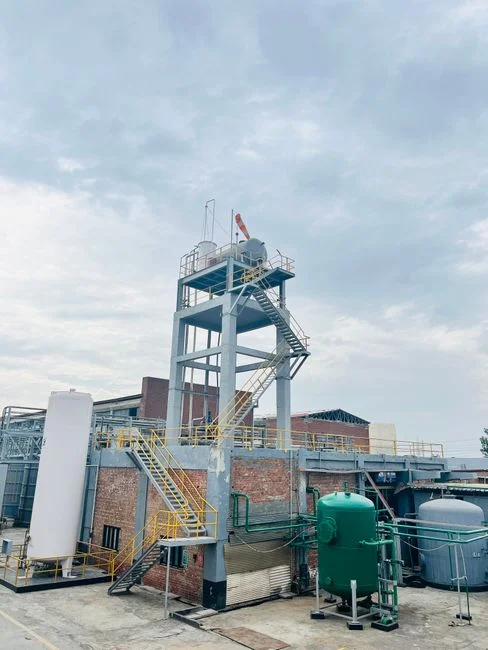
Quote the complete process train only after identifying which units are justified. Screening may be needed for material entering the works; equalisation may be needed to control variable flow and load; pH adjustment may be required for chemical dosing or biological treatment; and separation, biological treatment and polishing should follow from the wastewater profile. Avoid including units simply because they appear in a generic plant description.
The equipment catalogue identifies rotary mechanical bar screens for municipal and industrial headworks, while DAF is presented for industrial pretreatment applications. It also identifies automatic chemical dosing for coagulants, flocculants and pH adjusters, and plate-and-frame presses for municipal and industrial sludge dewatering. Ask the supplier to explain where each item fits in the proposed train, including the expected sludge quantity and characteristics and the proposed disposal route. Those site inputs remain unverified until the buyer supplies them.
Where a constructed wetland is proposed, use the Wageningen University and Research thesis on constructed wetlands and micropollutant removal as supporting research rather than as a ready-made Jamaican design. Request the design assumptions for land area, climate, hydraulic loading and maintenance access, then have the proposal checked against the actual site.
Build an RFQ-ready scope and acceptance checklist
Require each bidder to state the design flow and peak-flow basis, influent characteristics, treatment objectives, process description, utility requirements, footprint, commissioning tests and O&M deliverables. A credible quotation should identify who supplies site data, civil works, electrical supply, drainage, sludge removal, laboratory testing and operator training. If a boundary is excluded, require it to appear as an explicit exclusion rather than an implied supplier responsibility.
| Quote line item | Technical scope to specify | Red flags to check before signing |
|---|---|---|
| Design basis and influent characterization | Design flow, peak daily flow, wastewater source, COD, BOD, suspended solids, oil and grease, pH, temperature and toxicity data. | The offer relies on unspecified “typical” wastewater, omits batch discharges, or cannot reconcile the selected duty with the stated flow. |
| Process route and performance guarantee | Named stages, treatment objectives, applicable permit conditions, reuse requirements and proposed commissioning test methods. | Generic compliance claims lack an identified Jamaican authority, permit condition or test method. |
| Equipment and utilities | Equipment sizing, chemical dosing, power, water, drainage, controls, footprint and operating attendance requirements. | Civil, electrical, drainage, laboratory, sludge-removal or operator-training obligations are left unassigned. |
| Sludge and residuals | Expected sludge characteristics, quantity, dewatering provisions, storage, handling and disposal route. | The quotation treats sludge as an automatic by-product without defining handling, access or disposal responsibility. |
| Site and local verification | Site survey, soil conditions, available footprint, power supply, receiving drain and any reuse destination constraints. | The supplier treats Jamaica-specific permissions or site conditions as confirmed without supporting documents. |
| Commissioning and handover | Testing protocol, acceptance samples, training, spare parts, documentation and performance-defect remedies. | Acceptance is tied to undefined parameters, supplier-selected samples or no remedy for failed performance. |
Before signature, compare the quoted process against the wastewater analysis, the applicable Jamaican permit conditions, the reuse requirements and the guaranteed performance tests. Obtain the named permit or authority correspondence and the relevant site documents; do not accept a catalogue statement that equipment meets unspecified national or international standards as proof of compliance at the proposed discharge point.
Related Equipment
- DAF system for industrial effluent pretreatment — specifications, capacity range, and technical data
Frequently Asked Questions
How should an industrial effluent treatment plant in Jamaica be selected?
Select it from the wastewater profile and required outcome, not from a standard catalogue package. Request representative flow and analytical data, identify the receiving drain or reuse application, and then determine whether DAF, biological treatment, MBR, UF or a combined train is justified. Confirm the applicable Jamaican permit conditions before finalising the route.
What information is needed before requesting a price?
Provide the average and peak flows; COD, BOD, suspended solids, oil and grease, pH, temperature and relevant toxicity data; the final effluent or reuse requirement; available footprint, soil and power; the receiving drain or reuse destination; and sludge-disposal arrangements. Ask each supplier to quote against the same documented design basis so equipment, civil work, utilities, commissioning and exclusions can be compared.
When is DAF preferred over MBR or UF?
DAF is the candidate when suspended solids, oil and grease or colloidal material must be separated before downstream treatment. MBR becomes relevant when biological treatment and membrane separation are both required, while UF is a fine-filtration or polishing option for an already suitable feed. The wastewater analysis and reuse objective must establish which condition applies.
How should a supplier be qualified for delivery and performance risk?
Require a route-specific process description, named design inputs, utilities, footprint, commissioning protocol and acceptance tests. Verify who provides civil works, power, drainage, sludge removal, laboratory testing and operator training. Also request local installation support and contractual remedies if the plant fails the agreed test basis; a general compliance statement alone does not resolve delivery or performance risk.