Which packaged treatment plant fits a Marseille housing development?
For a Marseille housing development, the best fit is a France-approved, collectively sized packaged sewage treatment plant with enough capacity for the calculated Population Equivalent, sufficient space for the tank and discharge solution, and written acceptance by the local SPANC. A buried WSZ unit is a strong candidate because it combines anoxic/aerobic contact oxidation, sedimentation and disinfection in one package and is catalogued for 1–80 m³/h. However, no model can be selected from the development name alone. The engineer must establish PE demand, whether public sewer connection is feasible, soil and groundwater conditions, tank access, effluent-discharge constraints and SPANC requirements. Marseille’s major rainfall-driven pollution risk makes storm inflow exclusion and discharge planning essential.
The WSZ underground integrated sewage treatment plant is the relevant catalog option for a collective development requiring a fully automated, buried package. Its stated process combines anoxic and aerobic biological contact oxidation, sedimentation and disinfection within one unit. The catalog range is 1–80 m³/h; that range must be checked against the engineer’s design rather than treated as a substitute for sizing.
A domestic micro station d’épuration and a collective housing package are not automatically interchangeable. Frenchentrée describes single-tank systems up to 20 PE and multi-tank systems up to 160 PE in the cited Tricel range, covering individual and collective housing applications. The applicable selection depends on the approved design, installation arrangement and operating regime.
| Selection gate | Evidence the buyer must obtain |
|---|---|
| Public sewer feasibility | Written confirmation of connection availability, connection conditions and the required point of discharge. |
| PE and hydraulic peak | Engineer’s loading schedule, occupancy assumptions, peak factors and wastewater characteristics. |
| Site and discharge constraints | Plot survey, soil study, groundwater information, access routes, drainage-field or watercourse option, and separation from stormwater. |
| Treatment and approval route | Applicable French ANC conformity evidence, SPANC consultation, formal work-authorisation route and final inspection requirements. |
| Lifecycle procurement | Installation, commissioning, maintenance, sludge handling, controls, training and long-term responsibility schedule. |
Marseille’s sewer and rainfall context changes the design brief
Marseille’s public sanitation service operates 1,950 km of wastewater and stormwater collection networks, alongside 51 km of coastline and 53 km of streams, according to SUEZ’s Marseille sanitation reference. SUEZ reports that heavy rainfall can cause untreated stormwater to overflow into the environment and that stormwater becomes effluent-loaded before treatment. The public system sends this water to the Géolide plant at up to 2 mm/hour.
The scale of the public system is relevant to a development brief because it establishes why a private package cannot simply be treated as an extension of municipal drainage capacity. SUEZ states that the Géolide service can store up to 50,000 m³ of wastewater and stormwater upstream of the treatment plant and treats 64 million m³ of wastewater annually. These are public-system figures reported by SUEZ, not design capacities for a housing-development package.
For the project engineer, the practical implication is to make the public-sewer route a formal feasibility question rather than an assumption. Obtain confirmation on connection availability and the required discharge point, and verify that the development’s foul-water network excludes stormwater, surface runoff and excessive infiltration.
The packaged sewage treatment plant for French housing developments is useful as a general comparison, but Marseille requires an additional check: the permitted effluent route and the interaction with intense rainfall. A buried treatment unit can remain a candidate where sewer connection timing or plot constraints justify a non-collective solution, but it does not replace the public stormwater strategy or establish permission to discharge.
Ask the design team to document how stormwater enters the public network and how the private package prevents clean or contaminated runoff from entering the sewage treatment process.
Size the development by loading, not by housing-unit count alone

For the cited French domestic non-collective rule, one main room equals one Population Equivalent. Frenchentrée states that this rule applies to systems from 1 to 20 PE. A main room is generally a living or sleeping room, including offices and playrooms, with a minimum ceiling height of 2.30 m, a minimum area of 7 m² and an opening to the outside.
The source’s illustrative dwelling contains three bedrooms, a living room, a kitchen and an office. It counts five main rooms and therefore 5 PE, even though the example records an average occupancy of three inhabitants. This example demonstrates the room-based method; it is not a validated sizing method for a multi-dwelling development. Frenchentrée explicitly states that professional expertise is mandatory for exact sizing according to project-specific conditions.
| Sizing input | Why the project engineer must establish it |
|---|---|
| Dwelling and ancillary-use schedule | Defines which uses contribute to the wastewater design basis and identifies non-residential spaces that may need separate treatment. |
| Design occupancy and occupancy phasing | Links Population Equivalent demand to the development schedule and phased handover. |
| Wastewater flow characteristics | Supports hydraulic and process checks beyond a simple room count. |
| Peak factors and rainfall assumptions | Tests the package against the design peak and clarifies whether stormwater is excluded. |
| Groundwater, soil and future expansion | Identifies installation constraints, discharge options and whether future capacity must be reserved. |
Request a calculation that states the design Population Equivalent, the corresponding wastewater-flow basis, the applicable peak assumptions and the treatment-stage loading checks. The engineer should reconcile that result with the 1–80 m³/h WSZ catalog range without converting PE to flow using an unprovided loading rate. The equipment supplier can then identify which catalog configuration covers the approved design.
Do not let a unit count become the commercial size criterion. A development with fewer dwellings but communal facilities, offices, guest accommodation or phased occupancy may produce a different loading basis from another site with the same number of homes. The decentralized domestic sewage treatment engineering guide can support general process discussion, but the Marseille design must remain specific to the French collective-development route.
Compare the realistic treatment architectures for the site
The process comparison should follow the approved design, not the product label. Frenchentrée distinguishes fixed-culture systems, free-culture activated sludge and SBR technology. It describes fixed-culture treatment as using attached bacteria, while activated-sludge systems use a free bacterial culture; an SBR is identified as a distinct technology within the free-culture family.
The cited fixed-bed sequence has three treatment stages. Primary settlement removes distributed solids and heavy material, aeration supplies air to bacteria attached to filter media, and final settlement separates the remaining sludge, which is returned to the primary settlement chamber. Fixed-culture systems are commonly designed without electronics, with a compressor and diffuser providing aeration.
The WSZ architecture instead combines anoxic and aerobic biological contact oxidation, sedimentation and disinfection in one buried package and is described as fully automated and not requiring an operator. This creates a different comparison from a conventional single-house microstation, but it does not establish approval or superiority without the project calculation and SPANC review.
| Comparison field | Fixed-culture microstation | Buried collective package |
|---|---|---|
| Process | Primary settlement, aeration with attached bacteria and filter media, final settlement with sludge return. | Anoxic/aerobic contact oxidation, sedimentation and disinfection in one buried package. |
| Controls | Commonly designed without electronics, according to Frenchentrée. | WSZ is described as fully automated and not requiring an operator. |
| Space and access | Compare tank footprint, chamber arrangement, access covers and service clearances. | Compare total buried envelope, lifting or access provisions, controls and maintenance access. |
| Maintenance and sludge | State inspection, aeration, emptying, sludge handling and owner responsibilities. | State biological-process maintenance, sludge removal, controls servicing and service intervals. |
| Approval status | Must be established for the offered configuration and site. | Must be established for the offered configuration, installation and discharge solution. |
Make access, utilities, maintenance, future sludge handling and operator responsibilities explicit bidder fields. Do not infer lower lifecycle cost from a particular process without a project-specific analysis. Where reuse-sensitive effluent quality is a project requirement, an MBR membrane bioreactor for reuse-sensitive developments may warrant a separate technical assessment, but it does not replace the ANC and SPANC route.
Navigate SPANC approval, setbacks and discharge constraints
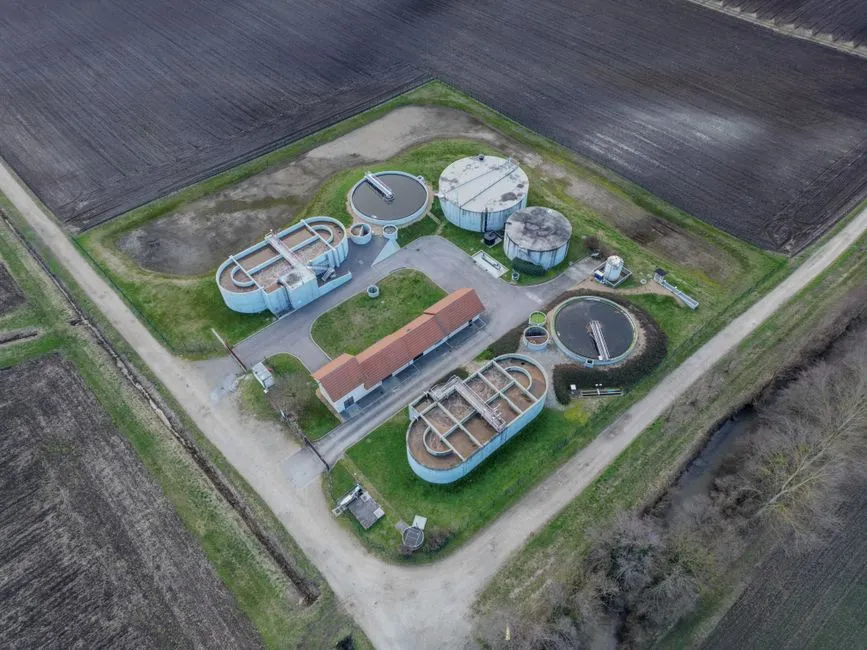
The correct sequence is to consult the SPANC first, obtain a soil study where required, use that study to develop the system and discharge solution, submit the formal request for work authorisation, and arrange final inspection. Marlowe identifies the SPANC as the local body overseeing new packaged treatment plant installations in France.
During inspection, the SPANC checks the installed model and size, pipe slopes, ventilation and distances from the tank, drainage bed, building, trees and plot boundaries. If the installation follows the authorised design, the SPANC issues a compliance document for future reference. Consultation and inspection do not guarantee a connection outcome or remove the need for a complete technical file.
The tank must be installed at least 5 m from the building under the requirement described by Marlowe from 23 October 2023. The cited framework is the legislation of 7 September 2009, modified against European standard EN 12566-3 and CE marking. Marlowe identifies CSTB and CERIB as public certification bodies acting for the Ministry for the Environment. From July 2024, packaged treatment plants must also undergo a lid-integrity test for 600 daN, described by Marlowe as nearly 610 kg.
| Project stage | Required action | Decision output |
|---|---|---|
| 1. Feasibility | Consult the SPANC and establish whether public sewer connection is available. | Agreed route and required studies. |
| 2. Site investigation | Obtain the soil study where required and assess access, groundwater and plot constraints. | Possible tank location and discharge solution. |
| 3. Design | Develop the treatment system, drainage field or direct watercourse discharge solution where feasible, and apply the relevant setbacks and installation requirements. | Coordinated technical design and supporting documents. |
| 4. Authorisation | Submit the formal request for work authorisation. | SPANC decision and conditions for works. |
| 5. Installation and inspection | Inform the SPANC before works, complete installation and arrange the final inspection. | Compliance document if the installation matches the approved design. |
Use the soil report as a design input, not paperwork added later. Marlowe says it can identify suitable tank locations and a drainage field or direct watercourse discharge where possible. Neither infiltration nor direct discharge should be promised in advance: both depend on the site study, the legally permitted route and the SPANC decision.
Turn the technical brief into a procurement specification
Ask each bidder to demonstrate how its proposed flow range covers the engineer’s design and identify the relevant configuration within the 1–80 m³/h WSZ catalog range. The comparison should be based on the approved design basis, not the largest available unit. Include treatment-stage duties, the required process scope, hydraulic performance and the operating strategy.
Require evidence of conformity with the applicable French ANC approval route. The technical file should address EN 12566-3, CE marking and the certification evidence relevant to the offered system, without implying that one certificate covers every project-specific installation. Also request evidence of the 600 daN lid-integrity requirement, installation drawings, access requirements, control-system scope, maintenance tasks and required documentation.
| Bid package | Information to request |
|---|---|
| Process and performance | Proposed configuration, design-flow coverage, treatment stages, duty or loading basis, controls and monitoring scope. |
| Conformity | Applicable EN 12566-3 evidence, CE marking and the certification documents for the exact offered package. |
| Civil and mechanical scope | Incoming works, tank, biological process, sedimentation, disinfection, pipework, access covers, utilities, testing, commissioning and operator training. |
| Installation and maintenance | Access requirements, 600 daN lid evidence, maintenance schedule, sludge handling, spare-parts arrangements and service responsibility. |
| Interfaces and exclusions | Named responsibilities for the developer, civil contractor, SPANC, discharge recipient and maintenance provider. |
| Programme and commercial basis | Delivery programme, phased occupancy assumptions, future expansion options, exclusions and priced maintenance scope. |
Marlowe describes the examination of packaged treatment plant life over 15 years, covering durability, installation guidance, maintenance and overall cost. Use that context to request lifecycle information, but do not state a purchase price, annual cost or payback period: the supplied research contains no validated cost data for this Marseille project. The SCADA cost and control-system considerations for wastewater plants can help structure questions about control scope, but it is not a quotation for the development.
Finally, require bidders to price the interfaces separately. A low equipment quotation can become incomplete when civil works, electrical supply, controls, access, discharge infrastructure, commissioning or maintenance are excluded. Compare responses against one written scope and make the developer, operator and future service provider responsible for named actions.
Frequently Asked Questions
What size packaged sewage treatment plant does a Marseille housing development need?
The size must be established from a professional loading calculation covering the approved Population Equivalent, peak conditions, wastewater characteristics and the SPANC-approved design. Do not convert PE to flow using an assumed rate or select capacity from the number of homes alone. Ask the engineer for the calculation and then require bidders to map it to a catalog configuration.
Is a WSZ underground package suitable for a new housing development in Marseille?
It can be a candidate where its cited 1–80 m³/h range covers the approved design and the SPANC accepts the treatment process, installation, access and discharge solution. The unit must also satisfy the 5 m building setback, the 600 daN lid-integrity requirement and the applicable conformity evidence. A buried installation does not itself confirm that infiltration or direct discharge is permitted.
How much does an approved packaged sewage treatment plant cost in Marseille?
The supplied research provides no validated project-specific price. Request a site-specific quotation that separates the treatment package, civil works, incoming and discharge pipework, access, utilities, controls, commissioning, training, maintenance and sludge disposal. Compare the complete scope rather than accepting a headline equipment price.
Can the municipality or SPANC approve a non-collective plant in a new housing development?
SPANC consultation is central to the cited French ANC process, but that does not guarantee a particular plant, site or discharge route will be accepted. The project team should obtain the SPANC’s requirements before final design, use the soil study to develop the system and discharge solution, submit the formal work-authorisation request and arrange the final inspection.
What should a housing-development supplier provide to demonstrate suitability?
Request the approved process scope, applicable EN 12566-3 and CE-marking evidence, certification documents for the offered system, 600 daN lid-integrity evidence, coordinated installation drawings, access requirements, maintenance and sludge-handling instructions, commissioning documentation and operator training. The supplier should also state all exclusions and interfaces with the developer, civil contractor, SPANC, discharge recipient and maintenance provider.