Why a packaged plant, not the East Alexandria mega-project
The East Alexandria Wastewater Treatment Plant, where the SUEZ and Arab Contractors consortium was awarded a contract by the Construction Authority for Potable Water and Wastewater (CAPW) in October 2008 for rehabilitation, primary extension and secondary treatment addition, is a city-scale, cast-in-place civil works project (S5). A residential developer in Alexandria specifying a flow for a gated community or mid-rise housing block is buying a different category of equipment: a factory-built, skid- or container-mounted biological unit delivered to site for decentralized duty. The same delivery channel is already active in Egypt for non-municipal buyers, as shown by Elsewedy Electric Environmental Solutions' confirmed wastewater contract in the country (S1).
A packaged sewage treatment plant, in this residential context, is a self-contained biological treatment unit assembled and tested in a factory, then transported as one or a few skids or as a buried tank package. The two proven packaged configurations for a housing development are an anoxic/aerobic (A/O) buried integrated unit, such as the WSZ underground A/O packaged sewage treatment plant, and a submerged-membrane MBR packaged skid, such as the MBR packaged wastewater treatment system. Both run unattended, both are designed to be commissioned in days rather than the multi-year timeline of a CAPW mega-plant, and both are sized in cubic metres per day, a unit that maps directly onto a housing developer's unit count.
Alexandria's institutional and regulatory context
Sanitary drainage in Alexandria is administered by AGOSD, the Alexandria General Organization for Sanitary Drainage, the body that institutional development programs have focused on in the city (S3). Any packaged-plant proposal that does not name AGOSD as the connection counterparty, and CAPW as the higher-level authority, will read as locally unaware in a stakeholder meeting. The developer should expect both bodies to be on the approval path before a single skid is ordered.
National coverage figures reported in March 2019 provide the primary benchmark for sector performance: rural village sanitation rose from 12% in 2014 to 34% in 2018, urban coverage rose from 79% in 2014 to 94% in 2018, and drinking water reached 97% of rural villages in 2018 versus 95% in 2014 (S4). In the same March 2019 statement, the housing minister set out a package of 52 wastewater plants for Upper Egypt with a combined capacity of 418 million m³/year, serving about 8 million people at a cost of LE 8.1 billion ($462.8 million) (S4). That is the order-of-magnitude spending policy any Alexandria residential project is implicitly benchmarked against when a ministry official reviews a developer's environmental submission.
Before sizing a packaged unit, the developer must obtain three open inputs from AGOSD and the local CAPW office: written connection approval, the sewer depth at the tie-in point, and the effluent quality class required for the chosen discharge route. Without those, the design flow and the technology choice are both provisional.
Sizing a packaged STP for a housing development
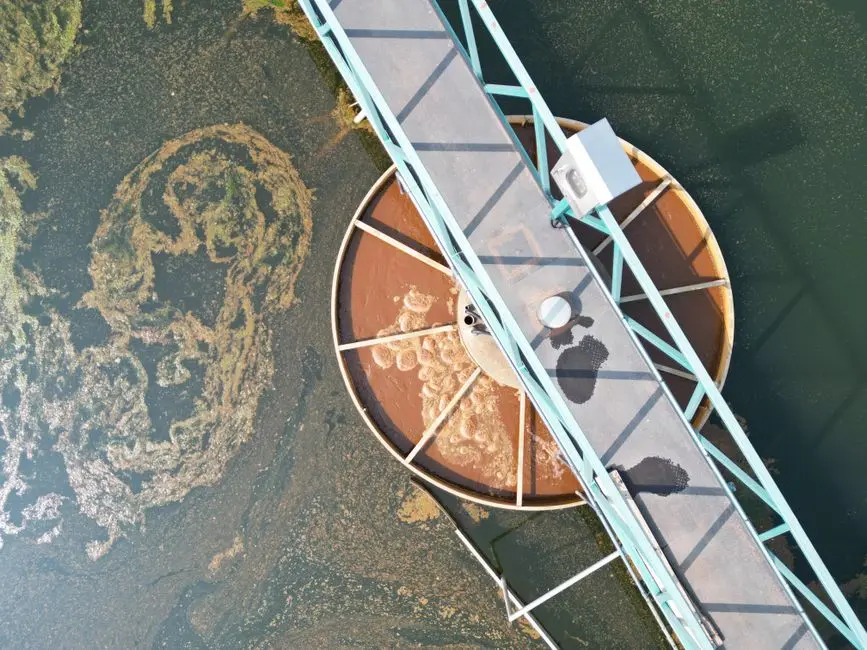
The design flow for a packaged residential STP is calculated using four specific variables.
Design flow (m³/day) = number of housing units × average occupancy (persons/unit) × LPAD (liters per capita per day) × peaking factor ÷ 1000
Three of the four inputs are site-specific and must be confirmed locally rather than assumed from a remembered rule. Average occupancy for an Alexandria mid-rise block is not the same as for a single-family gated community. The LPAD value is the liters-per-capita-day figure used by AGOSD and the local water utility for residential design, and it must be requested from them, not estimated. The peaking factor is the multiplier applied to the average dry-weather flow to capture morning and evening peak hours; again, it should be confirmed with AGOSD or the project's local consultant. A fourth input, commercial flow from any retail or clubhouse within the compound, must be added to the residential base before the biological load is sized.
For example, a 200-unit compound at 5 persons per unit and 200 L/capita-day gives a base average flow that the developer can compute directly; the next step is to multiply that base by the AGOSD peaking factor once that number is in hand. The worked arithmetic is left to the reader because the peaking factor, the LPAD, and the occupancy figure must each be sourced from the local utility before any number is fixed.
One further check item matters for Alexandria's coastal context: rainfall-derived inflow and infiltration must be excluded from the biological design load if the collection network is separate. A combined sewer, or a network with confirmed I/I during storm events, will push the hydraulic load well above the sanitary design flow and will distort the skid selection if it is not separated out at the sizing stage.
| Input | Source | Status before order |
|---|---|---|
| Number of housing units | Developer / project brief | Locked |
| Average occupancy (persons/unit) | Project brief / local market data | Confirm with local consultant |
| LPAD (L/capita-day) | AGOSD / local water utility | Request in writing |
| Peaking factor | AGOSD / local practice | Request in writing |
| Commercial / amenity flow | Project brief (retail, clubhouse) | Add to residential base |
| Rainfall-derived I/I (if combined sewer) | Hydraulic study | Exclude from biological load |
A/O buried unit vs MBR packaged skid: matching technology to the site
The choice of equipment configuration depends on the design flow in m³/day. For residential duty in Alexandria, the realistic shortlist is an A/O buried integrated plant or an MBR packaged skid.
The WSZ underground A/O packaged sewage treatment plant is an anoxic/aerobic biological contact oxidation unit with sedimentation and disinfection integrated into a single buried package, rated across a 1–80 m³/h capacity range and designed for fully automated, unattended operation. It can be installed below grade with landscaping above, or trailer-mounted for mobile or phased deployment. This is the configuration that matches a sewer-tie-in discharge route where the AGOSD effluent class is a conventional secondary standard.
The MBR packaged wastewater treatment system uses submerged PVDF membrane filtration to deliver near-reuse-quality effluent under 1 μm, with a 10–2,000 m³/day capacity range and a footprint roughly 60% smaller than a conventional activated sludge plant of equivalent throughput. The MBR skid is the typical match for projects where on-site irrigation reuse is specified, where the footprint is constrained, or where the AGOSD or CAPW discharge class is set higher than secondary.
Operationally, both packaged options are designed for unattended running. The cost line a developer should ask bidders to break out is periodic membrane maintenance on the MBR skid: chemical cleaning intervals, membrane replacement intervals, and the consumable cost per m³ treated. The A/O buried unit does not carry that line, which is why it remains the default for sewer-tie-in residential projects.
| Parameter | A/O buried packaged unit (WSZ) | MBR packaged skid |
|---|---|---|
| Capacity range | 1–80 m³/h | 10–2,000 m³/day |
| Biological process | Anoxic/aerobic contact oxidation + sedimentation + disinfection | Anoxic/aerobic + submerged PVDF membrane filtration |
| Effluent quality | Conventional secondary | Near-reuse quality, sub-1 μm |
| Footprint | Buried, landscaped over, or trailer-mounted | ~60% smaller than conventional activated sludge at equivalent throughput |
| Operation | Fully automated, no operator required | Fully automated, periodic membrane maintenance |
| Typical discharge route match | AGOSD sewer tie-in | On-site irrigation reuse, tight sites, higher discharge class |
Discharge mode: sewer tie-in vs on-site reuse
The discharge route determines the technology recommendation and the permitting path. There are two realistic modes for a packaged residential STP in Alexandria.
Sewer-tie-in mode: the packaged plant discharges to the AGOSD network. The developer pays a sewer connection fee, the effluent class is set by AGOSD's discharge rules, and an A/O buried unit is usually sufficient. The institutional layer is AGOSD for the connection and CAPW at the higher level. The developer should request written discharge approval from AGOSD before placing the packaged-unit order, because the approved effluent class is what locks the technology selection.
On-site irrigation reuse mode: the packaged plant must produce reuse-quality effluent, the developer operates the irrigation distribution network within the compound, and an MBR skid is the typical match because of its sub-1 μm filtration. A pipeline UV sterilizer is normally specified downstream of the MBR skid to meet the bacteriological quality required for landscape irrigation. The developer must obtain the current AGOSD or CAPW limit at the design stage.
For developers cross-checking residential STP delivery in a comparable African capital, the Kinshasa housing packaged STP guide walks through the same A/O versus MBR configuration logic at a similar flow range.
Frequently Asked Questions
How many housing units can a packaged STP serve, and how is the size selected?
Size selection is unit-count based. The developer multiplies the number of housing units by the average occupancy, the LPAD figure from AGOSD or the local water utility, and the AGOSD peaking factor, then adds any commercial or amenity flow. The m³/day result is the figure sent to bidders; the technology (A/O buried versus MBR skid) is then matched to the discharge route.
Should we choose an A/O buried unit or an MBR packaged skid?
Choose A/O buried when the discharge route is an AGOSD sewer tie-in and a conventional secondary effluent class is acceptable. Choose MBR when the discharge route is on-site irrigation reuse, when the footprint is constrained, or when AGOSD or CAPW specifies a higher discharge class.
What budget envelope should we plan for a packaged residential STP in Alexandria?
The available research does not include a per-m³ packaged-plant price for the Egyptian residential market. The developer should request from each bidder a fully itemized price that separates the skid cost, civil works, instrumentation, the membrane maintenance cost line (for MBR), commissioning, and the first year of consumables.
What should we confirm with AGOSD and CAPW before placing the order?
Confirm four items in writing before any purchase order is signed: written connection approval from AGOSD, the sewer depth at the tie-in point, the effluent quality class required for the chosen discharge route, and the lead time the bidder can hold the quoted price. The institutional layer (AGOSD for the connection, CAPW at the higher level) is the primary approval path for residential STP projects in Egypt.