Introduction to Scrubbers
Wet and dry scrubbers are the two main devices used to remove pollutants from industrial exhaust gas streams. Both technologies rely on contacting the dirty airstream with a capture medium - a liquid in a wet scrubber, a dry sorbent or filter media in a dry scrubber - to pull out particulate matter, acid gases, and odors before the air leaves the stack. Choosing between them depends on the pollutant mix, the required removal efficiency, the available footprint, and the wastewater or dust handling capacity on site. Most plants we size run gas flow rates between 1,000 and 200,000 m3/h, and the same scrubber type does not fit every duty.
The function of a scrubber is to capture pollutants, such as particulate matter, gases, and odors, from exhaust gases. This is achieved through various mechanisms, including absorption, adsorption, and filtration. The choice of scrubber technology depends on the type and concentration of pollutants, as well as the desired removal efficiency.
Wet Scrubber Technology
Wet scrubbers remove pollutants by contacting exhaust gas with a liquid, typically water or a chemical reagent solution. The three common configurations are packed towers, spray towers, and venturi scrubbers. Packed towers hold a bed of ceramic rings or plastic saddles to increase gas-liquid contact area; spray towers distribute liquid through nozzles into an empty vessel; venturi scrubbers accelerate gas through a throat where liquid droplets capture fine particles. According to industry data cited in the original article, wet scrubbers can remove up to 95% of particulate matter and handle soluble gases such as SO2 and HCl in a single step.
| Wet Scrubber Type | Removal Efficiency | Application |
|---|---|---|
| Packed Tower | 90-95% | Particulate matter, gases, and odors |
| Spray Tower | 80-90% | Particulate matter and gases |
| Venturi Scrubber | 95-99% | Particulate matter, gases, and odors |
Wet scrubbers are commonly used in various industries, including power plants, chemical plants, and waste-to-energy facilities. They are effective in removing a wide range of pollutants, including particulate matter, sulfur dioxide, and hydrogen chloride. For acid gas duties at power plants, a Flue Gas Desulfurization (FGD) Scrubber System is the typical wet scrubber configuration.
Dry Scrubber Technology
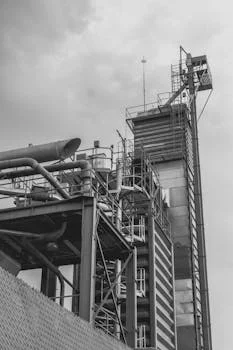
Dry scrubbers capture pollutants using a dry medium - a sorbent such as hydrated lime or sodium bicarbonate, or a filter element such as a fabric bag or cartridge. Common configurations include fabric filters (baghouses), cartridge filters, and electrostatic precipitators. Fabric and cartridge filters trap particles on the media surface, while electrostatic precipitators charge particles and collect them on grounded plates. Dry scrubbers typically need a downstream fabric filter or ESP to meet particulate limits, since the sorbent reaction alone produces a fine solid waste stream.
| Dry Scrubber Type | Removal Efficiency | Application |
|---|---|---|
| Fabric Filter | 99-99.9% | Particulate matter and gases |
| Cartridge Filter | 95-99% | Particulate matter and gases |
| Electrostatic Precipitator | 99-99.9% | Particulate matter and gases |
Dry scrubbers are commonly used in various industries, including cement plants, steel mills, and biomass power plants. They are effective in removing particulate matter, gases, and vapors from exhaust gases.
Wet Scrubber vs Dry Scrubber: Side-by-Side
The dry scrubber vs wet scrubber decision comes down to what the gas stream contains and how the site handles the byproduct. Wet scrubbers are generally more effective on soluble gases and odors because absorption into the liquid drives the removal, while dry scrubbers are more effective on particulate matter because filtration or electrostatic collection handles sub-micron dust that liquid droplets miss. Capital cost ranges for both technologies fall between $50,000 and $500,000 in the original data; operating cost is roughly $0.01-0.10 per cubic meter of gas treated for either type, but the cost drivers differ - wet systems spend on pumping energy, reagent makeup, and wastewater treatment, while dry systems spend on sorbent consumption and bag or plate replacement.
| Scrubber Type | Removal Efficiency | Operating Cost | Capital Cost |
|---|---|---|---|
| Wet Scrubber | 90-99% | $0.01-0.10 per cubic meter | $50,000-500,000 |
| Dry Scrubber | 95-99.9% | $0.01-0.10 per cubic meter | $50,000-500,000 |
In terms of operating costs, wet scrubbers generally require more energy and maintenance than dry scrubbers. However, wet scrubbers can be more effective in removing certain pollutants, such as sulfur dioxide and hydrogen chloride. For a closer look at where each technology fits specific plant duties, see the comparison in Wet Scrubber vs Dry Scrubber: Which is Better for Industrial Air Pollution Control.
Decision Framework for Scrubber Selection
Use this checklist before specifying a unit:
- Determine the type and concentration of pollutants to be removed.
- Evaluate the removal efficiency requirements for each pollutant.
- Consider the operating and capital costs of each scrubber technology.
- Assess the maintenance and repair requirements for each scrubber technology.
Add three more field checks: confirm whether the site has a wastewater treatment train that can accept the liquid blowdown from a wet system, confirm whether there is a landfill or reuse route for the dry solids produced, and confirm that the stack temperature stays above the acid dew point for dry sorbent injection. By following these steps, industrial engineers and procurement managers can make an informed decision when selecting a scrubber technology for their specific application. Buyers who need to compare wet scrubbers against baghouses, ESPs, or hybrid trains will find the broader trade-off discussion in Wet Scrubber System vs. Alternatives: An Industrial Air Pollution Control Guide. For sites ready to move from this checklist to a sized proposal, Request a free quote with your gas flow, pollutant load, and site constraints, and our engineers will return a wet, dry, or hybrid recommendation.
Case Studies and Industrial Applications
Wet and dry scrubbers are used in various industries, including power plants, chemical plants, and waste-to-energy facilities. For example, a wet scrubber was installed at a power plant to remove sulfur dioxide and particulate matter from exhaust gases. The scrubber achieved a removal efficiency of 95% for sulfur dioxide and 99% for particulate matter.
In another example, a dry scrubber was installed at a cement plant to remove particulate matter and gases from exhaust gases. The scrubber achieved a removal efficiency of 99.9% for particulate matter and 95% for gases.
These case studies demonstrate the effectiveness of wet and dry scrubbers in removing pollutants from exhaust gases. By selecting the most suitable scrubber technology, industries can reduce their environmental impact and comply with regulatory requirements.
Who This Guide Is For
This comparison fits plant engineers, EPC contractors, and procurement managers evaluating air pollution control for power, cement, steel, chemical, or waste-to-energy duties. If your site already runs a wastewater treatment plant and can accept acidic blowdown at 5-20 m3/h, a wet scrubber is usually the simpler pick for SO2 and HCl. If liquid discharge is restricted and the gas is mostly dust with low acid loading, a dry scrubber with a fabric filter is the lower-risk route.
Frequently Asked Questions

What is the difference between a wet and dry scrubber?
A wet scrubber uses a liquid - water or a reagent solution - to capture pollutants from exhaust gas through absorption and droplet contact, typically reaching 90-99% removal. A dry scrubber uses a dry sorbent such as hydrated lime or a filter medium such as a fabric bag, and typically reaches 95-99.9% on particulate matter. The byproduct is wastewater from a wet unit and dry solids from a dry unit.
How do I choose the right scrubber for my application?
Match the scrubber to the dominant pollutant first: pick a wet scrubber for soluble acid gases like SO2 and HCl, and pick a dry scrubber with a fabric filter when particulate matter above PM2.5 is the main concern. Then check the four-step framework - pollutant type and load, removal efficiency, capital and operating cost, and maintenance - before final sizing.
What are the maintenance requirements for scrubbers?
Wet scrubbers need pump seal replacement, nozzle cleaning, and tower packing washing on a 3-12 month cycle, plus blowdown pump and pH probe service. Dry scrubbers need bag replacement every 2-4 years, sorbent feeder calibration, and ESP rapper inspection on a scheduled outage. Both types benefit from stack opacity and differential pressure trending to catch problems early.
How much does an industrial scrubber cost?
Capital cost for either technology typically falls between $50,000 and $500,000 depending on gas flow rate and material of construction. Operating cost runs about $0.01-0.10 per cubic meter of gas treated; wet systems are energy- and water-heavy, dry systems are sorbent- and filter-heavy.
Need a sized unit for a specific flow rate and pollutant load? Request a quote with your gas volume, temperature, and target emissions, and our engineers will return a wet, dry, or hybrid recommendation with preliminary P&ID and cost.
Review the equipment options on the Wet Scrubber Solutions and Dry Scrubber Solutions pages for capacity range, materials, and technical data.