Select the treatment route from the wastewater profile
Select a high-COD industrial wastewater treatment system in Guatemala by first determining the wastewater’s flow, COD load, biodegradability, contaminants and Guatemala discharge route—not by selecting equipment from COD concentration alone. A practical train may combine equalization and DAF pretreatment, anaerobic loading reduction, aerobic biological treatment and membrane or advanced polishing. The receiving route and applicable Guatemala wastewater permit must be verified locally before final sizing or performance guarantees.
Request a representative wastewater characterization before comparing equipment. This establishes the complete daily and seasonal flow profile, influent COD range and maximum concentration, and COD load in kg/day. Calculate load using paired flow and COD measurements rather than treating a single concentration as the design basis. BOD5-to-COD testing is needed because COD measures oxidizable material, while BOD5 measures the fraction microorganisms can consume biologically. The wastewater COD monitoring analyzer selection guide can help structure monitoring, but analyzer selection does not replace site characterization.
Assess DAF as the first separation step if the stream contains suspended solids, oil and grease, or colloidal material. DAF can remove these material classes before they interfere with biological treatment. An industrial DAF pretreatment system should be quoted with the actual wastewater characteristics and required removal objectives, not with an assumed generic COD duty.
| Discharge route or influent problem | Governing rule or process option | What data settles it |
|---|---|---|
| Discharge to a municipal sewer or receiving water | Verify the applicable Guatemala wastewater permit and receiving authority’s requirements before setting the effluent target. | Requested discharge route; issued permit conditions; applicable COD and other analyte limits; receiving authority confirmation. |
| High COD concentration with variable flow | Design from COD load, flow variation and equalization duty; concentration alone does not establish capacity. | Complete flow profile, maximum COD, COD range, paired load calculations and production/shutdown scenarios. |
| Oil, grease, suspended solids or colloidal matter | Assess DAF, with coagulation-flocculation where required by the wastewater. | Oil and grease, suspended-solids and colloid characterization; DAF jar or pilot-test results; chemical-demand information. |
| Biodegradable but high-strength organic load | Assess anaerobic wastewater treatment before aerobic biological treatment, subject to treatability and operating conditions. | BOD5-to-COD ratio, biodegradable fraction, pH, temperature, salinity, toxicity profile and hydraulic profile. |
| Refractory, toxic or inhibitory compounds | Assess chemical pretreatment or advanced oxidation before biological treatment. | Compound-specific analysis, toxicity results, inhibition testing and trial-treatment data. |
| Reuse or stringent discharge objective | Assess advanced wastewater polishing after biological treatment. | Water-quality specification for the intended reuse or applicable locally verified discharge conditions. |
Build pretreatment and biological capacity around shock loads
Protect the biological process by sizing equalization and pretreatment around measured loads and shock conditions. Coagulation-flocculation, DAF and equalization can remove suspended solids, oil and easily separable organic matter before anaerobic or aerobic treatment. The buyer should identify which contaminants each unit is expected to remove and obtain evidence from representative testing before assigning the full COD reduction to that unit. These pretreatment steps prevent downstream process failure.
Sudden COD increases produce shock loading in A/O, AAO, MBBR, SBR and MBR systems. Inadequate equalization can reduce treatment efficiency and elevate effluent COD, while sustained overload can shorten equipment life and increase aeration and chemical demand. Specify the equalization volume from the actual flow and concentration profile, operating controls and the production cases it must absorb; no defensible volume can be selected without those data.
For high-strength, biodegradable flow, evaluate anaerobic treatment followed by aerobic treatment when the characterization supports it. Anaerobic technologies can reduce organic loading before the aerobic stage, but selection depends on COD load, BOD/COD ratio, inhibitory compounds, temperature, pH, salinity, hydraulic profile, biogas objectives and required effluent quality. Sludge yield and operating cost must also be evaluated for the project.
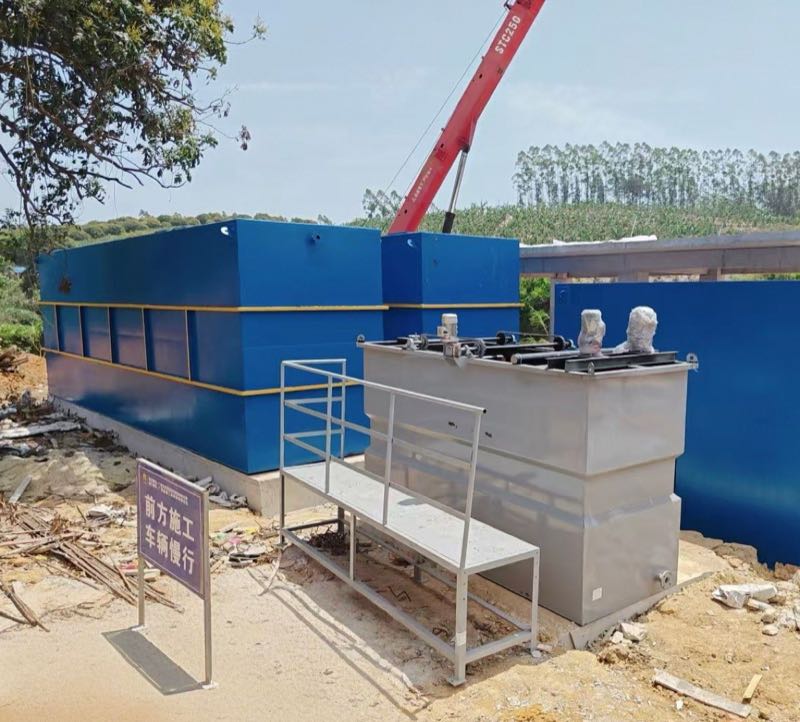
Compare two aerobic routes in the RFQ. One is a conventional aerobic system followed by UF or another polishing step. The other is an integrated MBR wastewater treatment system combining biological treatment with membrane separation. The MBR may suit a larger duty where compact installation and high effluent quality are priorities, but it is not a substitute for removing oil, grease, solids or inhibitory compounds upstream.
- Equalize the wastewater and establish the baseline flow, COD load and contaminant profile.
- Remove separable solids, oil and grease with the pretreatment train confirmed by testing.
- Apply anaerobic treatment where biodegradability and inhibitory conditions support it.
- Aerobically polish the residual biodegradable COD and ammonia load.
- Add membrane or advanced treatment only against a verified discharge or reuse objective.
Match the final treatment stage to discharge or reuse goals
Define the final stage by the verified receiving route, not by an assumed universal COD limit. A biological effluent train may be sufficient for one authorized route, while reuse or more stringent locally applicable conditions may require activated carbon, membrane filtration or additional advanced oxidation. The project should not promise a final COD value until the governing route, permit condition, baseline data and test method are documented. Consistent adherence to these metrics ensures regulatory compliance.
One published high-strength case provides a useful reference point: a three-phase fluidized bed reactor was designed for 1,500 L/day wastewater containing 5,000 mg/L COD and 230 mg/L ammonia, with an 8 h hydraulic residence time. Under the designed condition, it reported 91.7% COD removal and 56.7% ammonia removal. Ryerson University Library and Archives also reported a separate total process taking 2–3 hours, but that excerpt does not identify the complete process train and should not be transferred to a Guatemala design without its context.
For a Guatemala facility, ask the environmental authority or responsible compliance contact for the applicable Guatemala wastewater permit, discharge destination and required test methods. If the stream enters a municipal sewer, obtain the receiving authority’s current requirements; a general COD reduction target does not establish a direct-discharge limit. For reuse, define the intended end use and its water-quality specification with the receiving party.
Specify polishing performance as both concentration and pollutant load. This matters because load-based reporting can differ from concentration-based compliance, especially at changing flows. Ask the supplier to identify which measured parameter it guarantees, the sampling point, averaging basis, test method, baseline period and response to excursions outside the agreed influent envelope.
Turn the process decision into a quotation-ready scope
Require each bidder to quote a complete, site-specific treatment boundary rather than an equipment list. The quotation should state design flow, influent COD range, maximum COD, load basis, treatment objective, receiving route, applicable permit condition and test method. If the Guatemala permit or receiving route is unresolved, identify it as a pre-signature condition and exclude any final-compliance guarantee that depends on it. Clear documentation prevents scope gaps during the procurement process.
| Quote line item | Technical scope to specify | Red flags to check before signing |
|---|---|---|
| Design basis and influent envelope | Design flow, complete flow profile, COD concentration range and maximum, COD load in kg/day, BOD/COD ratio and physical/chemical wastewater data. | COD concentration is used as the sole sizing parameter; missing flow profile; no maximum case; no characterization report. |
| Process performance and acceptance test | Concentration and load obligations, influent baseline, sampling point, averaging basis, test method, operating conditions and demonstrated boundary. | Undefined guaranteed COD percentage; no baseline data; final COD promised without a governing receiving route; no method for excursions. |
| Process and hydraulic design | Process flow diagram, hydraulic calculation, equipment list, equipment duty cycles, equalization and pretreatment sizing, biological loading basis and polishing selection. | No calculation; process is offered without wastewater characterization; an MBR is treated as pretreatment; no explanation of shock-load control. |
| Residuals and operating resources | Sludge estimate, sludge characteristics, disposal assumptions, chemical demand, electrical load, compressed-air demand and water demand. | Chemical or sludge disposal excluded without responsibility allocation; utilities omitted; disposal route assumed without confirmation. |
| Controls and verification | Controls scope, instrumentation, alarms, duty cycles, FAT or SAT protocol, training, commissioning assumptions and performance-test provisions. | No test protocol; automatic controls excluded; commissioning depends on unverified influent limits; operating assumptions absent. |
| Installation and commercial boundary | Civil-work exclusions, utilities connection points, installation boundary, commissioning responsibility, spare parts, O&M assumptions and schedule assumptions. | Unclear delivery and installation boundary; excluded scope lacks a price or responsibility statement; delivery or lead-time basis is not stated. |
Request the industrial wastewater treatment equipment selection guide for internal comparison, but require the final bid to follow the site-specific site-specific high-COD wastewater specification discipline: document the data, exclusions and acceptance basis before price comparison.
Frequently Asked Questions
What inputs determine the size of a high-COD treatment system?
Determine the train from COD concentration, flow, COD load and wastewater characteristics—not from COD concentration alone. The bidder should receive the daily and seasonal flow profile, maximum COD, COD load in kg/day, BOD5-to-COD ratio, oil and grease, suspended solids, pH, temperature, salinity, toxicity and the required Guatemala discharge route. These inputs determine whether equalization, DAF, anaerobic treatment, aerobic treatment and polishing are required.
What must a supplier demonstrate before equipment is ordered?
Require a process design tied to an agreed influent baseline. The supplier should show a process flow diagram, hydraulic calculation, equipment duty cycles, COD and load calculations, pretreatment basis, sludge estimate and utilities demand. Performance testing should define the influent range, sampling point, concentration and load limits, test method, operating conditions and treatment of excursions outside that envelope.
What should a buyer request when comparing system cost and supplier pricing?
Request comparable quotations with separate prices for equipment, chemicals, controls, installation, civil works, commissioning, training, O&M and sludge disposal assumptions. Ask each bidder to state exclusions and the inputs needed to price them. No reliable price can be established from the available research because the site flow, COD profile, receiving route, utilities and installation boundary are unresolved; an equipment price alone is not an installed-treatment comparison.
Why must the Guatemala permit and receiving route be verified?
Ask the facility’s environmental or compliance contact for the governing permit conditions and confirm them with the relevant authority when sewer discharge is proposed. The research contains no Guatemala-specific COD limit or receiving-route rule, so a foreign standard cannot be substituted without verification. A supplier may design and guarantee only against the stated permit condition, receiving route, influent baseline and test method.